Blue Jay Barrens has never had an abundance of early spring
wildflowers, and as the deer population increases, those that were here years
ago have decreased in number. As a result, my perception of the early spring
blooming season is that of a sprinkling of small white blooms. All come from
tiny members of the mustard family. Some are quite rare, while others are
prolific weeds. The first to show itself is generally Michaux’s Leavenworthia, Leavenworthia uniflora, a species that
is listed as threatened in Ohio. I’ve been told that I feature this species,
along with a couple of other similar subjects, far too often in this blog.
Fortunately, the person providing that information is quite mistaken, so I will
continue to discuss these plants at whatever times I deem appropriate.

The Leavenworthia is an annual plant and races along in its
attempt to provide seeds for future generations. The blooms, held only a couple
of inches above the soil surface, are hard enough to see. Add to that the
rapidity with which the bloom withers around a quickly growing seed pod, and a
person is lucky to catch a glimpse of these flowers at all.

The smallest of the early bloomers barely reaches an inch in
height from the ground up to the top of the flower stalk. This is Carolina Whitlow-grass, Draba reptans, another state
threatened species. Carolina Whitlow-grass is not a species that you will casually observe while out walking on an early
spring day. You have to get down close to the ground and actively seek out
these plants. One identifying
characteristic of this plant is the relatively smooth stalk supporting the
cluster of flowers.
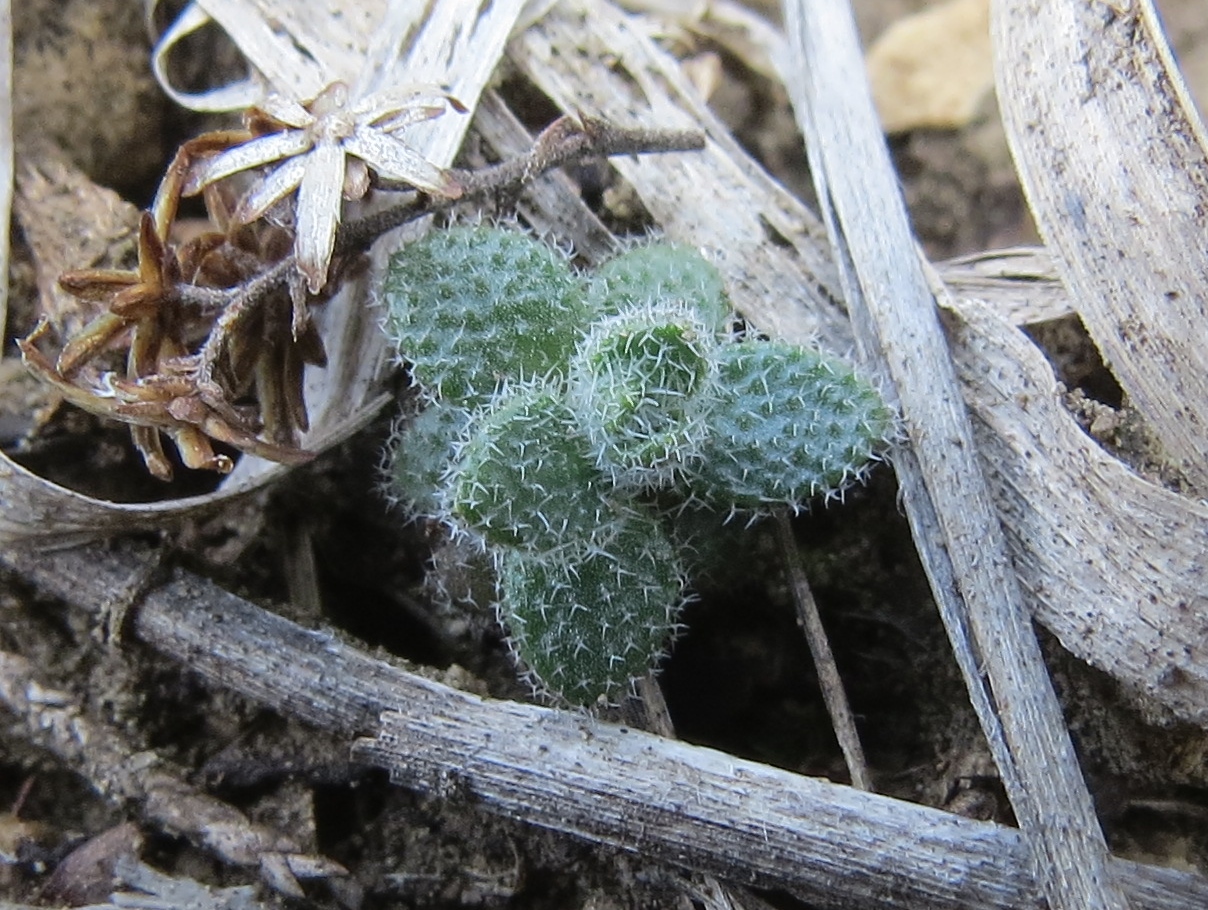
Prior to flowering, it’s best to have some type of
magnification when trying to view the plant. At this stage, the plant always
reminds me of a tiny cactus, but there’s no fear of being stuck by spines here.

Wedge-leaved Whitlow-grass, Draba cuneifolia, is the third early spring rarity that I regularly
see. The leaves of this species have shallow pointed lobes along the margins,
but this leaf feature may not be noticeable in very small plants. The surest way to separate Wedge-leaved
Whitlow-grass from the preceding the species is by comparing the flower stalks.
The flower stock here is densely hairy.

Wedge-leaved Whitlow-grass has the typical four petaled
flower of the mustard family. Each petal has a shallow indentation at the tip.

Several non-native species add their bits of whiteness to
the spring blooming season. These are weedy species that are commonly found in
most lawns and gardens. Whitlow Grass, Draba verna, although related to our
native rarities, is an extremely common non-native weedy plant. One reason that
these plants are so successful in human disturbed habitats is the fact that
they flower and distribute their seed before most people become active with
their gardening and weeding activities. The seed from these plants sits quietly
in the soil through the summer and fall months, and is ready to spring forth
the following winter.

The four petals of the Whitlow Grass are so deeply split
down the center that they are often mistaken as having eight petals. This feature
quickly distinguishes these alien plants from our native species.

Becoming ever more common in the urban landscape is the
Hairy Bittercress, Cardamine hirsuta. Blooms of this plant quickly disappear in
favor of elongated pods that rapidly fill with ripe seed. Once the seed is mature, the pods will
violently open at the slightest touch and scatter seeds in a wide area around
the plant. The seeds are easily carried
away on people’s shoes and gardening tools, to colonize fresh areas.

Field Pennycress, Thlaspi
arvense, is a non-native quick to invade into bare or disturbed ground. In
most situations it forms thick patches of plants.

The Field Pennycress seedpods seem to develop as quickly as
the flowers can form. In just a few days a tall spike of developing seedpods
replaces the initial flower cluster. These non-native species are interesting,
but my goal is to manage for native populations and that generally means that
the non-natives are considered weeds and must go.