Showing posts with label Barrens. Show all posts

Saturday, April 28, 2018

The Barrens Garden

Eighteen years ago, as the first act of creating a water garden, I dug a large hole near my front porch. Approximately 55 cubic yards of material was removed from the hole and placed in a pile here, near the east side of my barn.  First came slabs of sod a couple of inches thick that were placed in the upper left-hand corner the above photo. Next came the removal of a half foot of clay subsoil that found a permanent residence in the upper center of the photo. Following that, I chiseled through 2 feet of fractured limestone bedrock and added that to my spoil pile. Over the years the material has settled down to become a solid fixture in the landscape.

After several years, the gravel area began to closely resemble the gravelly barrens found tucked away in some of the steeper hillside prairies of Blue Jay Barrens. I then began considering the idea of introducing into this gravel pile seed from some of the rarer winter annuals found growing in the gravelly barrens. My last year’s crop of captive Leavenworthia uniflora and Draba cuneifolia produced such an abundance of seed that I had plenty to invest in this new project that I am calling the Barrens Garden.

In July 2017, I scattered seed over the entire spoil pile.  The results did not disappoint. Shown above are some of the hundreds of rare Draba cuneifolia that resulted from that seeding.

Drabas and Leavenworthia are both members of the mustard family and their flowers show the standard four petal arrangement. These plants are annuals and will not survive past Midsummer. All of the plant’s energy goes into the production of flowers and seeds. Seeds that fall to the ground in June will begin to germinate in October or November. Rosettes of basal leaves will form and grow through the winter. Flower stalks and blooms typically arrive in April.

Leavenworthia uniflora usually follows the same growth pattern of the Draba, although a greater proportion of the seeds tend to wait until February to germinate.

In other wildflower gardens I’ve created, my primary problem is the habit of plants developing much more robustly than they do in their natural setting. It appears that I’ve managed to provide conditions in this Barrens Garden that closely mimic the natural conditions. Above are three Leavenworthia uniflora bracketing a standard dime. The basal rosettes are hardly much larger than that ten cent piece.


Here’s that same dime beside two Leavenworthia uniflora growing in the natural barrens. The size of the plants is almost identical to that found in my Barrens Garden. I have high hopes that this project is going to prove to be a long term success.

Monday, December 12, 2016

Invasive Control - Misc Forbs

In many instances, the simple task of hand pulling is the most effective way of eliminating unwanted plants.  This pile of invasive Sweet Clover, Wild Carrot and Oxeye Daisy was removed from a one acre barrens opening this past summer.  Remnants of last year’s plant collection can be seen beneath this year’s greenery.

This area is typical of the Blue Jay Barrens openings.  Steep, shallow, extremely dry soils present numerous challenges to plant growth.  Invasive plants can become established, but not with the ease or rapidity demonstrated in the former cropland areas.

The welcome mat for invasive plants is in the form of exposed soil, a defining quality of barrens sites.  A seedling that overcomes the other obstacles can grow undisturbed by competing vegetation.  Colonization may be slow, but a persistent species can build quite a population over a period of years.

This is my fourth year of pulling Sweet Clover and Wild Carrot from this site.  Plant removal is quite an effective control method for these species.  They are biennials that form a rosette in year one, then produce seed and die in year two.  If you can halt the production of seed, you can eliminate new generations of plants.  An annual maintenance visit to each site is still necessary to catch any new plants that may emerge.  Sites that I began treating 10+ years ago, now have only a few Sweet Clover plants per acre and virtually no Wild Carrot.  Sweet Clover seed is notorious for persisting in the soil seed bank and remaining viable for decades after falling from the plant.  In order for the seeds to survive for that length of time, they need to be incorporated within the soil profile where they are protected by the ravages of weather and other environmental factors.  I’ve noticed that most of the studies of Sweet Clover seed longevity have been completed on former crop ground, where fresh clover seed could have been neatly buried by common agricultural tillage practices.  Seed produced on the barrens is unlikely to get buried to a depth that would allow it to be protected for extended periods of time.  The seed here stays near the surface and either germinates or dies, so removing plants rapidly produces positive results.

I’ve also been getting more hands-on with the invasive Oxeye Daisy.

I’m still looking for an effective control method in the old crop fields.  The plant is too numerous and too crowded by prairie plants to be easily removed by hand.  There are also too many quality native plants here to make herbicides a viable control alternative.

This Ragged Fringed Orchid, Habenaria lacera, visible in the center or the preceding photo, is just one of many unassuming plants that has found itself being pressured by Oxeye Daisy.

Oxeye Daisy has been slowly making its way into the barrens.  I hand pulled the daisy from a few test areas two years ago, with favorable results.  This year I pulled Oxeye Daisy right along with the clover and carrot.  New daisy plants begin as a basal rosette.  When they’ve stored enough energy, they send up a flower stalk.

Oxeye Daisy removal is totally effective if you leave no viable plant parts in the soil.  This young plant pulled easily and shows no evidence of missing underground parts.

A slightly older plant displays the start of a rhizome that would eventually give rise to new plants.  The stub of a broken rhizome on a pulled plant means that a viable plant part has been left behind to grow a new plant next year.

A single plant will eventually produce a thick colony of plants.  This plant has a single tall flower stalk and three healthy rhizomes.  I think I’ll be able to successfully eliminate Oxeye Daisy from the more rugged barren sites, but I’m still looking for viable control options in other areas.

I’m still collecting seed heads from Teasel in early August, but I also now treat random plants while I’m out doing other invasive species work.  A shot of glyphosate into the center of a basal rosette will kill the plant, or at least damage it enough that it never produces a flower.  Tall plants can be cut and the stump given a little spray of glyphosate.  These two methods would be difficult to apply on a large scale, but are handy to use when finding a handful of plants in an isolated location.  It’s easier to eliminate the plant at the time it is found, than it is to remember to revisit that spot later on to collect seed heads.

Of course, I’m always interested in animals that feed on invasive plants.  I found this stalk borer inside the base of a tall Teasel plant.  I doubt the borer would have killed the plant, but similar borers might be the reason I occasionally find plants broken off at the base.  These broken plants may lay down and hide in the tall grass, but the flower stalks turn upward and still produce plenty of seeds.  Since I have trouble finding these fallen plants, the borer may actually be hindering my control efforts.  Despite minor setbacks, I’m sure that I can eventually get most of these invasive plants under control.

Wednesday, April 15, 2015

April Winter Annuals

My artificial barrens in a pot continues to evolve.  Originally planted in the container were Draba cuneifolia, Draba reptans, and Leavenworthia unifloraDraba reptans persists in small numbers and is hardly noticeable.  Draba cuneifolia and Leavenworthia uniflora aggressively compete for dominance of the container.  Since its creation, no two seasons in this container have been the same.

In 2013, Leavenworthia uniflora dominated the container.  Last year there was a fairly even mix of Draba cuneifolia and Leavenworthia.  This year the Draba cuneifolia is definitely in control.  Draba flower stalks form a miniature forest.

A loose cluster of flowers forms atop the stalk.  These plants are just beginning to bloom.  The flower spike will continue to enlarge and the immature buds seen in the center of the cluster will be brought into position to open.

A number of these small bees were busy visiting the Draba flowers.

Wild Draba cuneifolia plants are also doing well this year.

It’s unusual for the plants on the barrens to grow this large.  I’m certain that their growth patterns are influenced by weather conditions, but I don’t know if it was spending several weeks buried by snow or the excessive rainfall during the last six weeks or some other factor that is responsible for the impressive growth this year.

Draba reptans is also performing above expectations this year.  This plant toppled over, but that won’t stop it from producing a good crop of seeds.  Total height, or length, of this plant is not much over an inch, so it didn’t have far to topple.

Draba reptans is similar in appearance, but smaller than Draba cuneifolia.  One characteristic that separates the two is the hairiness of the flower stalk.  The stalk on reptans is practically hairless, while the cuneifolia stalk has a fuzzy hairiness along its entire length.

Drabas and Leavenworthias are blooming side-by-side in the container barrens.  Draba cuneifiolia has a shallow indentation at the end of each of the four petals.  Leavenworthia petals are all well rounded.  A couple of non-native Draba verna have also managed to invade the container.  Seen in the lower right of the photo, Draba verna petals are split almost in two, so the flower appears to have eight petals instead of four.

This year’s Leavenworthia plants are quite tiny and have only a single flower stalk.  I’m afraid they couldn’t compete with the rapid early growth of the Drabas.

Contrary to what I’ve noticed in past years, the Leavenworthia growing on the barrens are much more robust than those in the container.

Most of the barrens grown specimens are producing multiple flower stalks.  The seed produced from these should be a definite boost to future generations.

The Draba cuneifolia in the container are going to make a tremendous amount of seed.  I’ll collect as much as I can and scatter it out on the same barrens from which I originally gathered the seed for this container collection.  If my original removal of seed from the barrens resulted in a diminished population of Draba, I’m sure my replacement of seed has more than made up for the loss.

The container plants are producing so much seed that I’m now finding Draba cuneifolia growing in the cracks of the concrete apron outside my barn door.  I love it when a rare plant begins to behave like a weed.

Friday, March 13, 2015

The Almost Final Last of the Season Cedar Maintenance

This aerial map shows the roughly three acre field in which I am currently completing cedar maintenance.  Red outlines indicate the areas of the field that have so far been completed.  A small area to the right is yet to be done.  The portions labeled B-2 and C were completed back in early February.  Work was then halted when a series of storms buried the field in snow.  Snow exited the field a couple of days ago, but it wasn’t until yesterday that the soil dried out enough for me to resume work.  Section D was completed yesterday afternoon and E is what I could get done this morning before heavy rain moved in.  I would not normally be doing this type of work in March, but I just couldn’t leave the field partially completed.  If the rain ends tomorrow as predicted, it will probably be the middle of next week before the soil will be dry enough for me to finish the last bit of this field.

The aerial view makes it appear that this field is heavily occupied by large Eastern Red Cedars.  The view from ground level shows that the cedars are spaced widely enough apart to allow plenty of sunlight to reach the ground.  Where soil conditions allow, a thick grass cover is present.

The slope steepens rapidly at the south end of the field.  The last 15 feet are an almost vertical plunge into the creek.  The last of the snow is still holding on along the top of the creek bank.

Field blends with woods at the steep north end of the field.  One October, about 20 years ago, I mowed a path through the tall grass.  The deer, which always seem to take the easiest option while walking, immediately began following the mowed path.  They still follow the same path and are responsible for it becoming a muddy trail.  As deer numbers increased through the years, they developed paths in other directions through the field and now this is just one in an expanding network of deer highways.

This is considered to be a south facing field.  Unlike the previous field I discussed, this one is dissected by a network of surface depressions that drain water in many different directions.  While the field is still generally south facing, there is a wide variation in slope steepness and direction.  This gives the field an interesting collection of microclimates within its boundary.

Saturated soil is still releasing water into the center of the drains.  The presence of water on the surface is short lived, but a gradual movement of subsurface water along this same route may persist for a couple more months.

Small cedars thrive in these areas of increased water availability.  This eroded area was practically bare when I bought this property.  Prairie grasses are slowly stabilizing the soil.

Between each drain is a ridge.  There is a drastic difference in the amount of water available to plants on the ridges as opposed to the drains.

This section of the field suffered soil slips that resulted in a stair step arrangement of bare patches on the slope.  The slipping stopped long ago, but the poor quality of soil exposed in each step is making it difficult for vegetation to become established.

Lichens are the pioneer species in these bare areas.  In time, grasses take root in the soil stabilized by the lichens.

Lichens become established on any stable surface.  Here they have encrusted an old cedar stump left from my initial clearing of the field.

The deep snow mashed down the fine grasses, making it more difficult to find the small cedars.  Even in the best of conditions I miss a few, but there were probably many more like this that escaped my search this time.

I found several patches of the uncommon Purple Triple-awned Grass, Aristida purpurascens, scattered about the field.  This grass was represented by only a few small clumps at the time this field was originally cleared.

The grass gets its name from the three long filaments, known as awns, projecting from the end of the seed.

I found collections of Blue Jay feathers beneath three different cedars, evidently the work of a Blue Jay predator.  I couldn’t tell if the feather piles represented three different birds, of if the predator moved the bird a couple of times while dining.  This batch included a section of leg bone.  I’m guessing this was the work of a Cooper’s Hawk.  The Cooper’s Hawks around here seem partial to Blue Jays and Mourning Doves.  It’s not unusual to find piles of feathers from these two species.  Even with the hawk whittling down their numbers, the Blue Jays seem just as abundant as ever.

Wednesday, May 28, 2014

Seed Harvest

This was a rough year for the small winter annuals that live in the barrens.  These plants begin their growth in the late fall and flower in early spring.  They grow as long as sunlight is available, but this year, frequent snowstorms kept the ground covered for most of the winter. When winter finally ended, the plants had developed to just a fraction of their normal size.  Small plant size corresponds into a reduced seed crop.  For a plant that dies following seed production, fewer seeds likely mean a reduced population size the following year.  Several bad years in a row could eliminate a population.


My container grown plants came through the year in excellent shape.  Unlike their wild counterparts, these plants displayed the best the species can produce.  They proved an excellent example of how slightly different growing conditions can make a big difference in results.  The Leavenworthia uniflora shown here are as robust as any I have ever seen.


I grow plants in containers so that I can observe the daily changes in plant development.  A secondary goal in raising the more rare species is to produce seed that can be used to augment what is being produced naturally.  The original seed for these plants came from the barrens of Blue Jay Barrens.  Extra seed produced in containers is returned to the site of the wild population. 

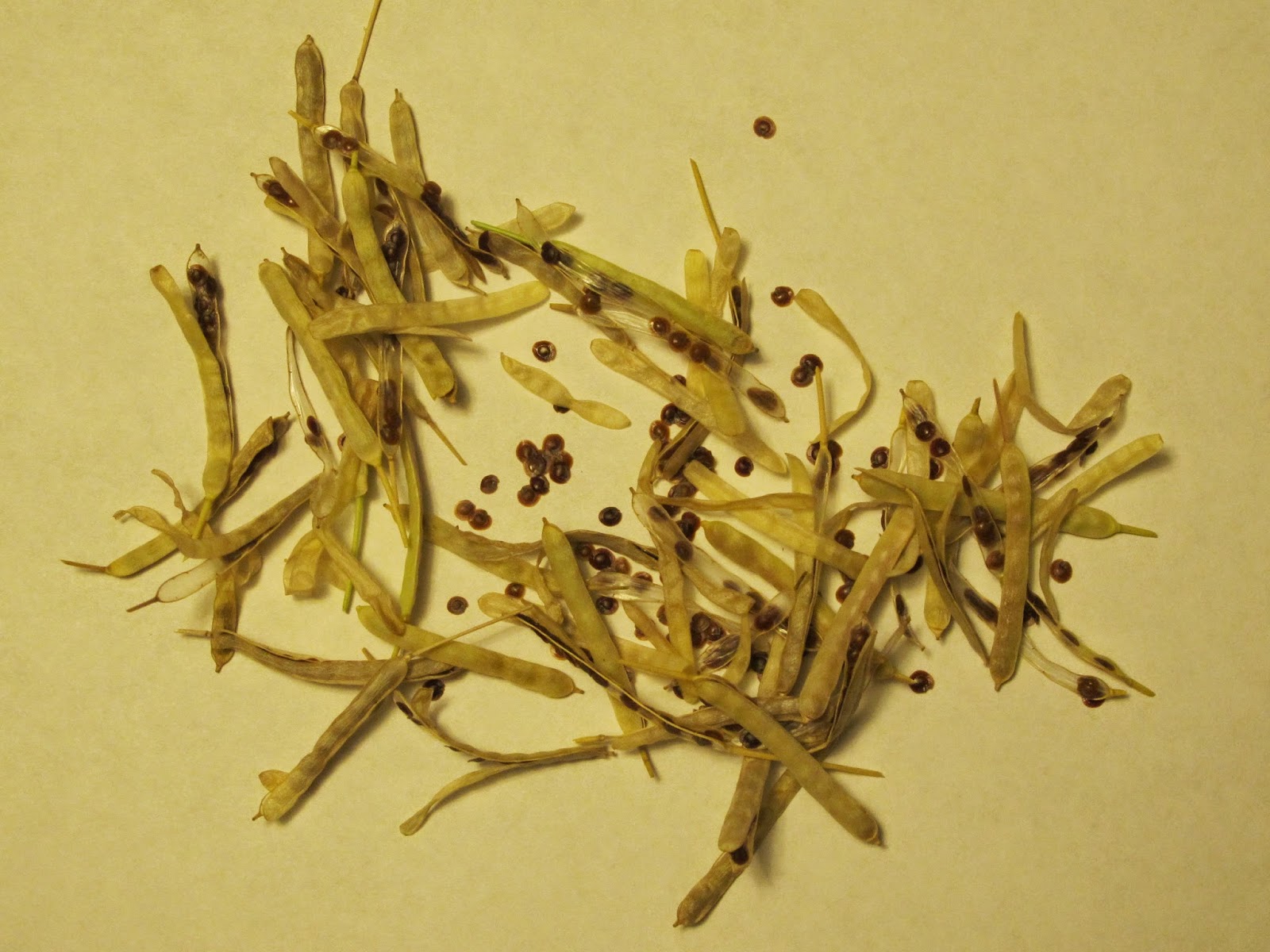
The fruits are stuffed full of seeds.  This is about an average yield for the container grown plants.  Those in the barrens only produce four seeds at best.


I’ve been collecting seeds from the container for a week now.  The photo above illustrates a typical day’s harvest, a total of about 40 fruits.  I harvest the fruits just as they begin to split and expose the seeds.  I miss plenty, so there are more than enough seeds left in the container for next season.


Harvested fruits are left to dry for a few days.


When the seeds have completely dried, they are stored in an envelope until planting time.


Once I harvest the last of the seeds, I’ll take them out and scatter them on the barrens.  Leavenworthia seeds need a period of hot weather to allow them to break dormancy and germinate in the fall, so it’s important to get them planted while there is still plenty of summer yet to come.  I’ve also found that it’s best to plant seeds at the same time they would naturally be dropping from the plant.  That way they are naturally going to get the treatment they need for germination.  Hopefully, the coming winter will be more conducive to Leavenworthia growth and the barrens will produce a record crop next year.