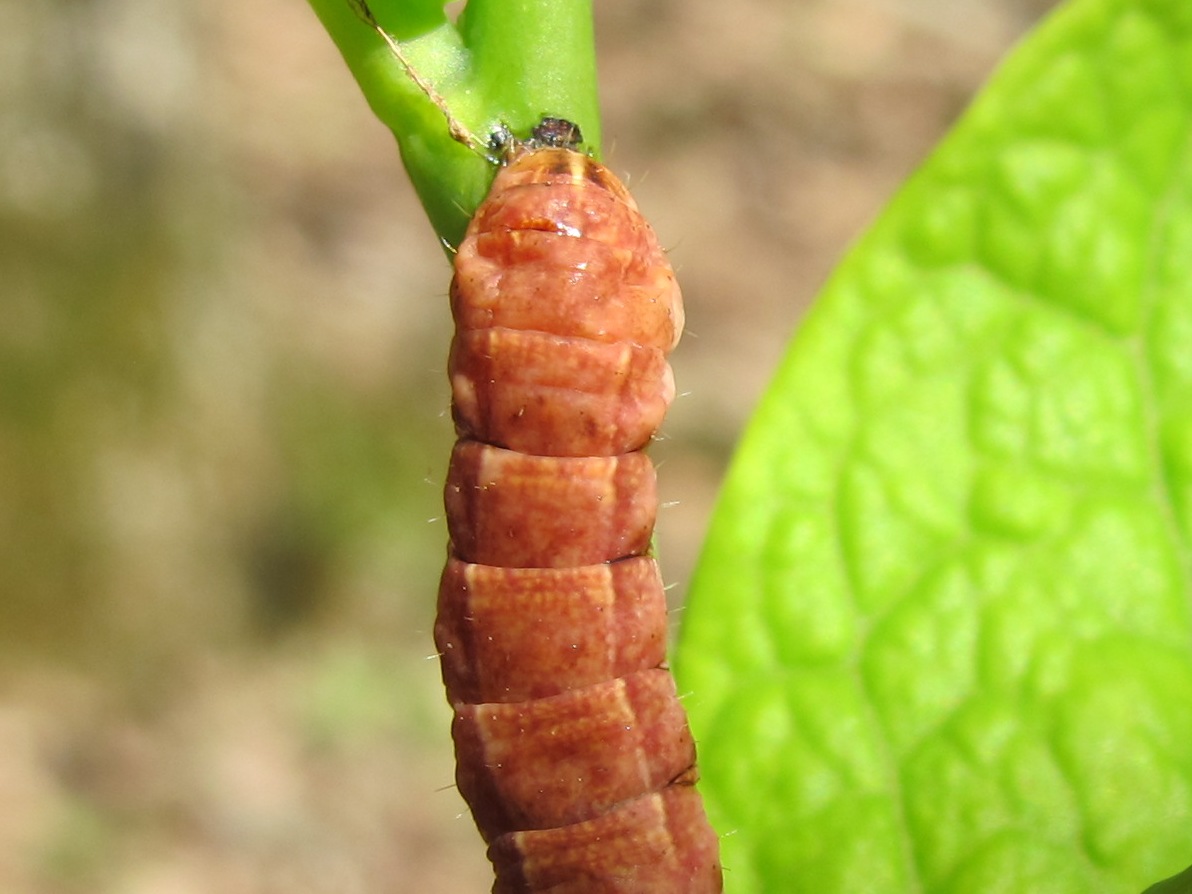
At this time of year, I become most curious about the identity of this particular insect. I’ve mentioned this
larva before. It feeds on the False Gromwell,
Onosmodium molle var. hispidissimum, and travels through web tubes that it constructs on the plant. I’ve never found anything laying eggs on the plant. The larva apparently leaves the plant to pupate, since I’ve never found pupae or pupal skins in the web tunnels. Larvae raised indoors will pupate on the plant, but I’ve had no luck producing adults from the pupae. Netting the wild plants has only resulted in dead larvae in the bottom of the net. I suspect the wild larvae may pupate on or in the ground. I’ve raised False Gromwell in pots with the thought that I could cage the entire pot once larvae appeared on the plant, but none of my potted plants has ever hosted larvae. I’d really like to see an adult.

Whatever this thing is, it must be fairly common. Typically 60 to 70 percent of the plants are infested with larvae. A single plant may contain a half dozen larvae. I’ve cut a flower pot in half and plan to enclose the base of a plant containing larvae. With the pot filled with soil and the plant completely netted, I may capture a pupa. We’ll see what happens.

The frass from feeding larvae covers the lower leaves. Lower leaves are not consumed by larvae, but they never seem to remain healthy. While examining this plant, I found another neat little insect.

I believe this to be a nymph of the Spiny Assassin Bug,
Sinea spinipes. There are a couple of similar species that can be readily separated as adults, but the nymphal descriptions made it difficult to be certain. There’s no doubt of it being an interesting little creature.

This clump of Gromwell was consumed by larvae the past two years. This year the leaves are blemish free. Feeding damage occurs late in the season and the loss of leaves doesn’t appear to hurt the plant or reduce seed production. Finding the adult form of this larva may be one of those things that’s going to have to wait until I have time to stay with the plant and catalogue visitors.
 Spider Milkweed, Asclepias viridis, is my favorite of the milkweeds at Blue Jay Barrens. The flower head is both showy and not showy. The lime green corolla lobes are conspicuous from a distance, which is considered to be showy. However, that color makes you think of a sickly, poorly performing plant, which is a failure as far as producing the attractive side of showiness.
 This is one of those southern plants that reaches its northern limits in Southern Ohio. The population here has been increasing slowly over the past 20 years. I don’t think it’s in danger of dieing out, even though a few plants turn up missing every time we have a particularly cold winter.
 It makes its home in the prairie openings. Full sun and dry conditions seem to best suit its needs. It also seems to do best in areas with minimal tall grass. I haven’t found any of these milkweeds growing in the thick Indian Grass, or Big Bluestem areas.
 Flowering stalks are usually around 18 inches tall. Without the flower, they blend neatly with the other vegetation and are hardly noticeable. The lean is typical. I rarely find any flowering stalks that are completely vertical.
 Ants are the only insects that I see regularly visiting the Spider Milkweed flowers. It’s odd that other milkweed species are so attractive to bees, butterflies and flies, but none of those fliers visits the Spider Milkweed. Ants may be the prime pollinator for this plant.
 I found these larvae munching away on the corolla lobes. I didn’t have much luck with a positive ID, possibly because these guys are still so young.
 I’ll give the larvae a few days to put on some size and then take another look at them. I just hope I can find them again later. It seems common for young larvae to begin life by eating the more tender parts of the plant, such as the buds or flowers. As they get larger, they move on to the leaves. If I have my typical luck, I’ll find nothing when I go back. We’ll see.