The person who sold us our house had a liking for Black Walnut and planted several of these mighty nut producers in the yard. If you’re going to maintain a patch of mowed lawn, the last thing you should consider planting is something that produces thousands of hard, round balls that drop for weeks in the autumn. My solution was to just stop mowing under the trees. At least Black Walnut is native to this area.

I really like the openness of the Walnut canopy. It always reminds me of the airy trees scattered across the African Veldt.

My real aggravation comes from the forest of walnut trees that develop from the scattered nuts. Some people have elaborate methods for making walnuts germinate. At my house, all you need to do is let the nut hit the ground and you get a new tree. Squirrels and Chipmunks have helped distribute nuts far across the field and I am constantly trying to eliminate the resulting saplings.

Black Walnut is a common tree of the old fence rows. The origin of the trees is the question. Are any of these trees descended from a lineage native to this site or were the parent plants brought in from somewhere else?

Our shallow soils may be perfect for sprouting walnuts, but they provide terrible growing conditions. Walnuts grow best in deep soils. When the roots are stopped by shallow bedrock, the tree begins to suffer. Frequent branch die back, twisted trunks, rotten cavities and multiple trunks are common characteristics of the trees that grow here. These are not the trees that timber buyers dream of. Of course, producing timber is not one of my goals.

There are some older Black Walnuts in the old fence line. This specimen bears the scars of old fence wire. A 1938 aerial photo of the property shows a tree growing in just this location. I believe this is the tree I’m seeing in the photo, so I can imagine the age being near the 100 year mark.

In a little valley below the barn, a group of younger walnuts put on some rapid height in the deeper soil. The root system of Black Walnuts produces a chemical called juglone, which is toxic to many types of plants. As a result, a community of juglone tolerant plants develops in association with the walnuts. The ground cover in this valley changes dramatically as you move out of the walnut dominated area.

Walnuts on the other side of the barn show signs of having been planted in rows. I wonder if past generations had a similar interest in planting the valuable Black Walnut. I have not found any Black Walnut trees in the wooded portion of Blue Jay Barrens. That doesn’t mean they were never there. Walnut would have been readily cut if it had even the slightest economic value and could have been eliminated from the woods decades ago. The origin of Black Walnut at Blue Jay Barrens is just one of those things I ponder when I’m in a pondering mood.
 The person who sold us our house had a liking for Black Walnut and planted several of these mighty nut producers in the yard. If you’re going to maintain a patch of mowed lawn, the last thing you should consider planting is something that produces thousands of hard, round balls that drop for weeks in the autumn. My solution was to just stop mowing under the trees. At least Black Walnut is native to this area.
 I really like the openness of the Walnut canopy. It always reminds me of the airy trees scattered across the African Veldt.
 My real aggravation comes from the forest of walnut trees that develop from the scattered nuts. Some people have elaborate methods for making walnuts germinate. At my house, all you need to do is let the nut hit the ground and you get a new tree. Squirrels and Chipmunks have helped distribute nuts far across the field and I am constantly trying to eliminate the resulting saplings.
 Black Walnut is a common tree of the old fence rows. The origin of the trees is the question. Are any of these trees descended from a lineage native to this site or were the parent plants brought in from somewhere else?
 Our shallow soils may be perfect for sprouting walnuts, but they provide terrible growing conditions. Walnuts grow best in deep soils. When the roots are stopped by shallow bedrock, the tree begins to suffer. Frequent branch die back, twisted trunks, rotten cavities and multiple trunks are common characteristics of the trees that grow here. These are not the trees that timber buyers dream of. Of course, producing timber is not one of my goals.
 There are some older Black Walnuts in the old fence line. This specimen bears the scars of old fence wire. A 1938 aerial photo of the property shows a tree growing in just this location. I believe this is the tree I’m seeing in the photo, so I can imagine the age being near the 100 year mark.
 In a little valley below the barn, a group of younger walnuts put on some rapid height in the deeper soil. The root system of Black Walnuts produces a chemical called juglone, which is toxic to many types of plants. As a result, a community of juglone tolerant plants develops in association with the walnuts. The ground cover in this valley changes dramatically as you move out of the walnut dominated area.
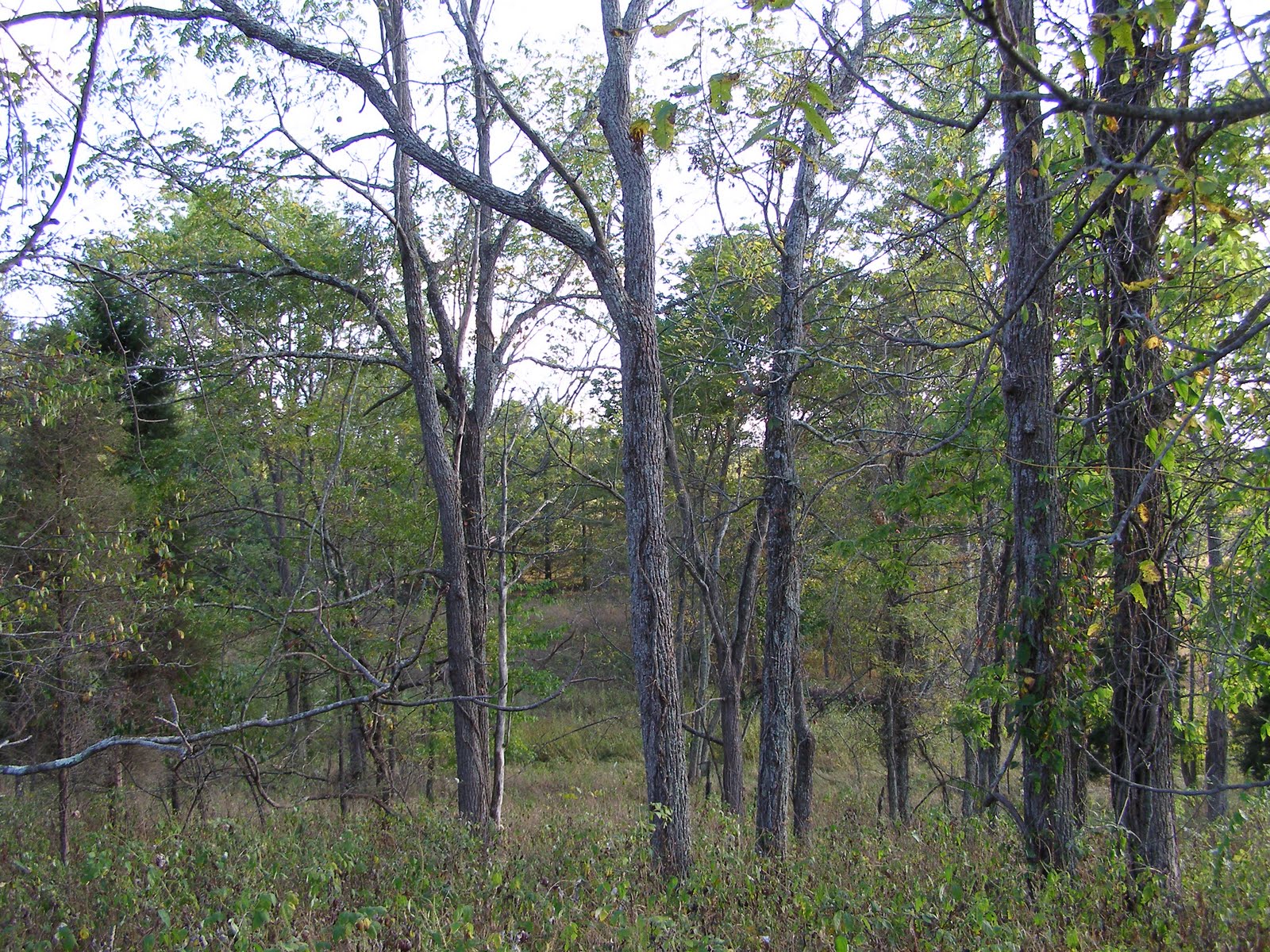 Walnuts on the other side of the barn show signs of having been planted in rows. I wonder if past generations had a similar interest in planting the valuable Black Walnut. I have not found any Black Walnut trees in the wooded portion of Blue Jay Barrens. That doesn’t mean they were never there. Walnut would have been readily cut if it had even the slightest economic value and could have been eliminated from the woods decades ago. The origin of Black Walnut at Blue Jay Barrens is just one of those things I ponder when I’m in a pondering mood.