Showing posts with label Monarch. Show all posts

Wednesday, August 6, 2014

Monarchs Abound

Monarch butterflies have suddenly become more abundant than ever before at Blue Jay Barrens.  During a typical summer, I’m used to seeing a few Monarchs each week.  Things pick up a bit during the fall migration, but this property is outside the primary Monarch migration route, so I usually don’t see multiple butterflies during that time.  This year I’ve been seeing Monarchs on a daily basis, sometimes several at once.  Many of those sightings are centered around the Milkweed plants in front of the house.  The flowers have passed, so that’s not the reason why they are drawn here.


The Monarchs circle the Milkweeds, occasionally setting down for several seconds before moving on.  It’s not always easy to see what they’re up to.


This is a common perching position.  While clinging to the edge of the leaf, the Monarch probes the underside with the tip of its abdomen.  Just a brief stop and then it moves on.


In most cases, an egg is left behind.  With luck, this will be an adult Monarch by next month.


Monarchs depositing eggs on the Common Milkweed near the house is something that happens every year.  This year the Monarchs are leaving their eggs on several other members of the milkweed family, which is something I’ve rarely seen them do.  I watched this Monarch visiting a patch of Butterfly Weed and noticed that its brief visitations to the flowers had nothing to do with nectaring.  I headed over to see if I could find any eggs.


I got sidetracked by the discovery of Monarch caterpillars already present on the Butterfly Weed.  These plants are growing in an area that was mowed in late May as part of a Sweet Clover control plan, so the plants are at an earlier stage of growth than most others in the area.


There were a lot of droppings on the leaves beneath the caterpillars, but it was difficult to see where they had been feeding.  Then I noticed the short stubs at the base of the flower clusters and realized they were all that was left of the consumed flower.


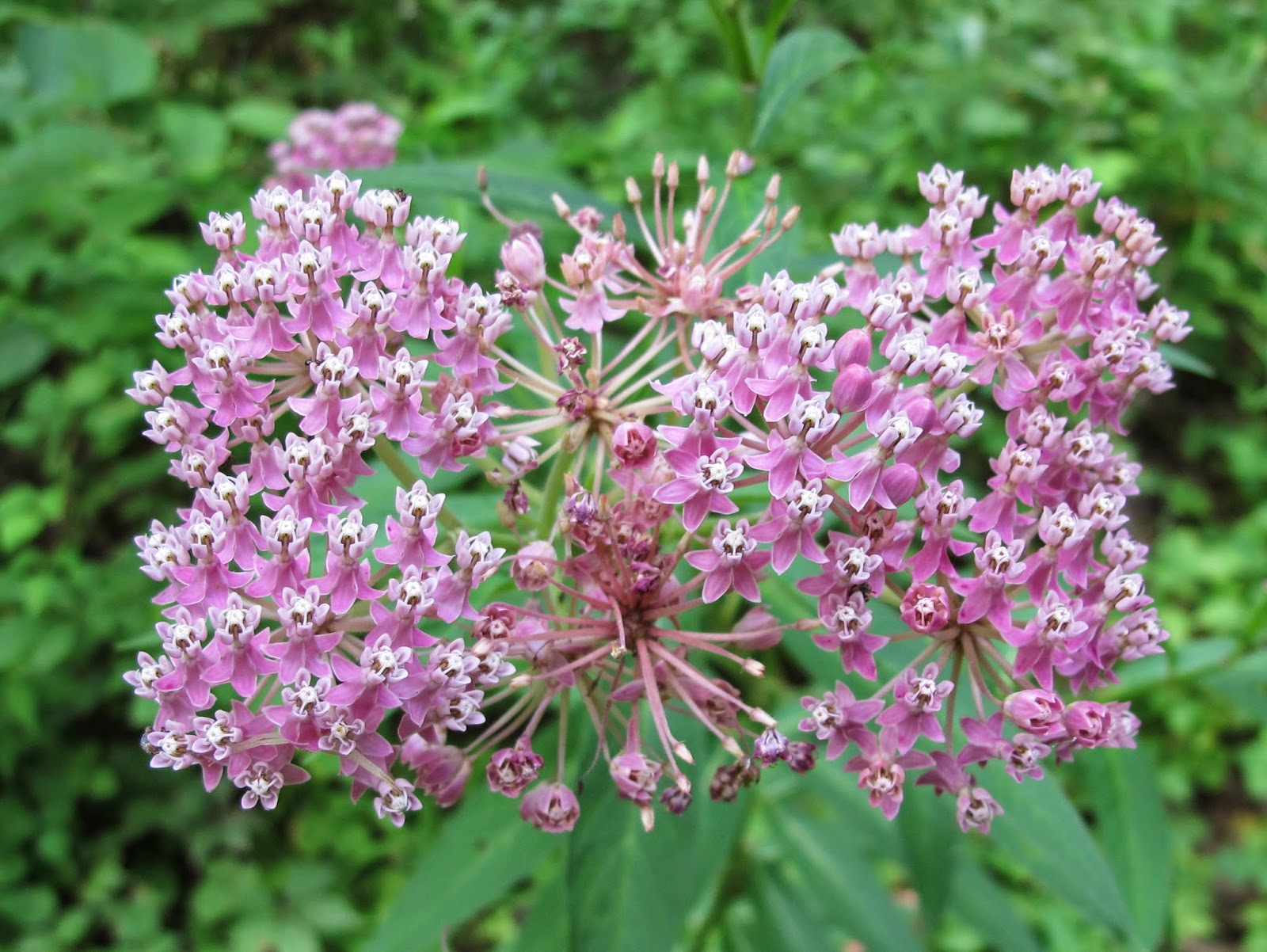
Uncommon at Blue Jay Barrens is the Swamp Milkweed.  That’s to be expected in an area that is primarily classified as a xeric environment.  A few Swamp Milkweed plants survive in sand and gravel deposits along the creek.  This is a shaded, mostly wooded environment that normally doesn’t attract open field travelers like Monarch Butterflies.


The Swamp Milkweed flower head is more erect and less dense than that of the Common Milkweed.  Each flower in the cluster has room to display itself as an individual.


The side veins in the leaf come away from the main vein in an acute angle that’s plain to see.  While admiring the leaves, I noticed that most were displaying some familiar holes.


Monarch caterpillar on the Swamp Milkweed.  This is the first time I’ve ever found Monarch caterpillars on this species.


I went on to count eight caterpillars on this single plant.  I wish them luck in their development.  Their survival depends much on the weather.  A heavy rain storm can quickly bring the creek to flash flood condition and that would lay this plant flat.  The plant can survive that type of treatment, but the caterpillars would probably be lost.  This unprecedented breeding effort by Blue Jay Barrens Monarchs would almost make you believe that the butterflies were aware of their declining numbers and were doing their best to turn the trend around.  I’m just happy to have this opportunity to enjoy such a marvelous creature.

Monday, July 14, 2014

Monarch Butterflies

The spring Monarch Butterfly migration passed without a single Monarch sighting at Blue Jay Barrens.  My earlier disappointment has been abated with a summer season Monarch count surpassing any in recent years.  The Milkweed stands are receiving frequent visitations from this colorful butterfly.


Of course, this is the real reason for maintaining patches of Milkweed plants.  Monarch larvae are Milkweed eaters.  Recent declines in the Monarch population make it more important than ever that this plant be readily available.


Having Milkweed plants snug up against the house makes it easy to monitor the progress of leaf eating insect larvae.  Because of a beating they took during a spring thunderstorm, a few of the plants are unable to maintain an upright position.  Most, however, are standing tall, even though a few needed some propping up and stem support to achieve this condition.


Landscape designers probably wouldn’t recommend crowding the entrance to your home with seven foot tall Milkweed plants.  I would agree, especially when the flower visiting bees during the day or moths at night get sucked into your home every time you open the door.  This Milkweed thicket was not actually intentional.  A single plant that became established beside the water garden was allowed to remain.  Within a couple of years that one plant became two dozen.  For the benefit of the Monarchs, I let them remain.  I must admit that I am also fascinated by the vast array of insects attracted by these plants.


I’m currently finding larvae of all ages.  The youngest are just beginning to show their characteristic black filaments.  Small larvae are easiest to see by looking from below a sunlit leaf. 
 

Midsized larvae show short stubs where the long black filaments will eventually be.  Larvae can also be located by examining holes in the leaves.  Feeding sites are more regular in appearance than hail damage left by the early storm.


Leaf damage causes the Milkweed plant to ooze its thick white sap.  The sticky sap can make it difficult for the larva to feed.  The larva overcomes this obstacle by systematically severing the veins leading to the leaf, this stopping the flow of sap.


In small leaves, the midrib is often cut to halt sap flow to the entire leaf.  On larger leaves, a series of lateral veins might be cut as seen here.


Once the sap stops flowing, eating commences.


The larvae seem to practice an eat-and-run technique that minimizes time spent in any one location.  A section of leaf is consumed and then the larva moves on to another location.  Many predators are attracted to leaf damage in search of prey.  Despite the Monarch’s unpalatability due to accumulating toxins from the Milkweed plant, some predators have to learn the lesson first hand to the detriment of the larva.  Even though they are bad to eat, the best survival strategy is to avoid the predators.


The excess rainfall experienced this spring has really benefited the Milkweeds in the field.  The plants bloomed early and are continuing to produce new flower buds.


This large stand of Purple Milkweed continues to attract Monarch Butterflies as well as other insects dependent on the Milkweed plant for their survival.


It appears that Blue Jay Barrens will contribute a large number of Monarchs to the masses that will make their way south later this summer.  I just hope that conditions at their wintering grounds are favorable for the species continued survival.

Tuesday, August 14, 2012

Common Milkweed Activity

I’ve been admiring some of the Common Milkweed plants that have put on luxuriant growth despite the super dry conditions.  This one has topped out at about seven feet.

Most plants are carrying six or eight seed pods.  Tendrils on the surface of the Common Milkweed seed pod present an alien appearance.

It looks like it’ll be a bumper year for Milkweed seeds.  All of the pods are large and full.  It won’t be long before the seam separates to release the ripe seeds.

Monarch butterflies are around loading the plants down with eggs.  I watched this female lay 17 eggs on a clump of three milkweed plants.

It may be warm now, but this egg is in a race to produce a mature butterfly before cold weather arrives.  Monarchs will not survive an Ohio winter.  In order to survive, the mature butterfly will have to emerge and make its long migratory journey to the south.

The Monarch is not the only insect depositing its eggs on the Milkweed leaves.  These orange gems were left by a female Milkweed Bug.

Here’s the likely source of those eggs.  This is an adult Small Milkweed Bug, a species that specializes on eating milkweed seeds that are still held within the pod.

The nymphs form colonies on the milkweed plants.  They are most likely to be found congregating on the seed pods where they use long, tube-like mouthparts to probe deep into the pod to access the hidden seeds.

The nymphs will shed their skins several times before emerging as an adult.  To avoid being damaged during this vulnerable time of their lives, the little bugs will move away from the pack and pick a secluded spot in which to shed.  After a while, shed skins can be found just about anywhere on the plant.  The variety of interesting activities occurring on milkweeds makes the cultivation of this plant a rewarding endeavor.

Friday, July 13, 2012

Teasel Nectar

The drought has greatly disrupted the normal sequence of blooming plants and created a shortage of nectar sources at Blue Jay Barrens.  Teasel, an invasive non-native plant, is currently providing an abundance of nectar to the local insects.  I actively work to eliminate Teasel from this property, but some people argue that non-native plants have a place in the landscape if they provide a valuable component that is otherwise missing.  The decision to tolerate or eliminate non-native species should be based on the land management objectives for the site.  My objective is to create a healthy ecosystem composed of native flora and fauna, so no matter what temporary benefit they may provide, non-native species must go.

Native plants offer multiple benefits to the community of which they belong.  Benefits provided by non-native species are generally limited.  Indiscriminate consumers of nectar will visit Teasel, but a quick meal is the limit of interaction between this plant and the local fauna.

The fact that I would love to be rid of this plant doesn’t stop me from enjoying the variety of insects attracted to the blooms.  Here a Tawny Edged Skipper goes after some sweet nectar.

I see the presence of a non-native plant as signifying the absence of a native plant.  Butterflies generally require specific plant species to serve as hosts for their larval stage.  If the required host plant can be found, adult butterflies can mate and lay eggs without ever tasting the first drop of nectar.  Nectar can prolong the butterfly’s life and possibly increase the number of eggs produced, but the future of the species is dependent upon availability of the host plant.  Eliminating the non-native nectar producers and replacing them with necessary host plants is a management goal that would be of maximum benefit to the butterflies.  Butterfly viewing opportunities might be reduced, but Horace’s Duskywing and other similar species would not suffer from the absence of Teasel.

Flowering of the Teasels is providing evidence that the butterfly numbers are still down this year.  These blooms would typically be swarmed by various swallowtail butterfly species, but none are in evidence.  Skippers, like this flashy Silver-spotted Skipper, have been the most frequent flower visitors.

Monarch butterflies have been scarce since their initial spring migration wave.  I think the first of the locally hatched crop are beginning to emerge.

Teasel is a biennial plant, so its continued existence depends on production of a large seed crop.  Plant numbers can be greatly reduced by physically collecting the seed heads before seed can be released.  This is not a large patch of Teasel, so it should not take long to gather up all of the seed heads.  Meanwhile, the flowers will continue to provide their nectar and I will watch to see what species arrive for a meal.