Showing posts with label Toad. Show all posts

Monday, April 3, 2017

Toad Pool Success

Keeping the toad pools full of water has not been a problem this year.  Two or three rainfalls per week has kept them filled to the brim. 

This is the fourth spring for Toad Pool 1.  Vegetation was quick to fill in here, but amphibians were slow to arrive.

This is the second spring that water has been present in Toad Pool 2.  Last year the pool was still under construction and only had a depth of a few inches.  This year’s pool has a center portion with a depth of about one foot, and the soil was compacted during construction to minimize leakage. 

The pools were constructed with the primary goal of creating Toad breeding habitat.  This is the first year that toads have actually visited the pools.  During warmer nights, males move into the pools to call for mates.  I counted nine males ringing the shoreline of Toad Pool 2 on March 25.

It took a few nights before a female made it to the pool.  This couple, with female in front, is ready to begin the process of depositing and fertilizing eggs.

On the morning of March 29, I finally found strings of toad eggs in the pool.  The depressions in the bottom of the pool were made by deer hooves.  Whitetail Deer treat these pools as their private playgrounds.  I’m hoping that doesn’t cause a problem for developing tadpoles.

Eggs began to hatch on April 2.  By the next day, hatching was proceeding at a rapid pace.

This collection of egg strands is in deeper water and wasn’t noticeable until hatching began.  Everything seems to be going well.  Hopefully, the end result will be a mass of small toads leaving the pool.

There was one thing different about the toad pools this spring that may have contributed to the toad visitations.  Both pools were surrounded by a mass of Spring Peepers creating a loud chorus.  I’m wondering if the Peeper song alerted the toads to the fact that a suitable breeding pool was available.  The newly hatched Peeper tadpoles shown above are just two of dozens hanging in the algae around the edge of the pools.  This toad pool venture may just turn out to be a success.

Monday, December 19, 2016

Toad Pool 2

In November, I managed to get some more work done on Toad Pool 2, my second attempt to create more toad breeding areas at Blue Jay Barrens.  Frequent rains during the first part of summer kept the soil too wet to work.  Weather conditions went to the other extreme during the last half of summer, causing the soil to be too dry to compact.  Finally, a perfect balance was reached on November 17, so I continued with my construction activities.

My construction techniques are fairly simple.  I use a tiller to pulverize the soil to be excavated.  The loose soil is scooped out and deposited to form a dam on the downhill side of the proposed pool.  The soil is built up in successive layers of an inch or less of soil.  Each layer of loose soil is fully compacted before the next layer is added.  The idea is to end up with a tightly compacted barrier to keep water from leaking out of the filled pool.

The soil on this site has no shortage of rocks.  Plowing activities that occurred several decades ago moved rocks to a higher position in the soil profile.  On this location, the plows must have been dragging very near the top of the bedrock layer.  During my excavation, I have encountered a couple of bedrock areas that were pulverized by the ancient meteor impact to a condition nearing small gravel.  This makes me wonder if the site will be capable of maintaining water for the period necessary for a batch of toads to be successfully raised.

I decided to finish this year with a pool that is smaller than planned.  I’ll see how well it holds water next spring and then decide if it is worth the effort to enlarge the pool area.  If it doesn’t hold water, I’ll then consider the option of installing a pond liner.

On November 30, a half inch rain put the first bit of water into the pool.

Another half inch of rain a week later brought the pool to within a few inches of being full.  There are three seasonal springs that feed into this area through the winter and spring.  With luck, they will produce enough water to offset any leakage in the pool.

On December 17, a 2.5 inch rain filled the pool.  Now it’s just a matter of waiting to see what happens.

Toad pool 1, about a quarter the size of the new addition, has proven able to maintain water long enough to raise a crop of spring breeding amphibians.  Unfortunately, the first pool is now four years old and I’m still waiting for the toads to discover this gem of a breeding area.

Friday, April 1, 2016

Breeding Toads

American Toads have recently moved into the pond for their annual breeding event.  I’ve seen a total of four toads; three singing males and one female.  It’s not a great turnout, but it beats last year’s total of zero.  These two males were in the center of the pond, requiring a long lens and flash in order to capture an image.  Animals with reflective eyes just aren’t good subjects for flash photography.

Frequent rains have kept plenty of water in the pond.  The runoff water has brought in a load of nutrients from the township road.  The nutrients, along with uncommonly warm weather, have triggered an excessive growth of filamentous algae.  The algae pads have allowed the male toads to perform their courtship songs far from shore.

The algae growth actually benefits developing frog tadpoles.  The tadpoles feed heavily on the algae, and the algae makes it more difficult for predatory salamander larvae to stalk and capture the tadpoles.

Long, black strands of eggs are the result of the toad’s breeding activities.

Here is the couple responsible for all of those eggs.  The male hangs onto the female’s back and fertilizes the eggs as they are released.  The female determines where they eggs will be placed.  She moves the couple around through the vegetation, while the male just goes along for the ride.

I’m hoping that these eggs will be responsible for a mass of small toads leaving the pond in a few months.  I saw young toads in abundance last year, but I never found the breeding site.  I’ll be taking a few of these eggs and putting them into the pool I built specifically for breeding toads.  If some toads actually hatch from that pool, maybe a few will eventually return there to breed.

Wednesday, July 1, 2015

Young Toads

Somewhere in the vicinity of Blue Jay Barrens, American Toads managed a breeding effort successful enough to cover the area with a new generation of toads.  I’ve been seeing little toads everywhere from the yard to the hilltop a half mile away.  Their numbers are akin to an invasion.

It doesn’t take long for newly transformed toads to become miniature replicas of their adult kin.  Just a few weeks ago, this toad was just a small black tadpole.  Now it has the appearance and behavior of a mature toad.  The one behavioral exception might be the tendency for very young toads to travel by way of a series of short, rapid hops.  A startled youngster appears almost frantic in its efforts to flee a perceived danger.

It’s been at least 20 years since I’ve seen this many young toads at Blue Jay Barrens.  I would really like to identify the breeding site.  My garden is full of tiny toads, but I know that the pools I developed nearby did not see any toad activity this year.  It’s possible that the heavy rains we had this spring created a temporary pool somewhere that was just perfect for toads.  Young toads may travel a long distance as they disperse from their nursery pool, so it’s hard to guess the distance or direction to their place of origin.

It’s fun to see the toads in the garden, but it means I have to be careful of where I put my feet.  This youngster was closely watching some small beetles walking on the strawberry leaves.

I found this fellow on one of the barrens.  It was nestled down in a dewy spider web and didn’t seem inclined to move.  Toads often spend much of their lives away from open water.  Dew can be an important source of moisture for hydration.

I managed to persuade this little guy to perch on my finger long enough to get a shot for size comparison.  The hand is normal sized.  The toad is tiny.

Friday, January 9, 2015

Open Water

The creek and its tributaries are the only natural source of open water at Blue Jay Barrens.  From Fall through Spring, the creek provides drinking and bathing water to a wide variety of birds and mammals.  Summer water is less dependable.  It is common for the creek to stop flowing for several weeks during August and early September.  Occasionally the dry season extends for months.

I have always enjoyed dabbling in water.  As a child, I could spend hours exploring a puddle in the yard. Finding mosquito larvae in the air conditioner drip pan was like discovering a gold mine.  My parents didn’t appreciate my efforts to increase water opportunities by enlarging potholes in the driveway or excavating beneath the downspouts.  My neighbors seemed to share this attitude.  So it’s only natural that once I reached a point where other people’s opinions had no bearing on my actions, I would create pools of water wherever I pleased.  The water garden, as artificial a body of water as you can get, proved quite effective at drawing animals as well as plants into position for my enjoyment.  It does freeze over easily though and doesn’t provide a reliable source of open water for the local wildlife in winter.

Even though my later attempts at developing open water are still artificial creations, they function more naturally than the water garden.  The established toad pool in the foreground and its under construction counterpart behind, are intended to provide a breeding environment for toads.  A declining toad population is coinciding with a decrease in Hognose Snake sightings.  The snakes feed on toads, so it seems logical that increasing the toad population will benefit the snakes.  It’s just a happy bonus that the pools also benefit a wide variety of other animals and give me more places to play in the water.

The new toad pool is still under construction.  The dam creating this pool is composed of topsoil that will eventually be used as topdressing over the permanent dam.  The center of the planned dam will be along the line of stakes sticking from the water.  Pooled water slowly seeps through this temporary dam and emerges clean on the downstream side.  This keeps sediment from actually leaving the construction site during the winter.

Seasonal springs emerge just above the planned water line.  The springs are almost keeping up with the seepage loss through the dam.  This makes me optimistic that the springs will easily keep the pool full of water well into early summer.  Deer visit the pool every night and seem to delight in running and jumping through the mud.

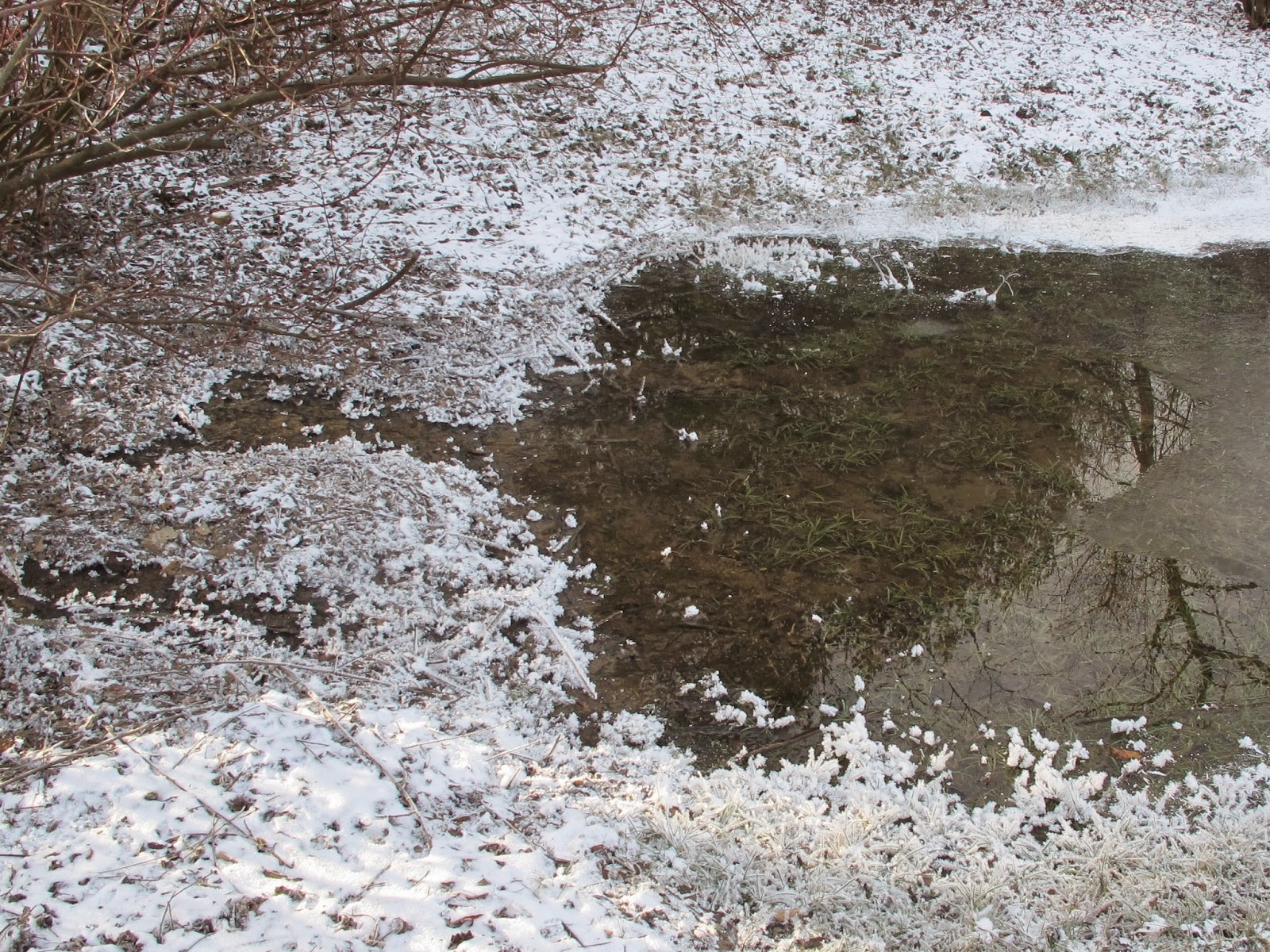
Cold weather caps the pools with ice.  The established pool is fed by a single small spring, but that is enough to keep a bit of water unfrozen.

The spring keeps a small area of open water available to visiting wildlife


The same conditions occur in the pond, an artificial water body that was created long before I purchased the property. 

A strong seasonal spring produces a continuous stream of water entering the pond throughout the winter.

The warm water from the spring maintains a large area of open water.  Even through the coldest winters, this portion of the pond remains unfrozen.  When other water sources freeze over, birds flock here to drink and bathe.

Water from the spring also helps maintain adequate water for the survival of the breeding salamanders.  The view may be blocked by snow, but the salamanders are busy with courtship and egg laying activities beneath the ice.  I would never threaten the native prairies of Blue Jay Barrens with a water development project.  I’m just glad there are a few areas of undesirable vegetation available for conversion to open water.

Wednesday, March 21, 2012

Toad Song

There’s usually more than a couple of days span between the first call of the Spring Peeper and the first song of the Eastern Toad.  My calendar records show Peepers normally active in late February and Toads showing up around April 1.  This year, Peepers preceded the Toads by only two days.  Peeper numbers have also been much lower than normal.  Daytime highs have been pushing 90 degrees, which I think is just too much for cool weather frogs.  The toads are breeding full force and the predicted continuation of warm weather should give them plenty of time to get their eggs laid before cool conditions return.

Toads usually stop calling when illuminated by a flashlight, but you can easily coax them back into action by producing a gurgly whistle.  In preparation of inflating the throat, a toad will inflate its body through a series of little breaths.  Then it will contract its body muscles to force the air into its throat pouch.  This guy has just finished the body inflation.

The call travels a long way.  It doesn’t take long for the pool to fill with toads.

Bullfrogs and Green Frogs are also wide awake and active.  They haven’t begun calling, but I wouldn’t be surprised if that happened soon.  There were no large frogs at all living in the Water Garden at the end of last season.  These found their way here during one of our warm late winter rains.

This large Bullfrog had some particularly handsome markings.  I’ll have to move him out of here before he begins making meals of the smaller frogs.  A pool with Bullfrogs usually turns into a pool with JUST Bullfrogs.

Sunday, June 5, 2011

American Toad

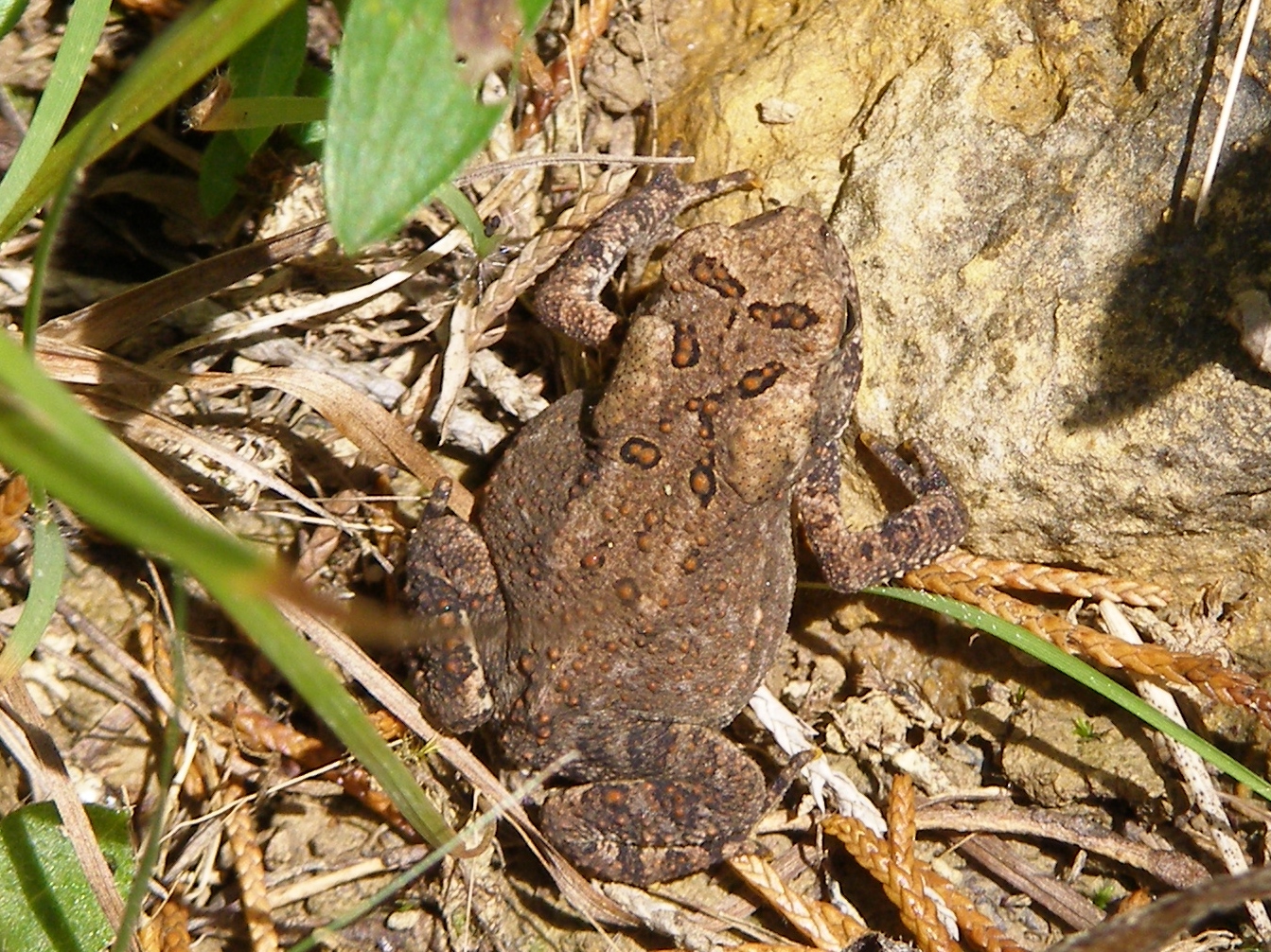
I’m encouraged by the number of large American Toads I’m seeing at Blue Jay Barrens this year. Things have been plenty moist, so this may be partially responsible for the frequent sightings. I like to believe that the population is increasing, if only slightly.


Toads display a wonderful camouflage. If they could keep from hopping as you walk by, most would probably go unnoticed.


The kidney bean shaped lumps behind the eyes are the paratoid glands. These glands are part of the toad’s defense system and create Bufotoxin, which coats the toads skin. Bufotoxin contains compounds that can produce many ill effects when ingested. Increased heart rate, hallucinations and vomiting are some of the conditions experienced by mammals that try to prey on a toad. This can really cause concern to dog owners who find their pet slobbering and staggering around the yard. It’s odd that many dogs continue to harass toads even after several experiences with the toxin.


I think reptiles and amphibians are the most photogenic of all animals. You would think they were intentionally posing for the camera. I don’t remember ever passing one in the field without taking a few photos. That spotting on the chest is one of the identifiers of the American Toad.


Toads were one of my favorite pets as a kid. I would find one soon after school was out and keep it for the summer. They would become amazingly tame. Their home was a one gallon terrarium in my bedroom. Almost every day, I would take the toad outside and help it search for food. It would climb over my hands as I dug around looking for suitable food items. I knew I couldn’t keep it through the winter, so towards the end of August I would release it where I had found it. I think those toads took on a role traditionally reserved for dogs.


There’s something special about this toad’s eye. As I gaze into its dark pupil I get a sense of compassion and strength and sensitivity. There’s an undeniable look of ancient wisdom and keen intelligence. Wait a minute. That’s my reflection I’m seeing.


I enjoyed my visit with the toad. It was engaged in the type of activity that I’m encouraging at Blue Jay Barrens. It was being a wild creature, as much uninfluenced by human activity as is possible in this part of Southern Ohio. It’s not going to be held captive by some nature loving kid or be flattened by a car or chopped up by a lawn mower. It will lead a normal toad life in the woods. I hope my brief intrusion didn’t detract from that life.