Fortunately, the trees I planted have spread many
seeds. I’ve let some of the resulting
seedlings grow along the side of the garage, so I can have a few Redbud
branches at my eye level. Many different
types of animals feed on the tree through the year, but in September it’s the
caterpillars that dominate. I took a few
minutes to photograph some of the current residents.

First off, I should probably mention the species that actually
targets the Redbud over other plant species.
The Redbud Leaf Roller can likely be found on any Redbud Tree. Because of its habit of folding over a leaf
edge and webbing it in place to form a sanctuary in which to feed, the Redbud
Leaf Roller is not seen by many people.

You have to unfold the leaf to reveal the creator. These caterpillars are known as skeletonizers
because of their habit of leaving the leaf veins and a thin layer of tissue
behind as they feed. Inside the fold of
the leaf, the caterpillar eats and leaves its droppings. A nice little package that hides most
evidence of the caterpillar.

Hanging by lengths of silk, these small green caterpillars
disperse themselves around the tree. It
doesn’t make sense to me that they are all just accidently falling off of their
leaves. It seems like poor survival skills to be
unable to keep hold of your food supply.
Some of the caterpillars keep lowering themselves until they arrive at
another leaf. Others sway in the breeze
and grab onto leaves or branches. Still
others climb back up their thread, apparently arriving at the end of their
tethers with nowhere to go. I think much
of their activity is in an effort to scatter themselves around the area.

I believe these thread travelers are early instars of the
Redbud Leaf Roller. I’ve found many
living in refuges made by webbing together the edges of two neighboring
leaves. Perhaps the younger caterpillars
do not have the strength to fold a leaf edge over on itself and take advantage
of an already occurring situation.

Colorful caterpillars are always more colorful when they
come in a group. These are early instars
of the Red-humped caterpillar. Like most
of the caterpillar species found on the Redbud, these caterpillars feed on a
variety of woody plant species. A few
end up on the Redbuds each year.

The final instar of the Red-humped caterpillar. Having groups of different ages suggests that
more than one female planted her eggs on this tree.

Fall Webworms are also generalist feeders, but they never
miss laying eggs on the Redbud.

A mass of webbing is generally the first indication of Fall
Webworms. The group stays together until
its final instar.

The last stage caterpillars head off on their own, sometimes
staying on the original host tree and other times wandering to a new location.

The caterpillar of the American Dagger Moth. I personally think of this as the English
Sheepdog caterpillar, because of the mass of hairs hanging down over the face.

Here’s a caterpillar that’s often overlooked as a bit of
fluff. This is the early instar of the
Black-waved Flannel Caterpillar.


Skiff Moth caterpillars don’t look at all like living
animals. They look more to me like galls
or other plant deformities.

Their coloration can vary.
This one carries an image on its back that looks more like a birds face
than do many actual bird’s faces. This
should certainly startle any predators approaching from the rear.

The Yellow-shouldered slug.
This is one of many caterpillars collectively called slug
caterpillars. It’s easy to see why they
were given that designation. Most in the
group are slow moving and look like an oblong blob.

You may not guess it from the name, but many of the slug
caterpillars are the showiest caterpillars around. This is the Saddleback Caterpillar. Those spines are far from being just
ornamental. I’ve received five stings
from this species this year: Two shoulder, One arm, One neck, One ear. It takes my body about 30 minutes to deal
with the toxin and get back to normal.
This caterpillar routinely sits near the edge of the lower side of the
leaf with the tips of the spines sticking out.
That makes it very easy to accidently brush against the spines.

The Spiny-oak Slug is another stinger, but it generally doesn’t
spend so much time at the edge of the leaf.
This is a variable species that can display a wide range of color patterns.

A real winner in the color category is the Stinging Rose
Caterpillar. The warning here is
included in the name. It may have the appearance
of a fancy piece of hard candy, but this is one morsel you don’t want to touch.

The black and white pattern of the Hickory Tussock Moth
caterpillar reminds me of white Bengal Tigers.
This specimen seems to be shedding.
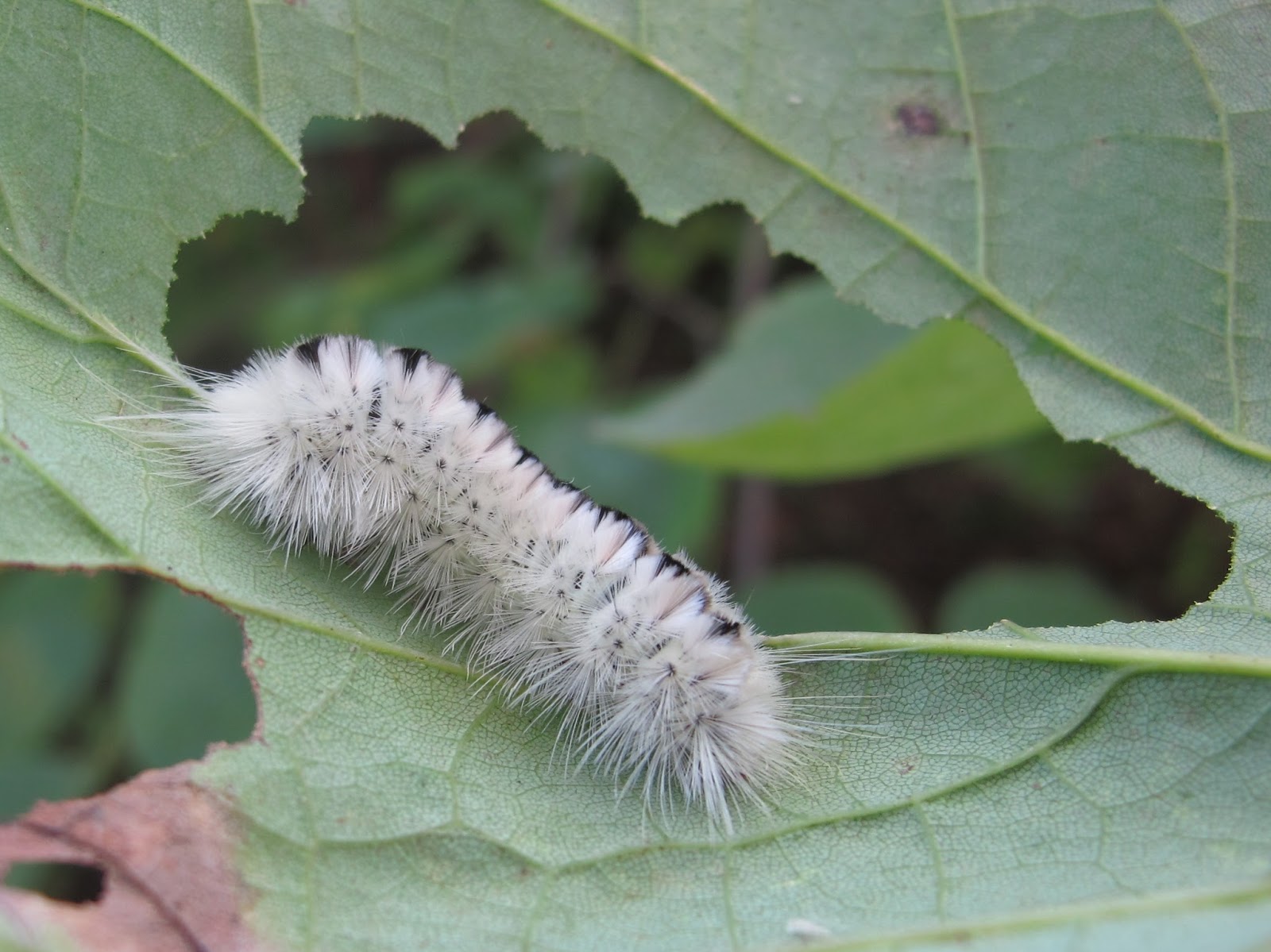
I found many of this species on the Redbud, but wasn’t
finding much evidence that they were feeding.
There was a chance that they were just migrating over from some nearby
Black Walnuts, a favorite food plant.
Then I found this guy carving a large hole in the middle of a Redbud
leaf and decided that they must also eat Redbud.

There are also several caterpillars that I can’t put a name
to. This little guy had three parasitoid
larvae riding its back. I found this
curious because the caterpillar was trudging along as though nothing was wrong. Typically, the parasitoid larvae would feed
and grow inside the caterpillar and then emerge to spin cocoons and pupate on
the caterpillar’s skin. As large as
these larvae are, it seems there would have been little left if they had been
feeding inside that small caterpillar.
The caterpillar should have at least moved sluggishly or remained stationary
as I’ve seen so many other caterpillars do in similar situations.

Finally, this European Hornet, which is not a caterpillar of
any kind, searched leaf after leaf and appeared to be following me as I examined
the Redbud. I thought it might be hunting
caterpillars, or some other creature on the tree, but it never seemed to find
anything. I’ll just add its behavior to
my enormous list of things I would one day like to understand.