Showing posts with label Leavenworthia uniflora. Show all posts

Saturday, April 28, 2018

The Barrens Garden

Eighteen years ago, as the first act of creating a water garden, I dug a large hole near my front porch. Approximately 55 cubic yards of material was removed from the hole and placed in a pile here, near the east side of my barn.  First came slabs of sod a couple of inches thick that were placed in the upper left-hand corner the above photo. Next came the removal of a half foot of clay subsoil that found a permanent residence in the upper center of the photo. Following that, I chiseled through 2 feet of fractured limestone bedrock and added that to my spoil pile. Over the years the material has settled down to become a solid fixture in the landscape.

After several years, the gravel area began to closely resemble the gravelly barrens found tucked away in some of the steeper hillside prairies of Blue Jay Barrens. I then began considering the idea of introducing into this gravel pile seed from some of the rarer winter annuals found growing in the gravelly barrens. My last year’s crop of captive Leavenworthia uniflora and Draba cuneifolia produced such an abundance of seed that I had plenty to invest in this new project that I am calling the Barrens Garden.

In July 2017, I scattered seed over the entire spoil pile.  The results did not disappoint. Shown above are some of the hundreds of rare Draba cuneifolia that resulted from that seeding.

Drabas and Leavenworthia are both members of the mustard family and their flowers show the standard four petal arrangement. These plants are annuals and will not survive past Midsummer. All of the plant’s energy goes into the production of flowers and seeds. Seeds that fall to the ground in June will begin to germinate in October or November. Rosettes of basal leaves will form and grow through the winter. Flower stalks and blooms typically arrive in April.

Leavenworthia uniflora usually follows the same growth pattern of the Draba, although a greater proportion of the seeds tend to wait until February to germinate.

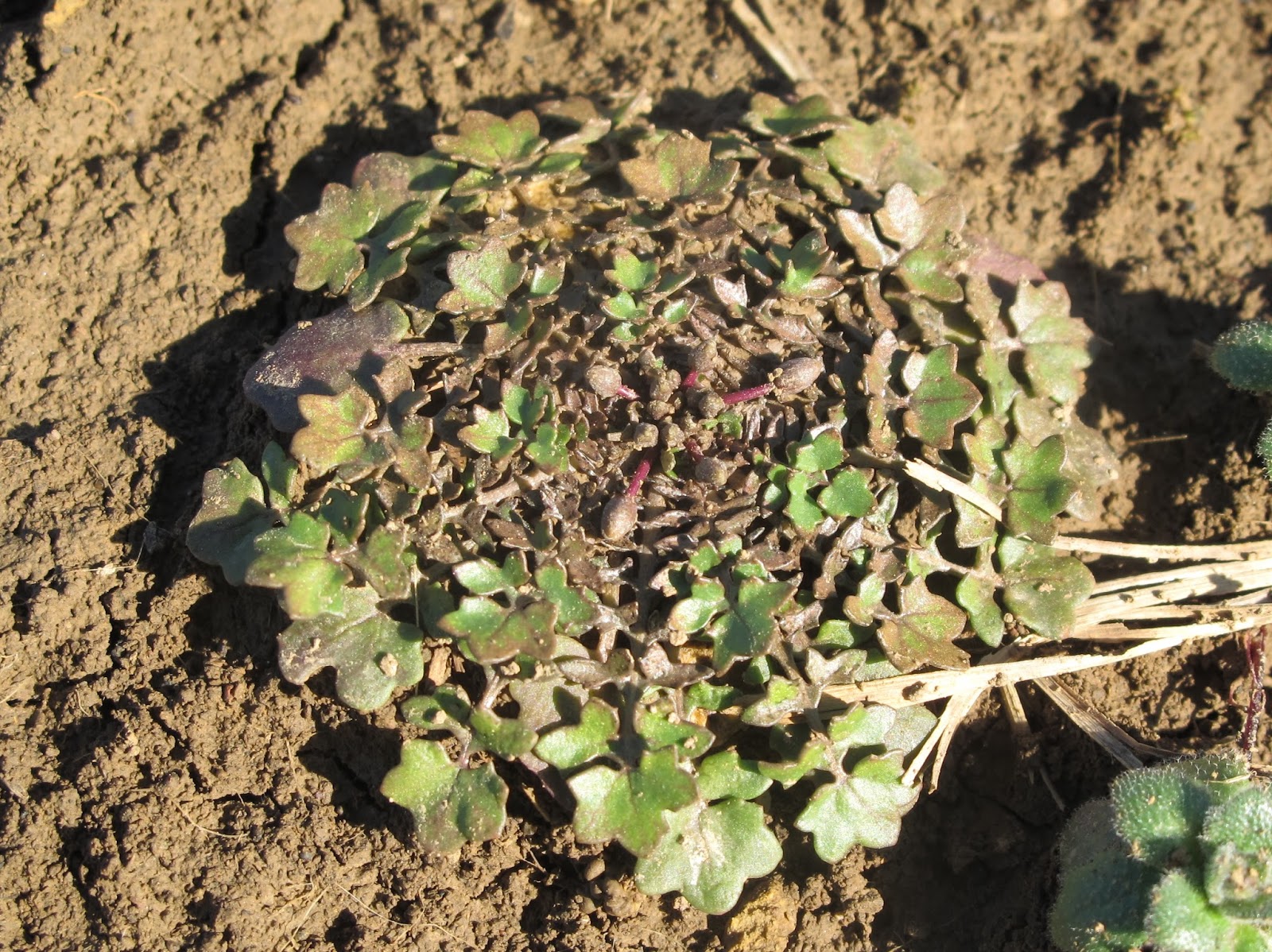
In other wildflower gardens I’ve created, my primary problem is the habit of plants developing much more robustly than they do in their natural setting. It appears that I’ve managed to provide conditions in this Barrens Garden that closely mimic the natural conditions. Above are three Leavenworthia uniflora bracketing a standard dime. The basal rosettes are hardly much larger than that ten cent piece.


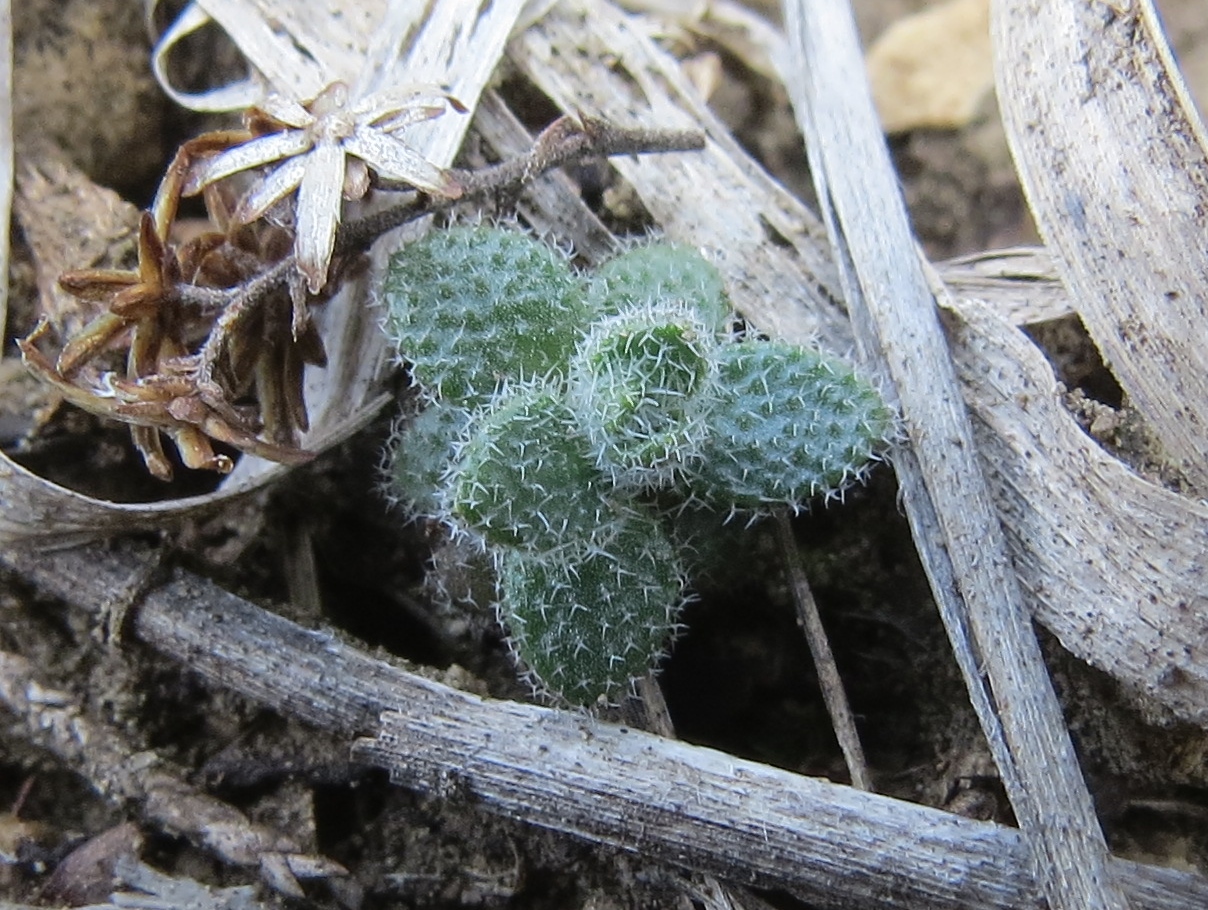
Here’s that same dime beside two Leavenworthia uniflora growing in the natural barrens. The size of the plants is almost identical to that found in my Barrens Garden. I have high hopes that this project is going to prove to be a long term success.

Monday, March 6, 2017

Blooming Leavenworthia uniflora

Leavenworthia uniflora is also setting a new early bloom record this year.  First bloom appeared on March 3, about ten days earlier than the previous record.

Leavenworthia has a basal cluster of leaves that develop horizontally outward from a central point. The collection of leaves generally does a pretty good job of shading out competitive vegetation, at least near the center of the whorl.

The plants all have a fine collection of developing flower buds. Each flower will be held aloft individually atop a thin, branchless stalk.

This individual grew to resemble a tightly woven beverage coaster. Despite its slightly unusual growth pattern, there are still plenty of buds developing.

None of the other Leavenworthia plants have yet reached this stage of development. I expect it will be a couple of weeks before the next plant in line begins to display blooms. By the end of March though, I expect all the plants will be flowering profusely.

Monday, April 11, 2016

Temperature Records

Blue Jay Barrens has been the site of many scientific inquiries over the years.  Researchers have visited to collect data on such things as magnetic anomalies, bedrock patterns, amphibian distribution and ant behavior.  The latest endeavor, a two year collection of air and soil temperatures, has just been completed.

Personnel from the Missouri Botanical Garden placed these temperature sensors in some of the barrens of Blue Jay Barrens to capture data on the microclimatic conditions of these unique ecosystems. Air temperature data was collected by sensors located near the top of a 5 foot aluminum rod. The sensors were shaded by two white plastic discs. The largest disc set at the highest point of the apparatus, while a smaller disk set a couple inches below that. Both discs functioned to provide shade for the sensors. The gap between the two discs was to allow air circulation so that neither blazing sun nor cap of snow would influence the air temperature sensors.  Soil temperature sensors were placed near the base of the aluminum rod, at a depth of approximately ¾ of an inch.

I knew that the unprotected soil of the barrens had always appeared to be baking in the summer sunshine.  The soil temperature readings provided data to which I had not previously had available. During a two-year period there were 105 days where the soil temperature exceeded 100° F. The highest soil temperature recorded was just above 120° F.

Blue Jay Barrens was chosen as a site for this temperature study because of this plant, Leavenworthia uniflora.  This area is close to the northeastern most limits of this species range. The species itself is being studied with the expectation that it may be an indicator of how rare plant species react to changing climate conditions. The Leavenworthia cooperated by producing outstanding crops in the vicinity of the temperature sensors.  Leavenworthia seeds need to go through a period of heat before breaking dormancy.  It appears that any seed spending the summer on the barrens is going to get all the heat it needs.

The air temperature sensors were contained within orange balloons held in place by rubber clips. Even though they were protected from direct sunlight the balloons deteriorated dramatically over the course of a single year.

As I was gathering up the equipment in preparation for shipping the sensors back to the Missouri Botanical Garden, I noticed a small jumping spider perched beneath the plastic disc.

At first glance it appeared to be a typical, healthy spider. Although, I couldn’t remember a species that exhibited a yellow abdomen.

A closer examination showed that the yellow was not a part of the spider at all. That, and the fact that the spider was not moving at all, cause me to reevaluate my assessment of its health.

The spider has been long dead. It probably died sometime last fall. The fuzzy yellow substance covering the abdomen is a fungus. It looks quite similar to the zombie fungi that attacks various insect species. This is the first time I’ve seen a spider that seemed to be afflicted by the same ailment.

Wednesday, April 6, 2016

Draba & Leavenworthia Blooms

Here we are again with two of my favorite plants, Leavenworthia uniflora and Draba cuneifolia. These particular plants are some that are growing in one of the beds of my vegetable garden. I get to see them every day, and every day I am more impressed with the size and vigor of these pampered specimens. What a difference good soil and lack of competition make in the development of these species.

These two Leavenworthia uniflora plants have grown together to form one. Leaf and flower production has been compromised where the two plants collide, but even when considering that impediment it’s fair to say that each plant has produced a remarkable number of flowers. At some points there are so many flower stalks that they almost obstruct the view of the leaves below.

Each one of those flowers will produce a pod containing 10 to 12 seeds. These two plants alone will produce hundreds of seeds.

The Draba cuneifolia hardly bears any resemblance at all to the much smaller plants found growing in their typical habitat on the barrens. Flower stalks come out of the main plant from all directions.

The typical wild plants generally have a single flower stalk that rises vertically from the cluster of basal leaves. These garden specimens produce a few vertical stalks, but far more of the flower stalks grow horizontally from the bulk of the plant.

Each stalk has no shortage of blooms.

Hidden by the wreath of open flowers are clusters of new buds, some ready to open and others just beginning to form.

Each flower leaves behind a small flat pod.  Each of these pods could easily hold over 100 seeds. The flowers remain clustered at the top stock, but once a seed pod begins to develop, the stock elongates so that there is a gap between each pod.

Most of the Draba cuneifolia plants already have a dozen or more active flower stalks, but that is only the beginning for this season. Dozens more stalks are already beginning to push their way upwards. My harvest of seed from these plants should be phenomenal. That seed will go a long way in helping to expand the populations now growing on the barrens. I’m just hoping that the 20°F temperatures and possible snow forecast for this weekend doesn’t have an adverse effect on the yield.


I would offer an apology to that individual who is tired of seeing me blog about the Leavenworthia uniflora and Draba cuneifolia, but I am certain that he would never have read down to this point.

Monday, March 21, 2016

Some Rarities and Weedities

Blue Jay Barrens has never had an abundance of early spring wildflowers, and as the deer population increases, those that were here years ago have decreased in number. As a result, my perception of the early spring blooming season is that of a sprinkling of small white blooms. All come from tiny members of the mustard family. Some are quite rare, while others are prolific weeds. The first to show itself is generally Michaux’s Leavenworthia, Leavenworthia uniflora, a species that is listed as threatened in Ohio. I’ve been told that I feature this species, along with a couple of other similar subjects, far too often in this blog. Fortunately, the person providing that information is quite mistaken, so I will continue to discuss these plants at whatever times I deem appropriate.

The Leavenworthia is an annual plant and races along in its attempt to provide seeds for future generations. The blooms, held only a couple of inches above the soil surface, are hard enough to see. Add to that the rapidity with which the bloom withers around a quickly growing seed pod, and a person is lucky to catch a glimpse of these flowers at all.

The smallest of the early bloomers barely reaches an inch in height from the ground up to the top of the flower stalk. This is Carolina Whitlow-grass, Draba reptans, another state threatened species. Carolina Whitlow-grass is not a species that you will casually observe while out walking on an early spring day. You have to get down close to the ground and actively seek out these plants.  One identifying characteristic of this plant is the relatively smooth stalk supporting the cluster of flowers.

Prior to flowering, it’s best to have some type of magnification when trying to view the plant. At this stage, the plant always reminds me of a tiny cactus, but there’s no fear of being stuck by spines here.

Wedge-leaved Whitlow-grass, Draba cuneifolia, is the third early spring rarity that I regularly see. The leaves of this species have shallow pointed lobes along the margins, but this leaf feature may not be noticeable in very small plants.  The surest way to separate Wedge-leaved Whitlow-grass from the preceding the species is by comparing the flower stalks. The flower stock here is densely hairy.

Wedge-leaved Whitlow-grass has the typical four petaled flower of the mustard family. Each petal has a shallow indentation at the tip.

Several non-native species add their bits of whiteness to the spring blooming season. These are weedy species that are commonly found in most lawns and gardens. Whitlow Grass, Draba verna, although related to our native rarities, is an extremely common non-native weedy plant. One reason that these plants are so successful in human disturbed habitats is the fact that they flower and distribute their seed before most people become active with their gardening and weeding activities. The seed from these plants sits quietly in the soil through the summer and fall months, and is ready to spring forth the following winter.

The four petals of the Whitlow Grass are so deeply split down the center that they are often mistaken as having eight petals. This feature quickly distinguishes these alien plants from our native species.

Becoming ever more common in the urban landscape is the Hairy Bittercress, Cardamine hirsuta.  Blooms of this plant quickly disappear in favor of elongated pods that rapidly fill with ripe seed.  Once the seed is mature, the pods will violently open at the slightest touch and scatter seeds in a wide area around the plant.  The seeds are easily carried away on people’s shoes and gardening tools, to colonize fresh areas.

Field Pennycress, Thlaspi arvense, is a non-native quick to invade into bare or disturbed ground. In most situations it forms thick patches of plants.

The Field Pennycress seedpods seem to develop as quickly as the flowers can form. In just a few days a tall spike of developing seedpods replaces the initial flower cluster. These non-native species are interesting, but my goal is to manage for native populations and that generally means that the non-natives are considered weeds and must go.

Wednesday, March 9, 2016

Leavenworthia Compared to Hairy Bittercress

I’ve recently received emails from two different people, describing their exciting discoveries of populations of the state threatened Leavenworthia uniflora in their lawns and flowerbeds. It’s always exciting to find a population of rare plants, especially when they’re growing as thick as weeds, which is how one correspondent described his find. They had both read some of my earlier posts on the species and wanted me to share in their joy of their newfound flora neighbors.

Unfortunately, the photo documentation they sent along with their emails showed the plants to be something other than Leavenworthia.  Their plants did bear a superficial resemblance to the Leavenworthia, but they were actually a non-native weedy species known as Hairy Bittercress, Cardamine hirsuta. No wonder they were thick as weeds.  I thought it appropriate to make a comparison between the two plants using easy to see features. I certainly don’t want people to be protecting weeds because of a mistaken identification, nor would I want a rare plant to be destroyed because of the same mistake.

Leavenworthia will grow in most locations that provide competition free conditions. In natural situations these are generally dry, rocky, shallow soils. These are annual plants that begin growth in early winter and by early spring, begin to flower. Leavenworthia produces leaves from a basal whorl. The leaves fan out horizontally, almost hugging the ground and presenting an appearance of level flatness across the top of the plant.

Hairy Bittercress has a growth habit similar to that of Leavenworthia, but is more typically found in areas of urban disturbance such as is found in people’s yards. It also begins growth in early winter, but it tends to flower one or two weeks earlier than Leavenworthia. The plant begins by producing several rings of basal leaves, but as it grows, the center portion of the whorl heaves upward, making the plant appear slightly mounded.

Leavenworthia flowers emerge from ground level at the center of the leaf whorl.  Flower stalks produce no leaves and bear only a single bloom at the top of the stalk.

Hairy Bittercress produces a branched stalk from the center of the whorl that produces both leaves and clusters of flowers.

Hairy Bittercress, shown on the left, produces compound leaves with leaflets that produce rounded lobes. The Leavenworthia develops sharply pointed lobes.

Here we have Leavenworthia on the left and Hairy Bittercress on the right. Hairy Bittercress most resembles Leavenworthia in its younger stages. I have yet to see both of these species actually growing together in a single location. To get this photo, I plucked a Hairy Bittercress rosette from another location and posed it beside the Leavenworthia. It’s easy enough now when making plant identifications to go online and find authoritative information about the plant in question. When doing that type of search, just make sure you go beyond the photo and read what the text has to say about the plant.

Wednesday, April 15, 2015

April Winter Annuals

My artificial barrens in a pot continues to evolve.  Originally planted in the container were Draba cuneifolia, Draba reptans, and Leavenworthia unifloraDraba reptans persists in small numbers and is hardly noticeable.  Draba cuneifolia and Leavenworthia uniflora aggressively compete for dominance of the container.  Since its creation, no two seasons in this container have been the same.

In 2013, Leavenworthia uniflora dominated the container.  Last year there was a fairly even mix of Draba cuneifolia and Leavenworthia.  This year the Draba cuneifolia is definitely in control.  Draba flower stalks form a miniature forest.

A loose cluster of flowers forms atop the stalk.  These plants are just beginning to bloom.  The flower spike will continue to enlarge and the immature buds seen in the center of the cluster will be brought into position to open.

A number of these small bees were busy visiting the Draba flowers.

Wild Draba cuneifolia plants are also doing well this year.

It’s unusual for the plants on the barrens to grow this large.  I’m certain that their growth patterns are influenced by weather conditions, but I don’t know if it was spending several weeks buried by snow or the excessive rainfall during the last six weeks or some other factor that is responsible for the impressive growth this year.

Draba reptans is also performing above expectations this year.  This plant toppled over, but that won’t stop it from producing a good crop of seeds.  Total height, or length, of this plant is not much over an inch, so it didn’t have far to topple.

Draba reptans is similar in appearance, but smaller than Draba cuneifolia.  One characteristic that separates the two is the hairiness of the flower stalk.  The stalk on reptans is practically hairless, while the cuneifolia stalk has a fuzzy hairiness along its entire length.

Drabas and Leavenworthias are blooming side-by-side in the container barrens.  Draba cuneifiolia has a shallow indentation at the end of each of the four petals.  Leavenworthia petals are all well rounded.  A couple of non-native Draba verna have also managed to invade the container.  Seen in the lower right of the photo, Draba verna petals are split almost in two, so the flower appears to have eight petals instead of four.

This year’s Leavenworthia plants are quite tiny and have only a single flower stalk.  I’m afraid they couldn’t compete with the rapid early growth of the Drabas.

Contrary to what I’ve noticed in past years, the Leavenworthia growing on the barrens are much more robust than those in the container.

Most of the barrens grown specimens are producing multiple flower stalks.  The seed produced from these should be a definite boost to future generations.

The Draba cuneifolia in the container are going to make a tremendous amount of seed.  I’ll collect as much as I can and scatter it out on the same barrens from which I originally gathered the seed for this container collection.  If my original removal of seed from the barrens resulted in a diminished population of Draba, I’m sure my replacement of seed has more than made up for the loss.

The container plants are producing so much seed that I’m now finding Draba cuneifolia growing in the cracks of the concrete apron outside my barn door.  I love it when a rare plant begins to behave like a weed.