Showing posts with label Striped Skunk. Show all posts

Wednesday, July 6, 2016

Skunk Family

I’ve had a family of Striped Skunks foraging in the yard the past few nights. They usually disappear each morning before it gets light enough to take decent photographs, but thick clouds ahead of an approaching storm front caused them to hang around the yard a little bit later than usual yesterday morning. Young skunks tend to bunch up, sometimes making it difficult to determine how many animals you are dealing with.  This looks very much like a pair of adult skunks.

In this case it’s actually one mother skunk, the one to the left with fur exhibiting a yellow stain, and three youngsters.

Mother stopped for a bit of grooming and the kids crowded in close beside her.

Within seconds they pretty much had her pinned to the ground. They appeared to just want to stay close to Mom. I didn’t see any trying to nurse. Their size suggests that they should be weaned or nearly so.

Here’s a short video of skunk mother and child interaction.

They’re at that age where they are beginning to make short explorations on their own.

An unchaperoned excursion away from Mother is short-lived.

They quickly return to the security of the adult. The proportion of black fur to white fur is highly variable on striped skunks. Many of the Blue Jay Barrens specimens exhibit extensive white coloration on the backs and tails.

Finally, the family moved on. The thump and clatter I heard shortly after they left the yard told me that they were taking refuge in an old hay baler sitting below the barn. The family will disband soon and the youngsters will head out to find their own territories, but I’m sure I’ll be seeing them from time to time.

In this video, the skunk family heads down the trail in such a close formation they appear to be a single animal.  That is until one pops out of line.

Saturday, September 1, 2012

Skunk

This Striped Skunk has been foraging in the yard every night for the last two weeks.  He usually doesn’t begin to forage until full dark, but on this evening he ventured out just after sundown.  I wandered over to see if he would submit to a few photos.

A slow approach usually gets me up close to a skunk without it showing any awareness of my presence.  This animal appears to be in prime shape.

I prefer yard skunks that show a lot of white.  It makes them easier to see in the dark.  I usually carry a flashlight while out after dark, but I can easily navigate my yard without light, so I don’t turn it on unless needed.  Once, while making a late night visit to the barn, I heard something in the grass at my side and turned on the light to discover an all black skunk hurrying along beside me like a dog at heel.  We must have both realized our mistake at the same instant, because I hurried off in one direction and he went in another.

The lawn was full of tasty morsels.  The skunk kept nuzzling into the grass and would always come up chewing.  I matched the skunk’s slow pace and followed it around the yard.

It suddenly did an about face and began foraging back in my direction.  It still acted as if I was not there.

I was trying to back slowly away, but it kept moving faster and was threatening to overtake me.  If I had just frozen in place, the skunk would most likely have gone right past me without incident, but I didn’t want to be so close that I couldn’t get clear if the shooting started.  Not wanting to spend the evening removing skunk odor, I retreated at a slightly brisker pace.

The more rapid movement got the skunk’s attention and it took off.  The slow shutter speed required to take shots in the evening gloaming allowed me to capture only a blur of the running skunk.  It never sprayed.  Skunks seldom do if they have a clear escape route.  Having a skunk claim the yard as part of its territory is a normal occurrence.  There’s usually just one and it’s a different skunk every year.

Monday, June 11, 2012

Going to the Barn for a Pair of Pliers

I am sometimes easily distracted.  While working on a project in the garage, I had to stop to get a pair of pliers from the barn.  I got just one step out of the garage before I had to stop.

You can’t walk by a beautiful Black Rat Snake without pausing for a moment of admiration.  This is one of several snakes that periodically migrate between the house and barn, keeping both mouse free.

A yard stick was just inside the garage door, so placed it beside the snake.  Laid out straight, the snake would probably measure in at about four feet.

Beside the door was a lovely Crane Fly.  These big flies are quite common at Blue Jay Barrens and are one of my favorites.

Their large size makes it easy to see some of the characteristics unique to flies.  Unlike most other flying insects, flies have only one pair of wings instead of two.  Their hind wings have modified into knobbed stick-like structures called halteres which are used to balance the fly in flight.  You can see halteres on all flies, but on none as easily as the Crane Fly.

This colorful larva was hidden on the mortar between bricks on the house.  The yellow-green color almost glowed like that of a firefly.

A few steps later, a light colored moth shot from the grass and lit beneath a leaf beside the house.  I’ve been hoping to see an adult of the rare Unexpected Tiger Moth, so I tend to chase every whitish moth that goes by.  No luck here.  This is a common moth known as The Beggar.

Above the moth, an orb weaving spider has spun its web.  I believe this is called the Orchard Orbweaver.  It had the look of a small jewel.

The feeding station is in a direct line from house to barn, so the animals must move aside as I pass.  Most are so used to my comings and goings that they don’t move very far or fast at my approach.

A female Raccoon is nursing a litter, so she’s been visiting the feeder during the day to get enough food to sustain her through this difficult time.  I suppose it won’t be long before the little guys are out and about.

I cleared the house just in time to catch the Red-shouldered hawk dropping from the electric line.

It managed to land with a branch between us, so I’m not sure what it caught.  The prey must have been something small, because it went down in one gulp.

A bit closer to the barn I was attracted to a rustling in the tall grass around some old tractor parts.  A mother skunk had her young out of their den.  The little ones never stopped moving and never left contact with their mother.  I didn’t get an accurate count, but there are three baby faces and the mother’s tail in this shot.  At my approach they all retreated into an old Groundhog hole beneath the tractor motor.

I opened the barn door to find a young Cottontail.  This must have been the perfect spring for successful nestings.  I think I’ve seen babies of just about every mammal we have here.

Up in the barn loft was a young Blue Jay that couldn’t seem to find its way out.  I opened the big door at one end of the barn, but the bird wouldn’t fly down through the rafters to that exit.  Its calls kept getting more frantic and a parent bird outside the barn kept responding.  I finally climbed the ladder and opened the loft door so the youngster could escape.

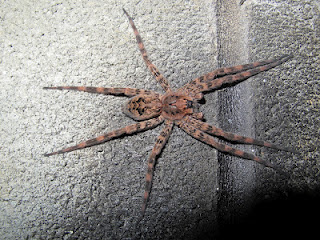
As I was coming down the ladder, I came eye-to-eye with a female Fishing Spider.  I enjoy finding big spiders and this one is about as big and beautiful as they get around here.

There aren’t many animals with a coat as beautifully colored and marked as this girl. 

Atop one barn wall was a fresh shed from a Black Rat Snake.  This is a common find when the snakes are hunting in the barn.  If a week goes by without a new shed appearing, I figure the snakes are in the house.

On the way back to the house I found this walnut shell left by a squirrel.  It must have known how much I like faces.  Sometimes you don’t have to go far to have an exciting walk.  It wasn’t until I walked back into the garage that I noticed I had forgotten to get the pliers.

Saturday, July 16, 2011

Skunk

I’ve had quite a variety of animals visiting the yard this week. Part of the reason I have a yard is to make wildlife viewing a little easier. Animals are often hard to see because they’re screened by vegetation. They are most easily observed when they enter a clearing and the chance of your being present when they come into view is greatly increased if the clearing happens to surround your house.


Since there aren’t a lot of native plants that can tolerate repeated cuttings with the mower, my lawn is primarily of alien origin. It’s composed of various grasses, a few clovers and a wide variety of broadleaved plants. There are even some Eastern Red Cedars that survive continued mowing and have taken on a bonsai like quality. It may not be native, but it’s certainly diverse and that diversity enhances its attractiveness to wildlife.
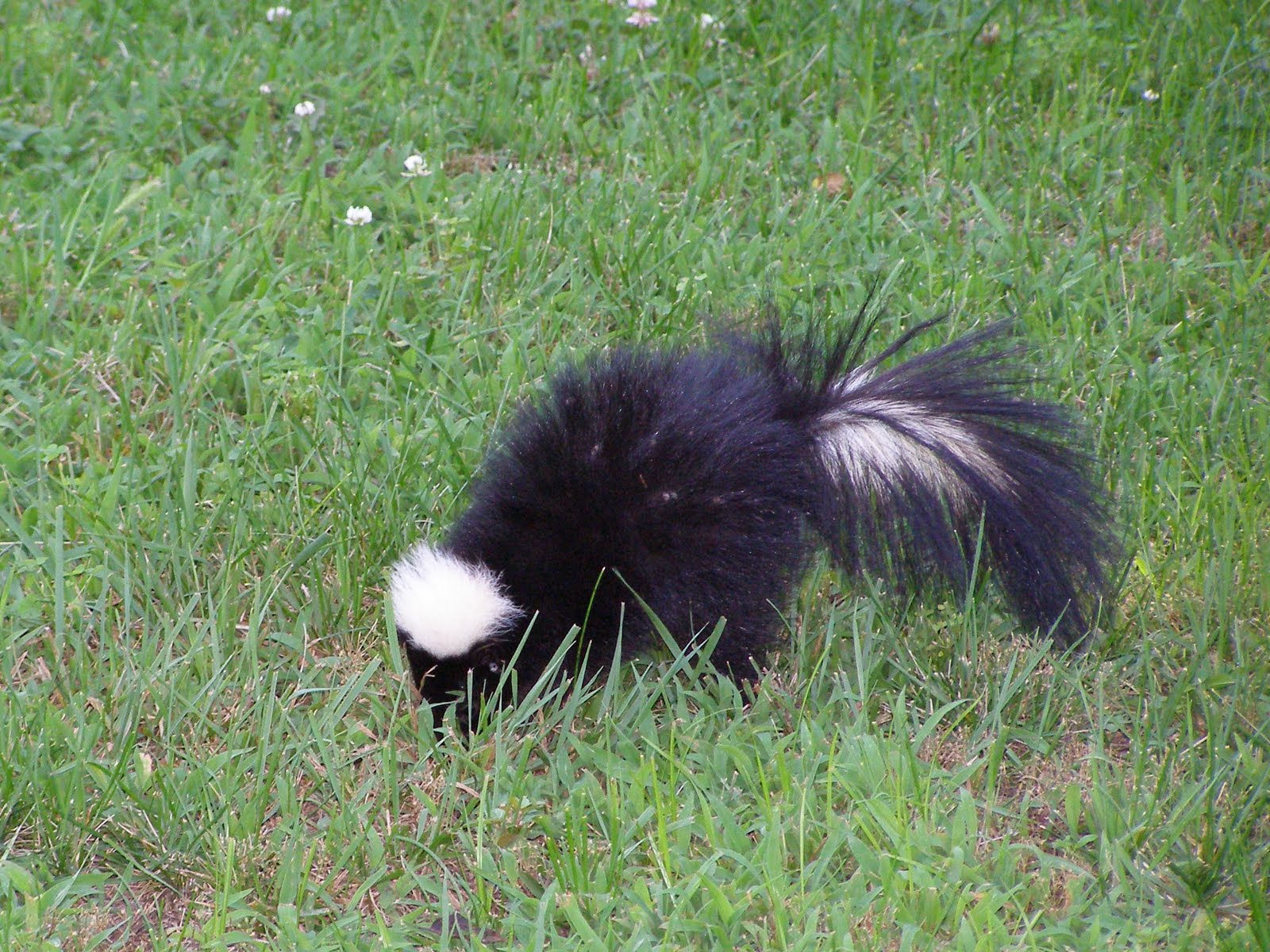

Beetle grubs abound in the lawn and attract those species that feed on grubs. One common visitor is the Striped Skunk. This youngster is so intent on digging out grubs that he hasn’t noticed that I’ve come well within his spraying range.


Patterning on Striped Skunks is extremely variable. I’ve had individuals range from almost full white to those that are pure black. I prefer the skunks to have at least some white so I can see them when I walk through the yard in the dark. This one has a very attractive white cap. If this guy doesn’t look up soon he’ll be foraging beneath my boots.


I’ve been spotted and the skunk is quickly departing. When given a choice between running and spraying, skunks will usually run. Based on my experiences, it seems that running is a reflex response and spraying is a voluntary act. Since a skunk can only hold so much spray at one time, it makes sense that it would not be used unless absolutely necessary. I just hope I don’t run into the odd skunk that has a reflex spray response.