Showing posts with label Bird Feeding. Show all posts

Wednesday, January 11, 2017

2017 Blue Jay Status

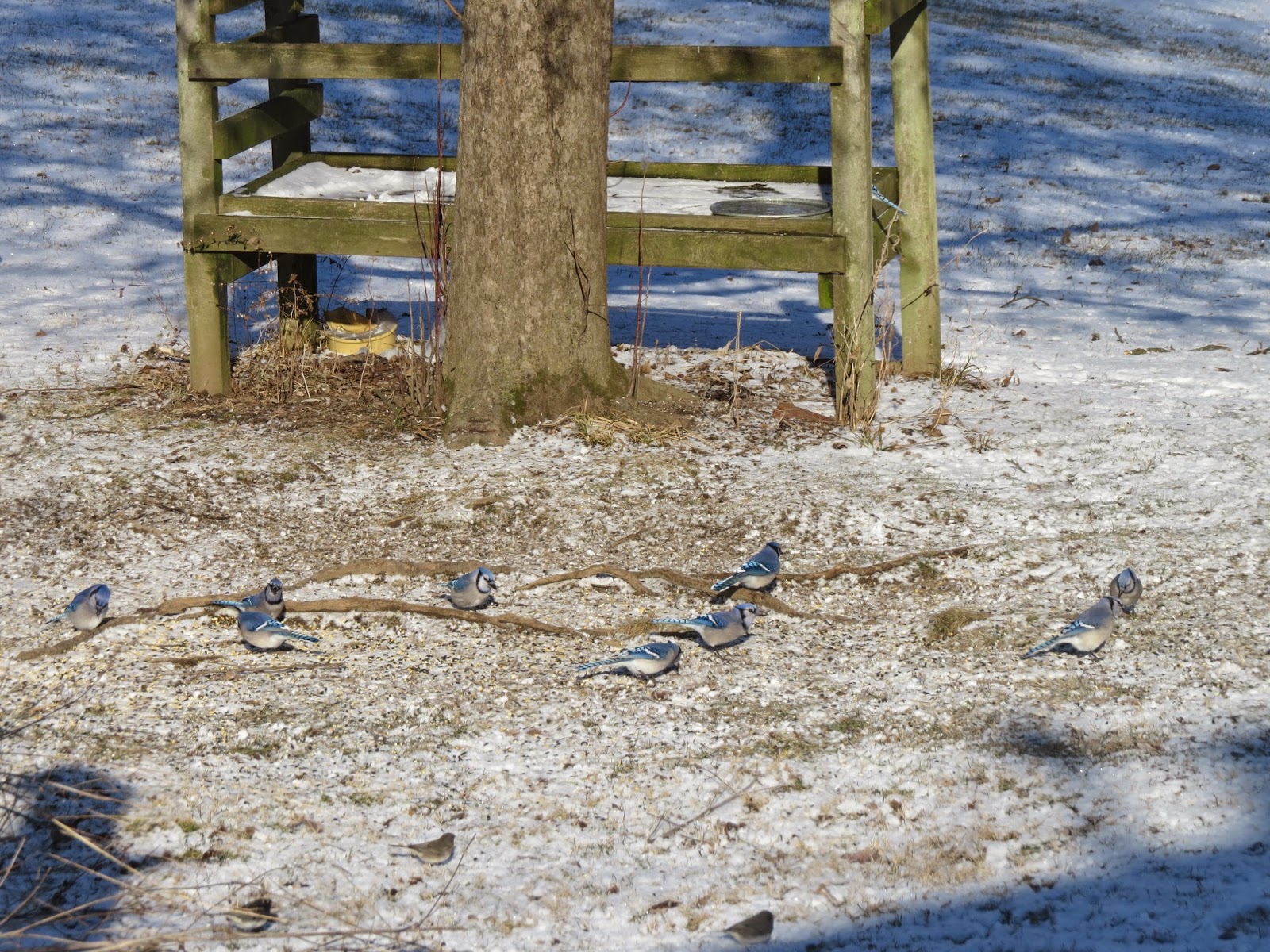
January weather typically includes a bout of cold temperatures and snow cover. These conditions bring an increase in activity at the Blue Jay Barrens birdfeeders and give me an opportunity to assess the local Blue Jay population.

Blue Jay numbers are running at about their normal level this year. Except for one or two birds that have a distinctive marking or unique behavioral trait, I can’t tell the individual birds apart, so I don’t know for certain how many are year-round residents of Blue Jay Barrens and how many have just moved in for the winter. The general behavior of the flock makes me think that the majority of individuals are here all 12 months of the year. In particular, I don’t believe that a new arrival would automatically know to sit in the apple tree and yell when the feeder goes empty.

As always, the almost constant movement between the feeding area and the nearby trees makes it nearly impossible to get an accurate count. I spotted 29 Blue Jays in the previous photo, including the one in the air. I know there were at least 47 here at one time, but at that same time I could see several more moving in the trees at the edge of the field a few hundred feet away.

The feeder on the post contains black oil sunflower seed. The area at the base of the tree in the upper right-hand corner of the photo gets a few cups of cracked corn scattered out each morning.

Second to the Blue Jays in producing consistently high numbers in the feeder area are the Cardinals. In between trips to the feeder, the Cardinals tend to hang out in the dry stalks of Giant Ragweed and Wingstem adjacent to the feeder.  The smaller feeder visitors also seem to prefer this area for feeding and loafing. The large crop of seeds produced by these plants has now been nearly consumed.

The tall plant stalks have been battered by rain, wind, and snow, but they continue to remain upright.

It’s not uncommon to count 30 or 40 Cardinals in the feeder area at one time. Most take their seed from the ground instead of directly from the feeder.

Mourning Doves typically arrive a couple hours after sunrise. There are usually 25 or 30 individuals in this flock.

Most of the doves in the area spend the winter gleaning seed from nearby harvested crop fields. A deep snow can make that source of food inaccessible, and the result is a substantial increase in Mourning Doves at the feeder.

These two Blue Jays demonstrate how so much sunflower seed gets on the ground beneath the feeder. They scrape seed up and over the edge of the feeder tray until they find just the seed they want. This also explains why my feeder sometimes so rapidly runs out of feed. I thought for a while that they were searching for the few shelled seeds that could be found in the mix, but that didn’t turn out to be the case. When they start to load up with seed, it’s just the standard seed in a shell. Maybe they just want to be sure that their friends down below have plenty to eat.

Friday, April 15, 2016

Big Yard Birds

This is the time of year when the size of the birds visiting my feeder suddenly increases.  For the past couple of weeks, this pair of Canada Geese has been making regular morning visits to my yard.  A lot of loud honking advertises their intent to make a splash down on the pond in front of the house.

They spend a few minutes eating some of the submerged greenery around the edge of the pond. 

I believe this pair is nesting near a neighbor’s pond.  Each morning and evening the geese fly a circuit around the area, noisily announcing the fact that this is their chosen territory and other geese should stay away.

After a few minutes in the water, the geese normally have a little foot race up to the feeder to gobble down some cracked corn.  However, on this particular morning, they have come to a halt at the top of the pond embankment.  For some reason, they are not running for the food.

Turkeys have beaten the geese to the feast.  A flock of turkeys generally has the feeding area all to itself.  The geese may be large, but they won’t try to move in on the turkeys.

Wild Turkeys typically spend the winter in the woods.  Once breeding season arrives, the turkeys suddenly show up back in the yard.  Hens, Jakes and Toms will travel in mixed flocks of 12 to 18 birds.  Sometimes two or three of these flocks will show up in the yard at the same time. It may be that food in the woods is becoming harder to secure or it could be that the turkeys are wanting to bulk up for their breeding efforts.  Whatever the reason, spring seems to signal the arrival of the big yard birds.  It also means I have to watch where I step when I go out to fill the feeders.

Friday, April 3, 2015

Some Unusual Birds

The intent of this post’s title is to suggest that the birds I am about to describe are not usually seen at Blue Jay Barrens.  This Wilson’s Snipe made me open my bird field guide to the section on shorebirds, a part of the book that is rarely needed to identify birds attracted to my dry, upland habitat.  I was working in the vegetable garden when this individual made a nearly vertical descent from the sky and landed among the Indian Grass stubble in the mowed field.

If the snipe was expecting wetland, it must have been thoroughly disappointed by the dryness of the field.  After turning from side to side for about a minute, it took off.  Hopefully, its next stop was more to its liking.

Most of my bird observations occur at the feeder.  In the past I’ve taken long walks around the property specifically looking for birds.  Often, moving a few hundred feet from the house takes me into a birdless void that ends only when I again get close to the yard.  Flocks of Red-winged Blackbirds have been moving in and out during the last few weeks.  This individual with the distinctive white patch at the back of the head was around for several days.

I’m used to observing the same birds for periods spanning months.  There are the usual year round residents, the summer visitors, and the winter visitors.  Occasionally, something out of the ordinary shows up.

Goldfinches and House Finches visit the feeder in large flocks.  Taking some time to sort through the flock can result in the discovery of a few surprises.

Thirty years ago, Purple Finches were regular winter visitors and visited the feeder in large flocks.  In recent years, I’ve not seen more than two or three pairs of this species in any winter season.

Back then, any reddish finch was most likely a Purple Finch.  I never expected anything else.

Then the first House Finches showed up.  Now the House Finch is the default choice when catching a glimpse of a reddish finch.

This year, another bird has joined the Goldfinch flock.  A casual glance can easily miss the similarly colored Pine Siskin foraging alongside the Goldfinches.

It’s not uncommon for Pine Siskins to flock with Goldfinches, but I don’t see them here very often.  This year I’ve counted five in a flock of about 40 Goldfinches.  It’s always interesting to have an uncommon species turn up, but I think I get more satisfaction out of observing the common species making daily progress through their yearly cycle.

Friday, February 27, 2015

Cardinals - The Evening Birds

The composition of species at the bird feeder progressively changes through the course of a day.  I think of Blue Jays as the morning birds, because they make their most concentrated visits shortly after sunrise.  At the other end of the day are the Cardinals, the last birds to leave the feeders in the evening gloaming.  With an intensified twilight appearance at the feeders, Cardinals are definitely the evening birds.

The Cardinals are as difficult to count as the Blue Jays.  There is a constant coming and going from the seed scattered beneath the Apple tree.

The tree itself is packed with resting Cardinals.  The blue of the morning Blue Jays is now replaced with the red of the evening Cardinals.

Cardinals usually fill the feeder to capacity.  A Tree Sparrow, trying hard to maintain its place at the feeder, is about to be displaced by a Cardinal.

Fallen sunflower seed in the vicinity of the feeder is quickly cleaned up by the Cardinals.  Rarely do they forage alone.

A mob typifies their more normal foraging behavior.  Many of these birds, in the company of their parents, made their first journey to the feeder this past summer.  Each year, I find a few Cardinal nests tucked away among thick cedar branches.

The glare of the setting sun sometimes makes it difficult to view the birds, but it also makes the Cardinals shine that much brighter.  I haven’t seen many unusual birds at the feeder this year, but the residents have been here in strong numbers.

Monday, February 23, 2015

Blue Jays

I think a Blue Jay may have been the first bird to visit my bird feeder when I moved to this property 30 years ago.  It was certainly the most commonly encountered species during that first summer.  I could not step out of the house or walk anywhere on the property without seeing or hearing Blue Jays.  It’s not hard to understand why I chose to name my property Blue Jay Barrens.

Since that first day, the number of Blue Jays at Blue Jay Barrens has grown.  It’s now rare to encounter a lone bird.  If a Blue Jay scolds me as I wander around the property, there are always several more ready to back him up.

The perch on the feeder is not nearly wide enough to accommodate the daily throng of Blue Jays that come in to feed.  Many of these are from this summer’s crop of youngsters.  A swarm of young birds join the flock each summer, but I have yet to find a Blue Jay nest.

Tree roots exposed by the digging actions of deer and turkey act as perches on which the Blue Jays can open their sunflower seeds.  After eating their fill, the birds usually take a few seeds off to cache for later.  I’ll find many of these caches in early summer when clumps of sunflower seedlings sprout from all sorts of unlikely places.

Counting the total number of Blue Jays visiting the feeder is just about an impossible task.  Those on the ground are constantly leaving to perch in the trees while others come in to take their place.

There are a couple of doves in the tree, but the majority of perching birds are Blue Jays.  This photo shows about a third of the tree area and the rest of the tree is just as crowded.  Add to that the Blue Jays in two other nearby trees, those spread over a considerable ground area, those perched out of view on the house gutter and those in the trees lining the field behind that house.  Now put them all in constant motion and you get an idea of how frustrating an attempt at counting can be.

I’ve added three Blue Jay videos to my YouTube channel.  Click on the links to view.

Video 1 – A short clip showing a very active concentration of feeding Blue Jays.  There is some camera shaking from my trying to untangle my sweatshirt sleeve caught in the gear that raises the camera on the tripod.  To view click HERE.

Video 2 – A two minute clip highlighting the comings and goings from a concentrated Blue Jay group.  I particularly like the Blue Jay that refuses to share the water.  To view click HERE.


Video 3 – A two minute clip showing the feeder, water and surrounding ground area.  A great coming and going of birds, with Blue Jays playing a major role.  To view click HERE.

Wednesday, January 28, 2015

Feeder Birds

Two quick moving storms over the weekend brought a total of three inches of snow to Blue Jay Barrens.  Snow typically increases the number of birds visiting the feeders, so I paid particular attention to that area in hopes of seeing some new additions to the normal mob.

In order to reduce the number of deer visiting the area, I usually wait until the sun is well up before replenishing the food and water supply.  Blue Jays begin arriving at daybreak and line up in the surrounding trees to await my appearance.  If I’m delayed for any reason, they begin to get noisy.  The Jays are first to the feed and pretty much dominate the scene for the first 15 minutes. 

Blue Jays primarily utilize a grab and go technique.  Their time on the ground lasts only seconds as they take a sunflower seed or bit of corn and depart.

Most take their find directly into the apple tree beside the feeder.  Here they shell their sunflower seed or wedge their corn into a crevice where it can be broken into smaller bits.

The apple tree has a definite wild and unkept look about it.  The branches are too interwoven and closely spaced for good fruit production, but they form a tangle that makes the birds feel safe.

Mourning Doves move in once the Blue Jays have finished. 

The whole schedule can be put on hold when the Wild Turkeys show up.  Fortunately, the turkeys normally visit the feeder in late morning, so most other birds have already had a chance at the feed.

While the larger birds feed in the open, smaller species forage in a forest of dead Giant Ragweed stalks.  Although the stalks seem brittle and fragile, they have not bowed to the pressures of wind or snow. 

The birds cleaned up the ragweed seeds long ago, but I always scatter some fresh feed among the stalks.

The House Finches seem to prefer feeding among the stalks.  They will visit the feeder mounted next to the ragweed, but they tend to shy away from feeding in the open area beneath the apple tree.

 There seems to be a constant stream of birds moving between the feeder and the ragweeds.

I was expecting an increase in bird numbers because of the snow, but the arrival of a single Evening Grosbeak was the only thing that made the snow day different from any other we’ve had during the past month.

Throughout the day, the regular birds arrived at their normal times.  I guess the snow just wasn’t enough to change any normal feeding patterns.

The woodpecker tree, despite the fact that it’s now on its side on the ground, continues to attract woodpeckers.  This Hairy Woodpecker consumes sunflower seeds from the feeder, but it also spends considerable time digging for insects in the dead wood.

The arrival of the Cooper’s Hawk signals an end to the feeding activity.  If I look out the window and see no birds, it usually means that the hawk is somewhere near.  This time he was sitting atop a branch stub projecting from the downed woodpecker tree.  This is a common perch used after an unsuccessful raid.  I’m sure he would have appreciated a large congregation of birds brought in by a heavy snow.  Maybe that’s not going to happen this year.