You can find a wide variety of interesting creatures by
searching across the hills and valleys, but sometimes it’s more productive to
stay in one place and let the animals come to you. All you need is some type of attractant, and
some of Ohio’s native flora provide the best attractants around. Flowering species that form small collections
or colonies of plants can bring in swarms of animals intent on availing
themselves of a meal of nectar. One of
the first of these to open its flowers at Blue Jay Barrens is the Indian Hemp,
Apocynum cannabinum, sometimes referred to as Hemp Dogbane. Insects swarm these plants as soon as the
first blossom opens.

Opening of the Indian Hemp flowers usually coincides with
the emergence of Great Spangled Fritillary butterflies. These butterflies will nectar on a wide
variety of flower species, but a concentration of desirable flowers in a small
area will draw in a larger proportion of the hungry butterflies.

Swallowtail species can’t resist the lure of the hemp. This Tiger Swallowtail has lost a bit of its
wing, but it is still a strong flier.

This is the summer form of the Spring Azure.
This is one of those species that has multiple broods through the year
with seasonal variations between the broods.
These small butterflies are often taken by spiders and other predators
that lurk among the flower clusters.

The Silver Spotted is my favorite among the skippers. It’s nice to find a brightly colored,
impossible to misidentify individual within a group that harbors so many
difficult to separate species.

Even though this specimen of Southern Cloudy Wing is clearly
marked, variations among individuals can make their appearance intergrade with
other related species. Identification
can be difficult, especially when your camera shots don’t show the best angles
or all of the necessary details.
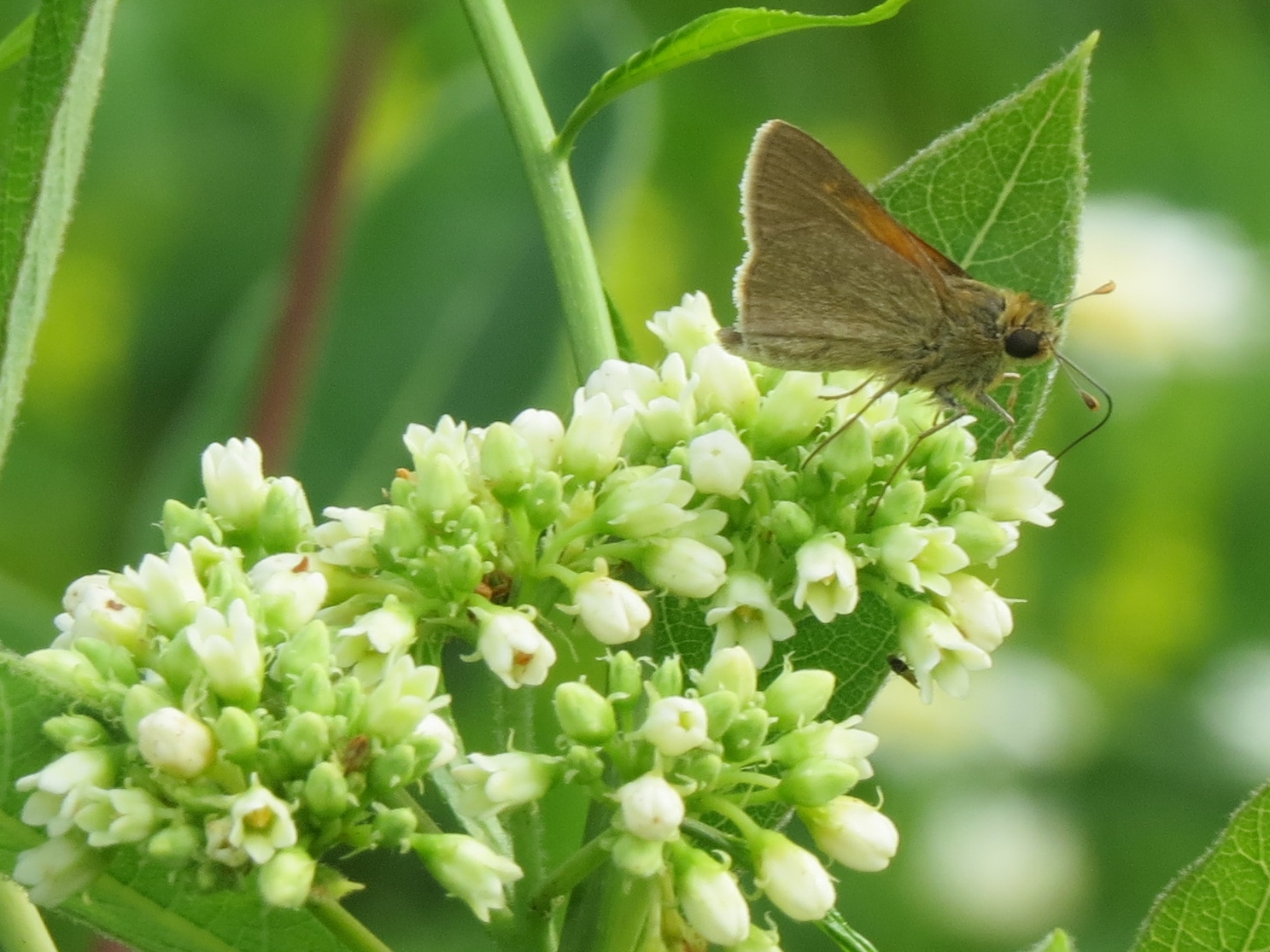
Then you have the skippers that just don’t show much in the
way of patterns or markings. Species
descriptions that include phrases such as “a little more orange than the
preceding species” or “tending to be more gray brown than light brown” don’t
often leave me with a feeling of satisfaction at my final identification. I called this a Tawny Edged Skipper, but I
have four more shots of the same individual and the differences of each shot
could lead one to believe that more than one butterfly was involved.

Peck’s Skipper demonstrates that a few skipper species have
the decency to be clearly marked.
Regardless of your identification skills, Indian Hemp brings in plenty
of these little speed demons of the butterfly world for close for viewing.

Butterflies may be most noticeable at the Indian Hemp
flowers, but bees are by far more numerous among the blooms. The large Bumblebees are certainly the most
conspicuous bee visitors.

Most numerous of the bee species are the small solitary bees
and wasps. These little guys may be the
most effective pollen movers around. I’m
partial to the green ones.

I seldom encounter the non-native Honey Bee at Blue Jay
Barrens. Most years will produce a
random Honeybee or two, but there are occasional years when I see none at
all. I think it’s a shame that this
species is what so many people think of when hearing the words bee or
pollinator. I am personally more concerned about the plight of our native bee
species.

Some species are attracted to the Indian Hemp plant
itself. This is the Dogbane Beetle, a
brightly colored species that depends on this plant for its survival.

The life cycle of this species is tied to the Indian Hemp. As an adult it feeds on the leaves and other
plant parts. Eggs are laid on plant
stems and the hatching larvae move into the ground to feed on the plant
roots. Larvae pupate in the soil and
adults emerge to feed on the developing plant.

Soldier Beetles show up as soon as the Indian Hemp flowers
begin to open. They will remain until
the last of the flowers is gone.

They seem to spend most of their time either eating or
reproducing. Sometimes both at once.

This Soldier Beetle has fallen to an attack of one of the
zombie fungi, Entomophtyora lampyridarum, that infects the body and causes the
beetle to anchor itself to a leaf or stem near the high point of the
plant. Once anchored, the beetle spreads
its wings and dies. Soon the fungus
consumes the body and sends out fruiting bodies that scatter spores to the
wind, some of which will infect other beetles.

Another species of Soldier Beetle, doing what Soldier
Beetles do.

Wherever animals congregate to eat or drink, there are
predators awaiting their chance to grab a quick meal. Adult Ambush Bugs fly in to the Indian Hemp
flower clusters and hide themselves among the blooms. When a nectaring insect comes near enough,
the Ambush Bug impales it with the hooked claws at the ends of its forearms and
drags the captor in for consumption.

Many interesting flies visit the Hemp Dogbane flowers. This is a Feather-legged Fly, Trichopoda
pennipes. It feeds on nectar as an adult,
but the larva spends its life as a parasite of Squash and Stink Bugs.

In flight, the Feather-legged Fly displays the features that
contributed to the decision on its common name.
I like to think of stands of plants such as the Indian Hemp as small
outdoor theatres. The flowers form a
stage that host a non-stop run of entrances and exits from a never ending cast
of fascinating characters.