Showing posts with label Black Rat Snake. Show all posts

Monday, June 13, 2016

Young Black Rat Snake

Black Rat Snakes were not particularly common when we first moved to this property 30+ years ago.  After a few years, snakes took up residence in our barn, garage and attic.  From then on, encounters with adult Black Rat Snakes became common.  It’s just been in the last couple of years that I have begun to regularly see youngsters.

I found this young snake perched on a leaning stake intended to hold up the side of a brush pile.  From this position, the snake had nowhere to go.  I think it was contemplating its next move as I arrived.

Young Black Rat Snakes have an overall grayish coloration decorated with a row of brown patches running the length of the back.  A hatchling leaves the egg with a body length of about one foot.  The pattern is most pronounced in the newly hatched specimens, but is slowly masked by dark pigment that develops as the snake ages.  At maturity, around four years of age, the snake will be about five feet long and predominantly black.  This individual measured at about 26 inches long.

Almost every young Black Rat Snake that I find seems to have a distinctive bulge of a recently swallow meal.  I always picture a mouse inside the bulge, but it could just as easily be some other small mammal, bird, reptile or amphibian.

After a moment of watching me take its picture, the snake turned around and headed down into the brush pile.  Somewhere in that mass of branches is probably where the cause of the snake’s bulge came from.

I found it interesting that as I entered the garage just minutes from having my young snake encounter, I came upon an adult Black Rat Snake patrolling the storage area in search of a tasty rodent meal.  This could easily be a parent of the youngster outside.

Monday, May 11, 2015

Black Rat Snake

Yesterday, I had my first Black Rat Snake encounter of the year.  I usually find them basking in the sun at this time of year, but the high temperatures have topped 90oF every day this past week, so there has been no need for snakes to seek the sun for warmth.  I think this is a good photo for people with a fear of snakes.  Who could be afraid of an animal that is powerless to stop a fly from riding along on its nose?  Oh, maybe some people didn’t stick around long enough to notice the fly.

The snake was emerging from the unmowed area surrounding the bird feeders.  This area is directly between the barn and the house, and is often used by the snakes as they move back-and-forth between the two structures in their constant search for mice.  This individual is making its way to the house.

The bright sunlight makes it easy to see the pattern on the snake’s skin.  So far, I have yet to see a Black Rat Snake that has grown large enough to completely lose the pattern of its youth.

The snakes enter the house through the garage door which is on the side away from the barn.  I’ve watched many snakes make the trip along the house foundation on their way to the snake access left open for them at the lower corner of garage door.  I’ve noticed some mouse activity near my bird feed storage area, so I’m sure the snake will find a couple of easy meals.  Using the bricks as a measurement aid, I think this snake could just make five feet long.

I’m still learning how to use the video features of my camera, so I have once again attached a video to my post.  The stairwell leading to an old cellar beneath the house acts as a minor obstacle to the snakes.  Instead of going around, they crawl down one side and up the other.  I filmed the snake as it left the stairwell and continued its journey towards the garage.  The video can also been seen on YouTube by clicking HERE.  I usually must reduce the size of the video file in order to post to Blogger, so the YouTube version is often has much more resolution.

Friday, October 17, 2014

Young Black Rat Snake

My house, barn and garage are home to many Black Rat Snakes, but until now, I’ve never seen a first year youngster.  This fine fellow gained entrance to the house when I left the door to the garage open while I carried some items out for storage.  I came in to find him scooting across the family room carpet and quickly moved to intercept.  The house is not a snake friendly environment and I would hate to find one like him dead and dried out on some future date.

Young Black Rat Snakes are often mistaken for Eastern Milk Snakes.  The Milk Snake shows a light “Y” shaped pattern surrounded by dark coloration that is clearly visible just behind the top of the head.  The Black Rat Snake has a gray “V” that blends into the gray on top of the head.

A black stripe begins behind the eye and ends when it reaches the corner of the mouth.

The back is marked by a series of dark blotches.  The coloration of the young snake bears little resemblance to that of the adult.  The pattern changes to an almost solid black as the snake grows.

Broken vertical bars mark the sides.  The body shape reminds me of a train tunnel.  Flat belly, straight vertical sides and a rounded back characterize the Black Rat Snake.

A double row of dark blotches runs down the belly. 

Overall, this is a very handsome looking snake.  The snake was quite docile, but by the time this shot was taken, it had warmed up enough that it wouldn’t stay still for any more photos.

I let the snake down into one of my growing containers to keep it confined long enough for a full body shot.  This guy is probably not more than a month old.

Then I let the snake go in a brush pile near the house.  The pile contains large rotting logs that will provide security from predators while my scent dissipates from its body.  I’ve noticed several animal species, especially dogs, that are attracted to the scent of humans.  I wonder if handling wild animals might put them at greater risk from these predators.

The snake wasted no time moving down into the pile of logs.
I may run across this snake again, but for now, that’s the end of this tail.

Monday, August 18, 2014

Black Rat Snakes

I noticed some mouse activity around the stored bird seed in the garage, so I knew that the Black Rat Snakes had moved out of the house.  Like many predatory species, the Black Rat Snake breaks its home range into hunting parcels.  It will hunt in one parcel until the prey becomes scarce and then it will move into the next parcel.  By the time it has made the circuit through all of the parcels, the prey will have rebounded in the first parcel and hunting will again be good.  My garage and attic make up one parcel.


Black Rat Snakes become more uniformly dark as they age.  In good light though, you can still see a remnant of the handsome pattern worn by the snake as a youngster.


Snakes moving across a loose substrate cannot get the leverage they need for smooth gliding locomotion.  They must use their muscles in a different way to achieve something similar to a belly crawl.  This is their equivalent of a person crossing an icy parking lot.  I’ve heard people attribute this condition to snake arthritis, road accident, dog attack, vicious clubbing and many other imaginative afflictions, but it is really just a natural condition for the snake under certain circumstances.


I found this snake coming around the corner of my barn and noticed that it was in a perfect position for estimating its length.  This wall was built with standard concrete blocks which are 16 inches in length, including the space between blocks, when in place.  The front part of the snake stretches two and a half blocks or 40 inches.


Around the corner we find the tail end stretching about four fifths of a block or 13 inches.  Add on another inch to cover the portion that wraps around the corner and the snake totals 54 inches or four and a half feet.  An impressive specimen.


The snake proceeded along the wall and entered the barn by way of the small space beneath the large barn door.  As soon as it got inside, it began scaling the wall.  These snakes are excellent climbers and easily ascend what is practically a smooth vertical surface.


The shelf atop the barn wall is a preferred site for shedding old skin.  This is usually my first indication that the snakes have moved into the hunting parcel that includes the barn.


Here are three fresh sheds, all left within the past week.


I usually take the skins and hang them in a nearby tree.  With luck, there will still be some lengths of skin around next spring that are suitable to those birds that use this type of material in their nests.


While I was exiting the small barn door, this young snake was trying to enter.  Its juvenile pattern is clear to see.


The small snake showed signs of having recently fed.  I hope that bulge represents a small mammal and not one of the adult fence lizards.


The water tubs at the barn corners are frequently used by the snakes. 


I usually see the snakes scale the barn wall to access the water tub.  This one chose to employ the stepstool method.


Large quantities of water are often consumed at one time.  This one drank for almost a full minute.


The snakes sometimes soak in the tub and I thought this one was going to do just that.


Instead of soaking, it shot through the tub and out the other side so fast all I could catch was the tip of its tail disappearing over the back side.


It took off across the grass and entered the field beside the barn.  It’s fun to watch these snakes going about their business undisturbed. 

Monday, June 11, 2012

Going to the Barn for a Pair of Pliers

I am sometimes easily distracted.  While working on a project in the garage, I had to stop to get a pair of pliers from the barn.  I got just one step out of the garage before I had to stop.

You can’t walk by a beautiful Black Rat Snake without pausing for a moment of admiration.  This is one of several snakes that periodically migrate between the house and barn, keeping both mouse free.

A yard stick was just inside the garage door, so placed it beside the snake.  Laid out straight, the snake would probably measure in at about four feet.

Beside the door was a lovely Crane Fly.  These big flies are quite common at Blue Jay Barrens and are one of my favorites.

Their large size makes it easy to see some of the characteristics unique to flies.  Unlike most other flying insects, flies have only one pair of wings instead of two.  Their hind wings have modified into knobbed stick-like structures called halteres which are used to balance the fly in flight.  You can see halteres on all flies, but on none as easily as the Crane Fly.

This colorful larva was hidden on the mortar between bricks on the house.  The yellow-green color almost glowed like that of a firefly.

A few steps later, a light colored moth shot from the grass and lit beneath a leaf beside the house.  I’ve been hoping to see an adult of the rare Unexpected Tiger Moth, so I tend to chase every whitish moth that goes by.  No luck here.  This is a common moth known as The Beggar.

Above the moth, an orb weaving spider has spun its web.  I believe this is called the Orchard Orbweaver.  It had the look of a small jewel.

The feeding station is in a direct line from house to barn, so the animals must move aside as I pass.  Most are so used to my comings and goings that they don’t move very far or fast at my approach.

A female Raccoon is nursing a litter, so she’s been visiting the feeder during the day to get enough food to sustain her through this difficult time.  I suppose it won’t be long before the little guys are out and about.

I cleared the house just in time to catch the Red-shouldered hawk dropping from the electric line.

It managed to land with a branch between us, so I’m not sure what it caught.  The prey must have been something small, because it went down in one gulp.

A bit closer to the barn I was attracted to a rustling in the tall grass around some old tractor parts.  A mother skunk had her young out of their den.  The little ones never stopped moving and never left contact with their mother.  I didn’t get an accurate count, but there are three baby faces and the mother’s tail in this shot.  At my approach they all retreated into an old Groundhog hole beneath the tractor motor.

I opened the barn door to find a young Cottontail.  This must have been the perfect spring for successful nestings.  I think I’ve seen babies of just about every mammal we have here.

Up in the barn loft was a young Blue Jay that couldn’t seem to find its way out.  I opened the big door at one end of the barn, but the bird wouldn’t fly down through the rafters to that exit.  Its calls kept getting more frantic and a parent bird outside the barn kept responding.  I finally climbed the ladder and opened the loft door so the youngster could escape.

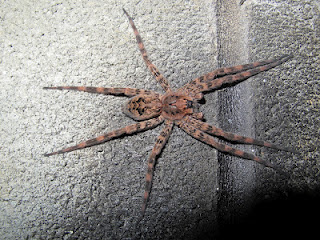
As I was coming down the ladder, I came eye-to-eye with a female Fishing Spider.  I enjoy finding big spiders and this one is about as big and beautiful as they get around here.

There aren’t many animals with a coat as beautifully colored and marked as this girl. 

Atop one barn wall was a fresh shed from a Black Rat Snake.  This is a common find when the snakes are hunting in the barn.  If a week goes by without a new shed appearing, I figure the snakes are in the house.

On the way back to the house I found this walnut shell left by a squirrel.  It must have known how much I like faces.  Sometimes you don’t have to go far to have an exciting walk.  It wasn’t until I walked back into the garage that I noticed I had forgotten to get the pliers.