Showing posts with label Cedars. Show all posts

Friday, March 13, 2015

The Almost Final Last of the Season Cedar Maintenance

This aerial map shows the roughly three acre field in which I am currently completing cedar maintenance.  Red outlines indicate the areas of the field that have so far been completed.  A small area to the right is yet to be done.  The portions labeled B-2 and C were completed back in early February.  Work was then halted when a series of storms buried the field in snow.  Snow exited the field a couple of days ago, but it wasn’t until yesterday that the soil dried out enough for me to resume work.  Section D was completed yesterday afternoon and E is what I could get done this morning before heavy rain moved in.  I would not normally be doing this type of work in March, but I just couldn’t leave the field partially completed.  If the rain ends tomorrow as predicted, it will probably be the middle of next week before the soil will be dry enough for me to finish the last bit of this field.

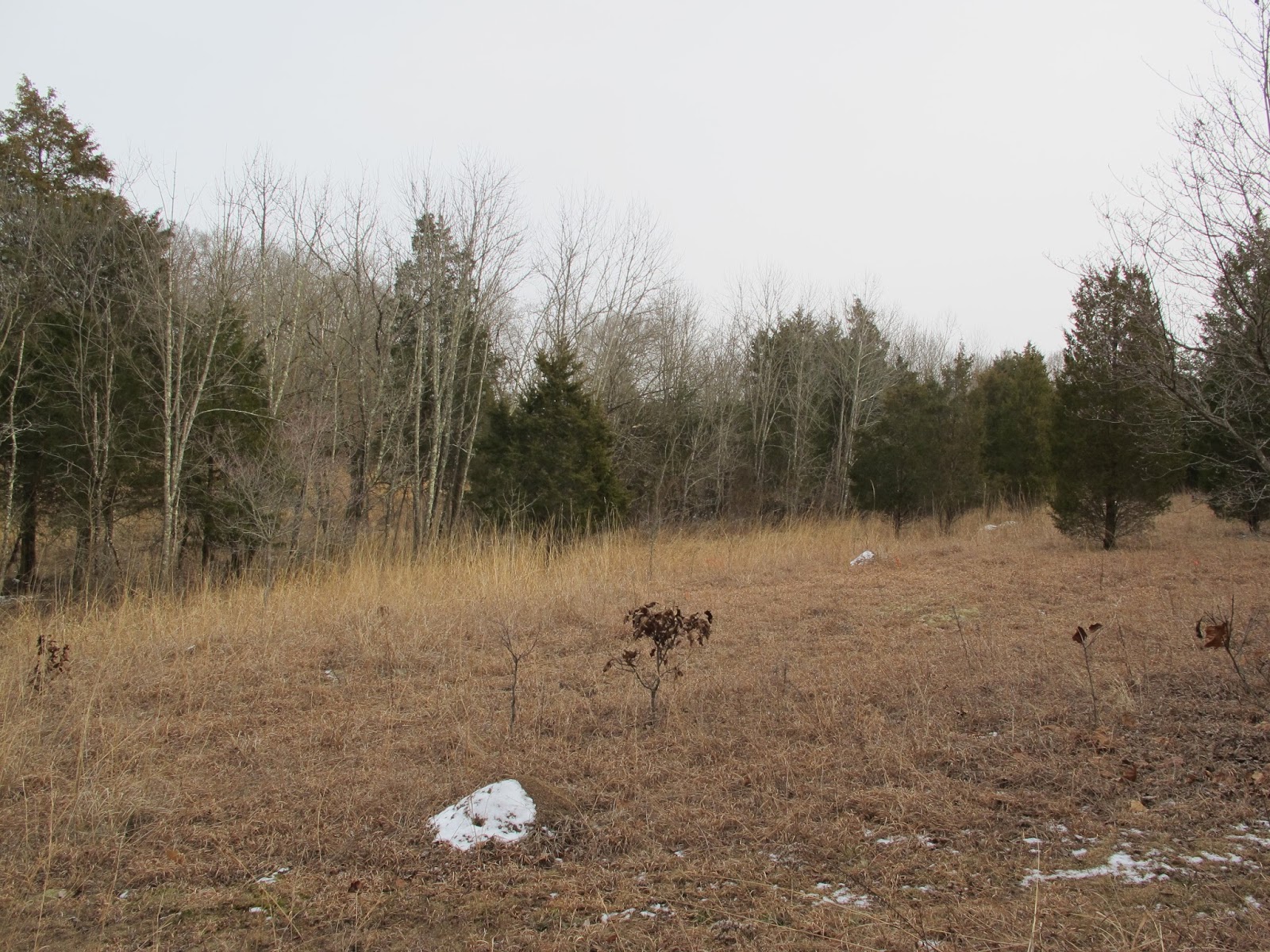
The aerial view makes it appear that this field is heavily occupied by large Eastern Red Cedars.  The view from ground level shows that the cedars are spaced widely enough apart to allow plenty of sunlight to reach the ground.  Where soil conditions allow, a thick grass cover is present.

The slope steepens rapidly at the south end of the field.  The last 15 feet are an almost vertical plunge into the creek.  The last of the snow is still holding on along the top of the creek bank.

Field blends with woods at the steep north end of the field.  One October, about 20 years ago, I mowed a path through the tall grass.  The deer, which always seem to take the easiest option while walking, immediately began following the mowed path.  They still follow the same path and are responsible for it becoming a muddy trail.  As deer numbers increased through the years, they developed paths in other directions through the field and now this is just one in an expanding network of deer highways.

This is considered to be a south facing field.  Unlike the previous field I discussed, this one is dissected by a network of surface depressions that drain water in many different directions.  While the field is still generally south facing, there is a wide variation in slope steepness and direction.  This gives the field an interesting collection of microclimates within its boundary.

Saturated soil is still releasing water into the center of the drains.  The presence of water on the surface is short lived, but a gradual movement of subsurface water along this same route may persist for a couple more months.

Small cedars thrive in these areas of increased water availability.  This eroded area was practically bare when I bought this property.  Prairie grasses are slowly stabilizing the soil.

Between each drain is a ridge.  There is a drastic difference in the amount of water available to plants on the ridges as opposed to the drains.

This section of the field suffered soil slips that resulted in a stair step arrangement of bare patches on the slope.  The slipping stopped long ago, but the poor quality of soil exposed in each step is making it difficult for vegetation to become established.

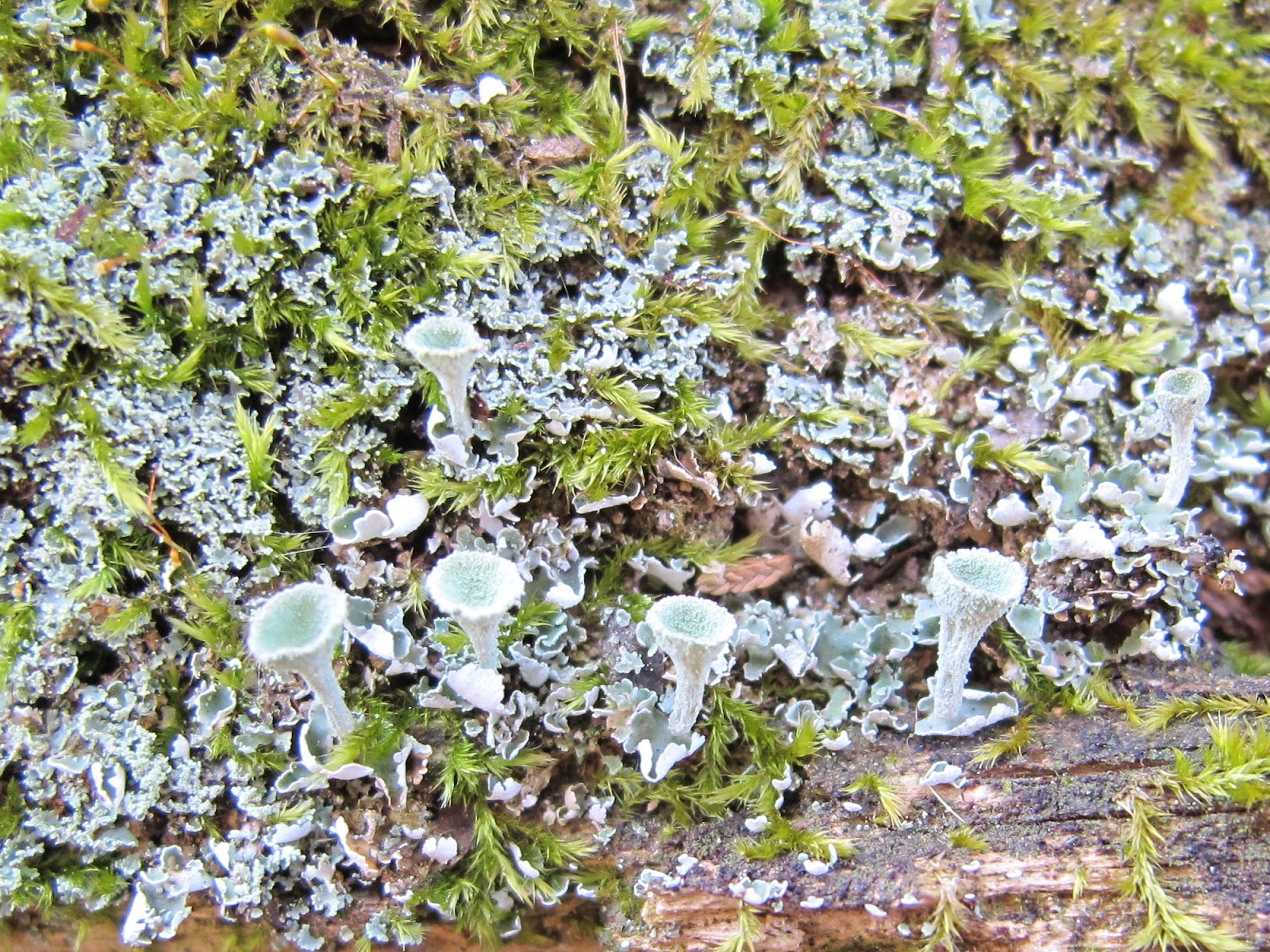
Lichens are the pioneer species in these bare areas.  In time, grasses take root in the soil stabilized by the lichens.

Lichens become established on any stable surface.  Here they have encrusted an old cedar stump left from my initial clearing of the field.

The deep snow mashed down the fine grasses, making it more difficult to find the small cedars.  Even in the best of conditions I miss a few, but there were probably many more like this that escaped my search this time.

I found several patches of the uncommon Purple Triple-awned Grass, Aristida purpurascens, scattered about the field.  This grass was represented by only a few small clumps at the time this field was originally cleared.

The grass gets its name from the three long filaments, known as awns, projecting from the end of the seed.

I found collections of Blue Jay feathers beneath three different cedars, evidently the work of a Blue Jay predator.  I couldn’t tell if the feather piles represented three different birds, of if the predator moved the bird a couple of times while dining.  This batch included a section of leg bone.  I’m guessing this was the work of a Cooper’s Hawk.  The Cooper’s Hawks around here seem partial to Blue Jays and Mourning Doves.  It’s not unusual to find piles of feathers from these two species.  Even with the hawk whittling down their numbers, the Blue Jays seem just as abundant as ever.

Monday, February 2, 2015

Cedar Maintenance - Another Field Completed

Weather conditions caused me to temporarily suspend cedar maintenance work on the Middle Field, but conditions have taken a favorable turn and my work has resumed.  Marking flags were left in place during the poor weather and except for a couple of flags that suffered at the hands, or I should say mouths, of the deer, everything was as I had left it.  I began my work at the wide end of the field, so each move forward is a little narrower than the one behind.  It didn’t take long to finish off the two acre field.

Many of the removed cedars were quite short, making my after photos look not much different than the before.  I probably see more in the after photo than most people, because I can still remember the look of each bit of ground as I zigzagged my way across the field looking for tiny cedars.

Small oaks are growing well next to the ant mounds in the field.  The oaks have gotten large enough to host a batch of Edwards’ Hairstreak larvae.  The butterfly has already established a colony in the next field over.  I’m hopeful that in the next year or two I’ll also find the butterflies in this field.

Virginia Pine seedlings are almost as numerous as cedars in this field.  Despite the fact that deer give these trees a good yearly thrashing, some have managed to survive and are threatening to grow to seed bearing size.  I decided to go ahead and cut all pines not growing in the designated Pine Grove area.

I’ve been trying to remember to take more before and after shots of my work efforts.  I think they have value in illustrating how different types of management techniques change a particular area; even if it’s just the removal of a single tree.  In this case I failed to notice that I hadn’t moved the cut tree completely out of the frame.  That’s it on the left side just beyond the small ant mound.  I had taken the before shot earlier in the afternoon, but didn’t cut the tree until evening.  After hurrying to cut the tree so I could take my after shot before it got too dark, I drug it down and left it beside the brush pile that is to the left just outside the photo.  I was so busy lining up features to make the after shot match the before that I never even thought of the tree laying there in front of me.

Several orange ribbons mark plants that either need to be cut and sprayed this coming spring or need to be protected from the mower.  Most are roses.  About half are natives and the other half are multiflora.

I found two Chinese Mantis egg cases in this field.  The female mantis lays two or three masses of eggs, usually in close proximity to each other and covers each mass with a foamy mixture that hardens into a protective case.  When an egg case is found, a quick search of the immediate area should turn up one or two more.  The Chinese Mantis is an introduced species and is a predator famous for its ability to capture and consume large quantities of insects.  I don’t appreciate exotic predators threatening the native insects, so I do what I can to reduce the size of the Chinese Mantis population.

This is the egg breaker treatment I give to each egg case.  The elongated eggs are situated inside the case in such a way that a cut with my hand pruners from top to bottom through the case destroys the entire batch.  Several years ago, I could easily find many dozens of egg cases in these fields.  This year, I have found only six egg cases over an area of 25 acres.  My efforts must be having an effect.

I took my search for small cedars right though the old fence row and to the edge of the next field.  Since the removal of the last of the non-native shrubs, the fence row is looking quite open.  I’m anxious to see what plants may appear here now that sunlight can reach the ground.

Snow load and wind put this Virginia Pine into a permanent lean.  If left in this position, it would kill the grass beneath its dense branches.  I chose to remove it.

This time I managed to get the tree out of the way for the after photo.  In its upright position, the tree did not cast a dense enough shadow to adversely influence the growth of surrounding grass.  I certainly didn’t want to lose this nice patch of prairie grass to a reclining pine.

If the weather cooperates, I’ll bring JR out in a couple of days and mow this field.  The primary targets for the mowing are some clumps of blackberries and sumacs.  Mowing will also allow me to more easily evaluate the early spring growth and identify any potential future problems.

Monday, December 22, 2014

Cedar Maintenance - First Field Completed

After 37 hours of work, spread over 12 days, I’ve completed cedar maintenance activities on the first and largest field on my winter maintenance list.  A narrow ridgetop dead ends in the center of this eight acre field.  In this area is found the largest Blue Jay Barrens population of the rare Edwards’ Hairstreak butterfly.

The land falls away in all compass directions from the serpentine ridgetop.  The population of small cedars has now been nearly eliminated.  When I last conducted cedar maintenance on this field ten years ago, I spent only three hours on the activity.  I performed a much wider search pattern and removed only those cedars that were easily seen.  That explains why so many of the larger young cedars that I just cut were clearly older than ten years.  I’m hoping that my more intensive search will allow the field to go several years before young cedars once again become noticeable.

The edges of the field are bounded by woodland or cedar thickets.  This line generally marks the transition to deeper soil.

Grass growth ends abruptly where the tree canopy closes to block the sunlight.

Larger Eastern Red Cedars are scattered throughout the field.  In most cases, sun loving grasses and wildflowers grow right up to the trunks of the trees.

Some wide spreading cedars develop a community of woody plants beneath the tree canopy.

I sometimes call these grassy fields prairies and other times refer to them as barrens.  I’ve studied many different systems of classifying grassland communities and have trouble finding a suitable identifier for Blue Jay Barrens.  Some portions of the field are treeless, but these aren’t the broad expanses of grass associated with prairies.  Several portions of this field would fit neatly enough into categories of common classification systems.  Because of a wide range of vegetation, soil depth and bedrock type; it’s the field as a whole that doesn’t seem to belong.  The term barrens seemed appropriate when I named the property years ago and I think it is still my preference.  Whatever it is, I’ve relieved it of several thousand tiny cedars and the rare plants found here will benefit by that action.

When I did my original clearing of this field 25 years ago, I left a small area untouched as an example of what the field was like prior to my management.  The fact that the cedars have made little noticeable growth since then is testimony to the poor soil and harsh growing conditions on this site.  Some of the trees originally cleared from the field were no taller than this, but showed 60+ growth rings in a trunk not much over one inch in diameter.

The cedars originally cut from the field formed six massive brush piles.  The pile at the base of this cedar once rose up into the green branches of the tree.

Many of the large cedars have been around for more than a century.  1938 aerial photography clearly shows these trees having been large even back then.  I believe them to be a valuable component of this uncommon ecosystem.

Cut banks are clear evidence of massive erosion that historically occurred on the site. 

Areas of bare ground that were present when I first took possession of the property are now covered by native vegetation.  Instead of continuing their progression back into the field, the cut banks are mellowing down to a gentle slope suitable for plant growth.

As I worked, I used orange ribbon to mark items that I wanted to come back and deal with later.  Here is a tangle of barbed wire, thrown into a gully decades ago and left to rust.

At some time in the future I’ll probably have to decide how many and what species of oak will be allowed to grow in the field.  I found it interesting that the Red Oak on the right was ringed by a thick stand of cedar seedlings, while the Blackjack Oak on the left had almost no cedar seedlings.  Blackjack Oak is favored by the Edwards’ Hairstreak Butterfly, so I would hope to maintain that species.  If a point is reached where some oaks must be eliminated, the Red Oak is certainly looking like a species that could be sacrificed.  It’ll be a while before a decision of that nature will be required.  I’ll probably still be thinking about it the next time I do cedar maintenance in this field.

Sunday, February 19, 2012

A Chunk of Cedar

Part of a tree trunk lying on the ground is a perfectly natural occurrence.  Having that piece of wood display the clean cut of a chain saw somehow makes it appear quite unnatural.  Regardless of its method of arrival, it behaves naturally enough during its process of decomposition and no wild creature is going to fault it for succumbing to the power of the saw.

This exposure does give an interesting look at the pattern of decomposition inside the section of trunk.  I wonder what it was about that particular band that made it so susceptible to decomposition.  The center section is always the most rot resistant portion of the log.  In a fresh cut specimen, this part is colored red.  The outside shell retains moisture for only short periods at a time, so decomposes more slowly than the deeper wood that holds on to its moisture.  I’ve seen this same decomposition pattern on whole logs, but it’s odd that the end portion that has been fully exposed to the elements for the past 30 years doesn’t show a different pattern from that further into the section.

A loose section is easily removed to reveal the compost that resulted from decomposition.  It looks like some mighty rich material that would provide plenty of nutrients to a plant that was able to tap the bounty.  It might be several more decades before the outside layer of wood finally reaches the point where the log crumbles to the ground.

Mosses and lichens form a thick cover over much of the wood.  The mat gives the appearance of harboring a variety of species.

It sometimes takes decades for moss and lichen colonies such as these to develop.  The resistance to decomposition displayed by Eastern Red Cedars makes it reasonable to expect large fallen cedar logs to provide a secure base for 50 to 100 or more years.  Old colonies utilize every bit of space available on the log and continually grow more complex with the passing years.  The various forms of life utilizing the section of cedar trunk are performing perfectly natural functions.  I guess it’s just my personal bias that puts a note of artificiality to the whole affair just because I can see a human inflicted cut on the surface of the wood.

Friday, January 27, 2012

Cedar Clearing

With a nice corridor linking the brush pile to the cedar clearing area, I’m ready to begin cutting cedars. 

At this point in the process, I like to go around and cut everything that can be handled by Big Loppers.  This gets a lot of the eye blocking greenery out of the way and gives you room to work with the saw around the larger cedars.

To help carry the smaller cedars, I use a willowy seven foot cedar as a bundling strap.  I put the strap on the ground and lay a bunch of cut cedars across it.  I then grab the strap on each side of the pile and lift the whole collection up to move to the brush pile.

When I pile the material, the top of the cedar strap is caught between the brush pile and the material being carried.  By taking the butt of the cedar and forcing it in and down through the pile, you can bind the material and affix it snuggly to the side of the pile.  Additional bundles can be stacked up to a height of about four feet.  Trying to go any higher is usually unsuccessful because of the difficulty of holding the bundle together as you lift it for placement.  I like to call this the Jelly Roll method of stacking cedars.  It really works best with cedars in the five foot range.  The cedars shown here are about twice that size.

After I’ve finished with Big Loppers, I use Little Bow to take out the larger trees.  I just start at the corridor and keep working outward until I reach the edge of the work area.

Stumps give a good picture of the density of the cedar stand.  Little Bow does a good job of cutting things close to the ground, so there are no tall stumps left.  It’s really a nuisance to trip over cedar stumps when you walk through the prairie.  I would also like to avoid the pain involved with kneeling down to look at a plant and getting jabbed in the shin by a cedar stump.  By next winter the stumps will have turned gray and will be hardly noticeable.  It may take 15 or 20 years before they decompose and disappear.

I managed to add some bulk to the brush pile before being halted by thawing ground.  The brush pile base is as large as it will get.  A few more hours of clearing will take the height up to its maximum limit.  Weather forecasts are predicting a slightly warmer trend with more rain, so I don’t know when I’ll be seeing frozen ground again.

Dragging cedars across frozen ground gives the vegetation a raked appearance, but there’s no soil compaction and the plants suffer very little damage.  If my activities were continued into the warm afternoon, I would create a muddy, trampled path in the thawed earth.  By the middle of next summer, there won’t be any evidence left of my dragging activities.

Even if I don’t get back to this project this year, I’ve made a clearing large enough to bring in a lot of sunlight.  The prairie vegetation should respond favorably to the new situation.