Purple Coneflower plants are showing some
luxurious growth.
Purple Coneflower plants are showing some
luxurious growth.


 I’m still visiting areas of Blue Jay Barrens in an attempt to assess current conditions and identify future management needs. At this time of year I really enjoy visiting the areas of shallow soil that restrict the growth of tall, thick stands of prairie grasses. There has been plenty of moisture this year, so the Indiangrass has done well. Even when we have good growing conditions, this species remains short and scattered throughout the site.
 This particular ridgetop prairie lies in a depressed saddle between two knobs. Rain water flows off the knobs and into the depression before draining away, giving the saddle a moisture boost not enjoyed by the rest of the ridge. Tall wildflowers don’t grow here, but conditions are perfect for the short statured Gray Goldenrod.
 Some bare areas support very little vegetation. These make ideal sites for some of the rare winter annuals such as Leavenworthia and the Drabas. Western Sunflower maintains a strong population here, but the plants are dwarfs compared to others of their species growing in good soil.
 The area is filled with tiny specimens of Wild Rose, Rosa carolina. Most are much less than a foot tall and are hardly noticeable when not in bloom.
 The bright orange fruits make it a bit easier to find the rose plants. The Wild Rose is a plant of the dry prairie and seems well suited to life among the short plants. I’ve never found it in shaded areas or in stands of tall vegetation. I hope the creature that eats that fruit deposits the seed in a suitable growing site.
 Spiranthes orchids are still abundant. Slender Ladies’ Tresses, Spiranthes lacera, is recognizable by the green patch in the throat of the flower.
 Bluehearts are still blooming. Late bloomers are not uncommon, but they have been especially abundant this year.
 Early blooming Bluehearts have already produced mature seed and are scattering it about the hillside. For an area that was once thick with small cedars, this site has produced an amazing diversity of plant and animal life. I don’t see any need for hands-on management activities here for at least two or three more years. By that time, there will be a new crop of small cedars needing removed. Until then, this will be a place to observe and enjoy.
 The Prairie Garden is beginning to look a little bit raggedy. The tall plants can’t contain themselves within the confines of the garden and are spilling out into the yard. Trying to maintain an abrupt transition from tall prairie to mowed yard is impossible. The tall plants at the interface between wilderness and civilization can’t help extending beyond their intended bounds.
 Western Sunflower has amassed an unwieldy collection of blooms. The Thursday morning storm wove the tall flower stalks into an inseparable mat. Many of the stalks are still reorienting the flowers into an upright position. They may no longer stand tall and proud, but their ability to produce seeds has not been diminished.
 Indiangrass is at full flower and has formed a screen that effectively hides many parts of the garden.
 This Butterflyweed has produced a fresh batch of flowers. At the bottom of the photo you can see seed pods produced from an earlier batch of blooms. I wonder if the rainy weather is responsible for this second blooming season.
 The Baptisia seed pods are almost ripe. In another month, the pod covering will lose much of its shine and the seeds will come lose and rattle in the pods.
 There will be no shortage of Baptisia seeds this year. A fungus typically destroys about ten percent of the seeds, but the rest will be just fine.
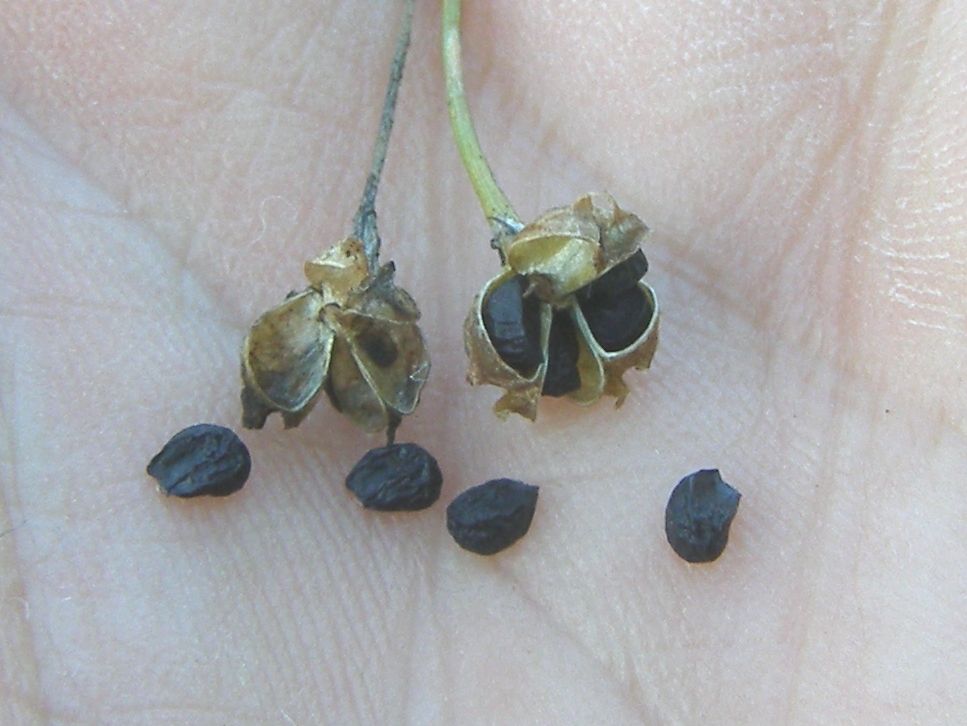 Despite floods, heat and drought, the Nodding Wild Onions have managed to produce some seed. I’ll be planting these in a special bed with hopes of having many new plants next year.
 Gray-headed Coneflower rushed rapidly through its blooming period and quickly produced seed. It’s been many years since this species has had such a short blooming season.
 For some reason, the Red Footed Robber Flies have declared the Prairie Garden a prime hunting ground. Dozens of these big predatory flies were perched around the perimeter of the garden. There was a constant drone of robber flies changing positions and darting out to capture insects flying across the lawn. After the initial disturbance from my approach to the garden, the robber flies settled down and behaved as though I wasn’t there. They put on a very interesting show.
 The dry weather seems to be delaying the transition into autumn. The fall asters have not yet begun to bloom, but most of the showy summer flowers have almost disappeared. The result is a landscape of golden brown grasses and very little bright color. Occasionally you see a fresh bloom from some summer species that has not yet called it quits. Here is a fresh Western Sunflower adding a splash of color to the field.
 Several Field Thistles are still producing new flowers. This is probably the most common nectar plant now available in the old crop fields. A Leonard’s Skipper is taking advantage of this nectar supply.
 Thistle flowers at Blue Jay Barrens also come in white, cream, pink and pale lavender. I’ve toyed with the idea of collecting seed from the various colors and creating a thistle flower bed near the house. Several things have kept me from pursuing this project. These are biennial plants, so I would have to plant seed every year in order to maintain flowers from year to year. Depending on patterns of pollen transfer and the genetics of the individual plant, I may not get any of the colors I’m actually after. I think it best that I just enjoy the plants out in the field.
 Most of the Indian Grass has finished blooming, but there are isolated patches that are just getting started. Most of the flowering specimens are found in more shaded locations on the lower slopes. These areas may have remained cooler early in the year and delayed the growth of the Indian Grass in the spring.
 Gray Goldenrod is still around and remains the most numerous blooming goldenrod. The later blooming goldenrods are going to have to hurry in order to flower and produce seed before they are knocked back by the first heavy frost.
 There are still some Orange Coneflowers blooming in the fields, but none display the attractive appearance I was seeing two months ago. This must really be a tasty flower. Every bloom I saw had some insect munching away at the leaves. The late flowers may suffer, but the plants have produced an ample supply of seed for future generations.