I’m really happy to see some fruit developing on the Dwarf Hackberry,
Celtis tenuifolia. The late frost we had in the spring was really hard on some of the trees and destroyed many of the flowers and developing fruit. The maroon coloration of the fruit is one of the characteristics that sets this species apart from the Common Hackberry,
Celtis occidentalis, which has a dark blue fruit.

I first found this specimen about 20 years ago and I believe it’s about the same size now as it was then. It grows tucked in between two good sized Eastern Red Cedars, which is probably what protected it from the frost. I trimmed the branches of the cedars slightly to give the Dwarf Hackberry plenty of light, but I tried not to change the micro-environment that seemed to suit it so well.

The canopy is never very thick. This is one of those plants that you could easily walk by without noticing. The leaf area must be adequate for the tree’s needs, because it produces fruit every year.

The leaves of Dwarf Hackberry at Blue Jay Barrens are very lightly toothed or totally without teeth. In other parts of its range the leaves are sometimes much more toothed. Stunted specimens of Common Hackberry sometimes masquerade as Dwarfs. Leaves often aren’t enough to make a definite identification, so I’m always glad to have a few fruits to verify my decision.

Dwarf Hackberrys grow on dry, rocky ground. Fortunately, those conditions abound at Blue Jay Barrens. It may be the lack of those growing condition across its range that explains the general rareness of this tree. Even though this rough ground appears to provide the tree’s preferred conditions, it’s still a tough place to grow. This misshapen trunk is evidence of the many die-backs and injuries suffered by the tree over its long life.
 The Dwarf Hackberries have recently had a couple of rough growing years. Late frosts and extreme droughts managed to almost eliminate fruit production in 2009 and 2010. 2011 provided milder temperatures and plentiful rainfall which resulted in an abundance of Dwarf Hackberry fruit. You can’t say that the branches are straining to hold up the bounty, but this is a heavy crop for the typical Dwarf Hackberry.
 Dwarf Hackberry is one of the Blue Jay Barrens rarities. I do what I can to keep the trees from being adversely impacted by things like competitive vegetation, but I haven’t yet learned to control the weather. We’re at the northern extreme of the Dwarf Hackberry’s range and weather is a primary factor influencing the survival of this southern species. I hope the birds distribute these seeds to suitable locations around the property.
 When you combine the hackberry’s naturally unusual growth pattern with damage caused by weather extremes, you get a decidedly odd looking tree. People are constantly suggesting that I remove these obviously inferior tree specimens. My assurance that the trees are just doing what they are meant to do seems to carry little weight in the discussion. Fortunately, I’m able to dismiss these suggestions as having no merit and can continue to manage things as I think best.
 Lichens seem to find the branches of the Dwarf Hackberry to be desirable places to colonize. Dead branches are always covered with lichens, but the lichens also grow on the living branches without any apparent damage to the tree.
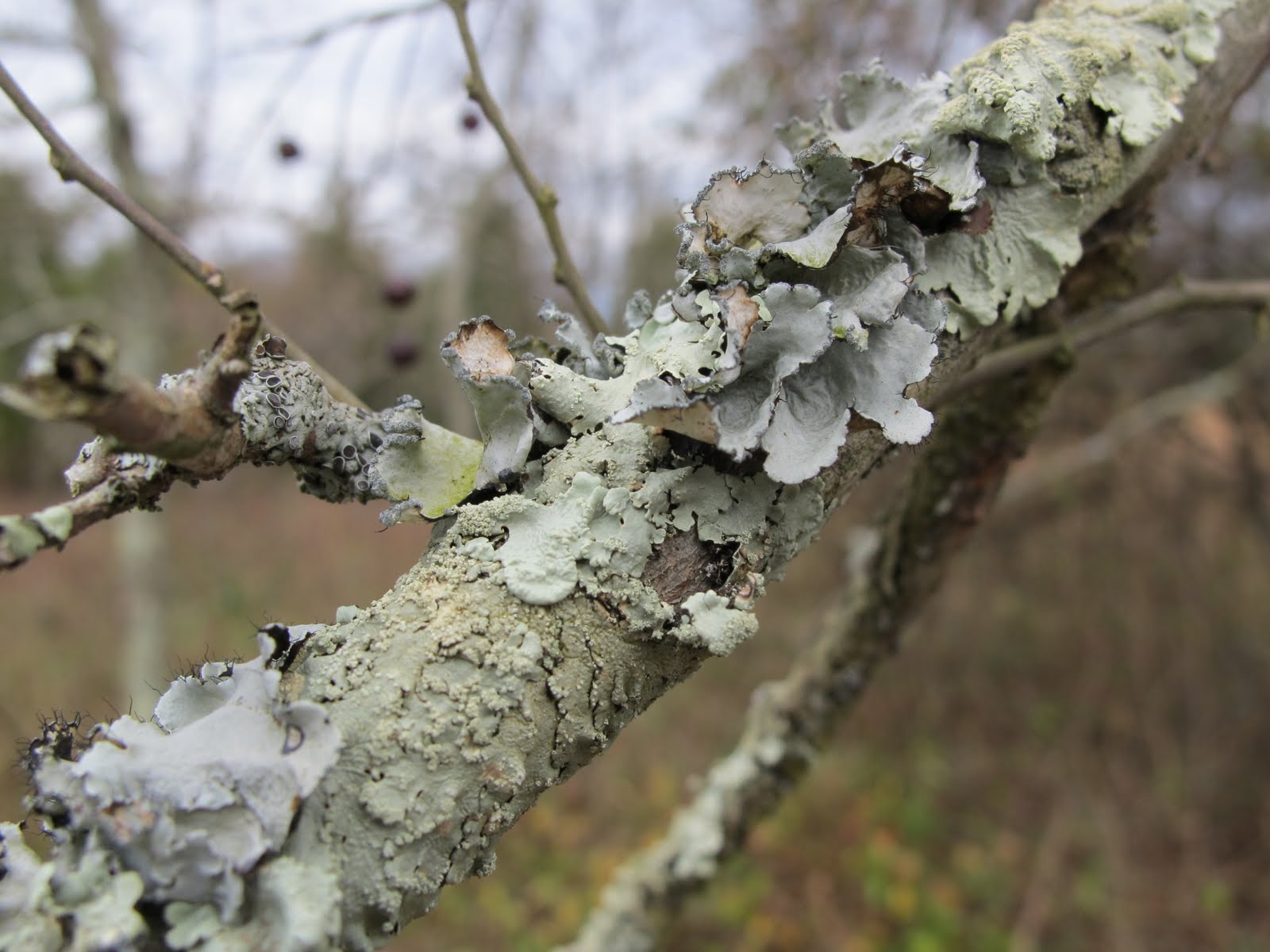 There appears to be a variety of lichen colors and shapes represented here. I’m wondering if this lichen covering is typical of Dwarf Hackberries across their range. I may look into that when I have time to squeeze lichen identification into my schedule.