Showing posts with label Silver-spotted Skipper. Show all posts

Wednesday, June 22, 2016

Common Milkweed

Common Milkweed is now in full bloom at Blue Jay Barrens.  Common Milkweed has a strong network of rhizomes that allow a single stalk to become many in a short amount of time.  Milkweeds have just about surrounded the Water Garden this year.  I had to remove some stalks from the driveway and a couple more that were threatening to block access to the front porch, but there are still plenty left for the Monarch butterflies and other animals.

Milkweeds form a mass of flowers whose stalks all originate from the same point, a form known as an umbel. The large number of flowers found in each umbel typically cause the umbel to appear in the form of a sphere.

The petals fold back to reveal a central column of reproductive parts which is surrounded by a set of five two-part structures known as the hood and horn.  This arrangement has always reminded me of the old dental spit-sink with a hooked claw emerging from the drain.

Milkweeds do not produce the dust like pollen common in many flowers. To affect pollination, an insect carries a pollen mass, known as a pollinium, from one flower to another. A knot like affair joins two pollinia by short threads.  The insect’s foot or leg catches the thread and pulls the pollinia from a slit between the hoods. The photo above shows the location of the slit with pollinia still intact. Above that is a pair of pollinia that have been removed from the flower. I guess a flower needs to attract a wide range of insect visitors when pollination requires an incidental snagging of a pollen mass followed by the proper placement of that pollen mass on a new flower.
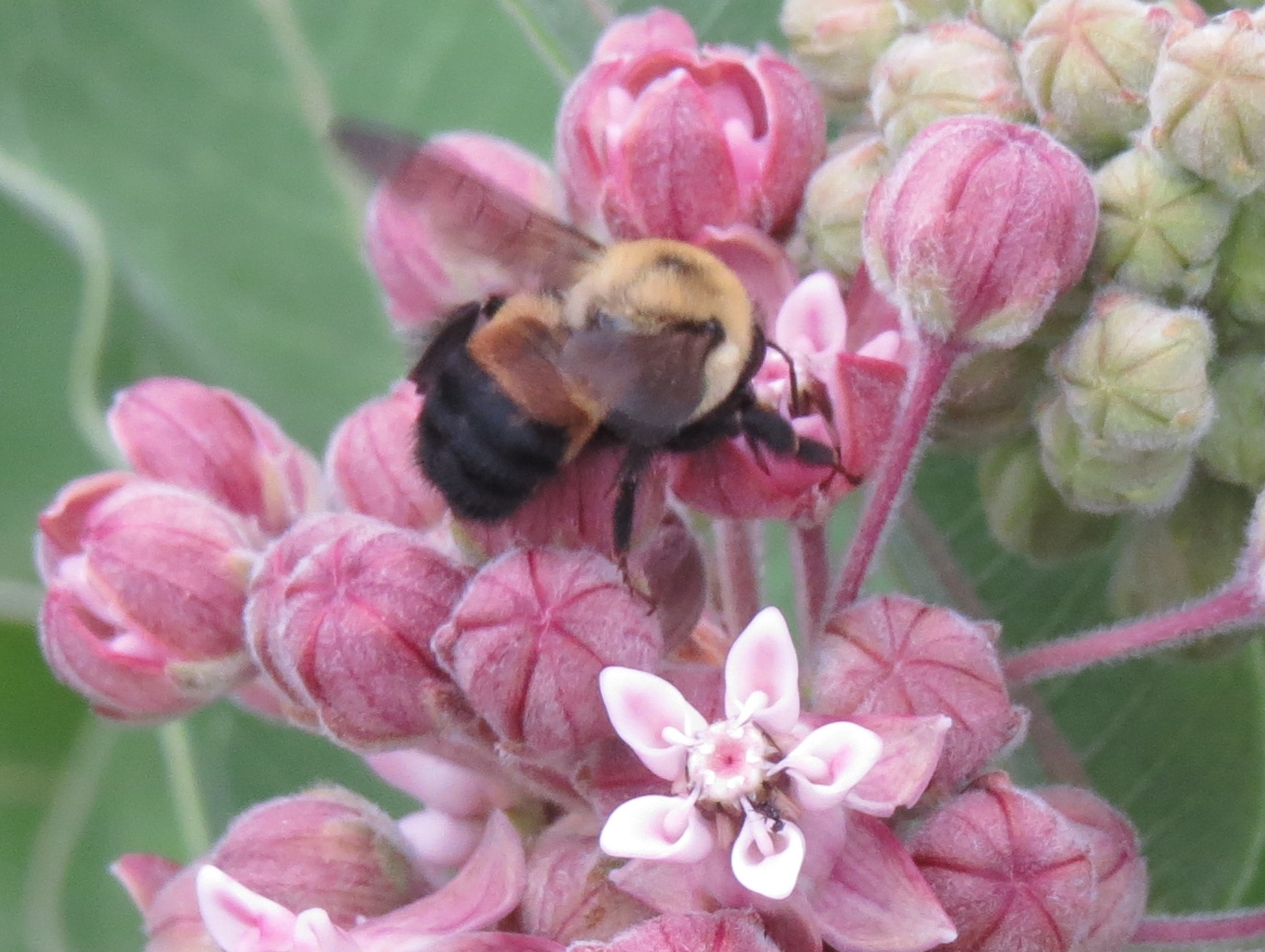
Milkweed flowers attract a wide range of bee species, from large…

… to small.

Some insects are attracted to the milkweed plant not by the flowers, but by other flower visitors. This is a Conopid fly.  Conopid larvae are parasitic on bumblebees. The Conopid adult will attack a bumblebee in the air, force apart two abdominal segments, and lay an egg in the abdomen of the bumblebee. The larva consumes the bumblebee from within over the course of a couple of weeks. The action of this parasitic consumption causes the bumblebee to dig a hole and bury itself before dying, providing the Conopid larva with shelter in which to pupate and overwinter.

Like many other insects, the Conopid Fly uses mimicry to help avoid predation. In this case the fly looks suspiciously like a wasp.  Would-be predators, fearful of a stinging response, are more likely to pass this fly by.  The easy way to tell the difference between a fly and a wasp is to count the wings. A wasp has two pairs of wings, while a fly only has a single pair. In lieu of the second pair of wings found on bees and wasps, a fly has a pair of structures known as halteres.  Halteres help to balance the fly in-flight. In the photo above, the two white objects at the rear of the thorax are the halteres.

Highly colorful Long-legged Flies flit about the leaf surfaces of many plants. The large milkweed leaves seem to particularly attract this insect.

It wouldn’t be a milkweed plant without Milkweed Bugs. Milkweed Bug pairs are often in mating tandem at this time of year. The reproductive process is not going to stop the upper bug from probing the milkweed flowers for a meal. The lower bugs is dragging around a pair of pollinia on its middle foot. The pollinia will be wasted if not deposited into an open flower.

Goldenrod Soldier Beetles are also busy with courtship rituals. These beetles are pollen eaters and will visit many species of flowers besides their namesake Goldenrods.

The milkweed flowers are brightly colored, strongly scented producers of abundant nectar. Most moth visitors appear after dark and are rarely noticed.  The Hummingbird Clearwing is one of the few brightly colored moths that visit the flowers during the daytime.

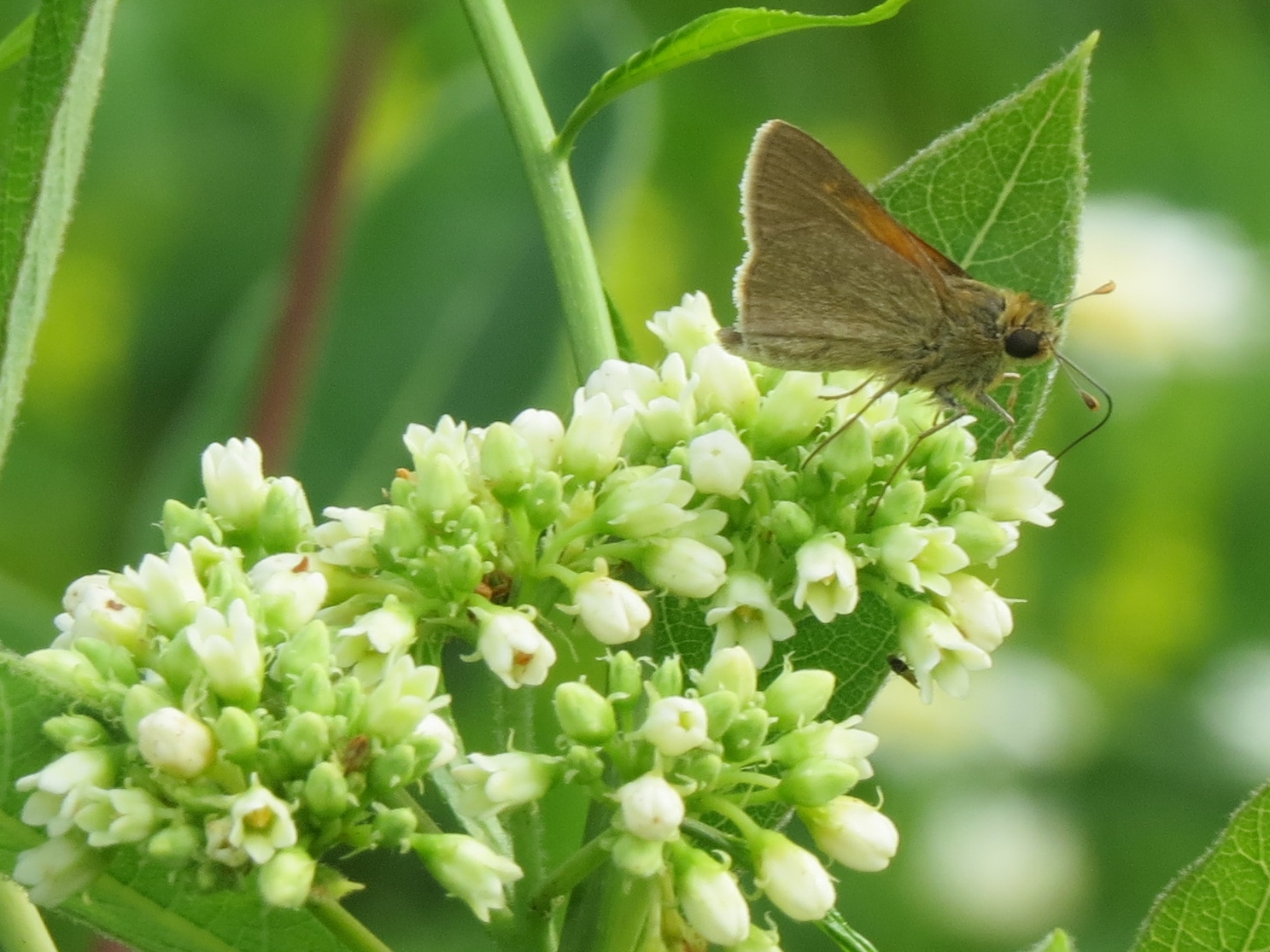
Many species of skippers are attracted to milkweed. This is the Silver-spotted Skipper, one of the largest and most easily recognized of that group.

Butterflies of all sizes visit milkweed. On the smaller end of the scale are the tiny hairstreaks, like this attractively marked Banded Hairstreak.

Great Spangled Fritillary butterflies have been mobbing some of the milkweed flowers. If your interest is in viewing butterflies, and other interesting animals, it’s worth encouraging a few Common Milkweed plants to live somewhere near your house.

Still photos don’t do justice to mobbing butterflies, so I offer the short video above.

Friday, June 12, 2015

Indian Hemp Theatre

You can find a wide variety of interesting creatures by searching across the hills and valleys, but sometimes it’s more productive to stay in one place and let the animals come to you.  All you need is some type of attractant, and some of Ohio’s native flora provide the best attractants around.  Flowering species that form small collections or colonies of plants can bring in swarms of animals intent on availing themselves of a meal of nectar.  One of the first of these to open its flowers at Blue Jay Barrens is the Indian Hemp, Apocynum cannabinum, sometimes referred to as Hemp Dogbane.  Insects swarm these plants as soon as the first blossom opens.

Opening of the Indian Hemp flowers usually coincides with the emergence of Great Spangled Fritillary butterflies.  These butterflies will nectar on a wide variety of flower species, but a concentration of desirable flowers in a small area will draw in a larger proportion of the hungry butterflies.

Swallowtail species can’t resist the lure of the hemp.  This Tiger Swallowtail has lost a bit of its wing, but it is still a strong flier.

This is the summer form of the Spring  Azure.  This is one of those species that has multiple broods through the year with seasonal variations between the broods.  These small butterflies are often taken by spiders and other predators that lurk among the flower clusters.

The Silver Spotted is my favorite among the skippers.  It’s nice to find a brightly colored, impossible to misidentify individual within a group that harbors so many difficult to separate species.

Even though this specimen of Southern Cloudy Wing is clearly marked, variations among individuals can make their appearance intergrade with other related species.  Identification can be difficult, especially when your camera shots don’t show the best angles or all of the necessary details.

Then you have the skippers that just don’t show much in the way of patterns or markings.  Species descriptions that include phrases such as “a little more orange than the preceding species” or “tending to be more gray brown than light brown” don’t often leave me with a feeling of satisfaction at my final identification.  I called this a Tawny Edged Skipper, but I have four more shots of the same individual and the differences of each shot could lead one to believe that more than one butterfly was involved. 

Peck’s Skipper demonstrates that a few skipper species have the decency to be clearly marked.  Regardless of your identification skills, Indian Hemp brings in plenty of these little speed demons of the butterfly world for close for viewing.

Butterflies may be most noticeable at the Indian Hemp flowers, but bees are by far more numerous among the blooms.  The large Bumblebees are certainly the most conspicuous bee visitors.

Most numerous of the bee species are the small solitary bees and wasps.  These little guys may be the most effective pollen movers around.  I’m partial to the green ones.

I seldom encounter the non-native Honey Bee at Blue Jay Barrens.  Most years will produce a random Honeybee or two, but there are occasional years when I see none at all.  I think it’s a shame that this species is what so many people think of when hearing the words bee or pollinator. I am personally more concerned about the plight of our native bee species.

Some species are attracted to the Indian Hemp plant itself.  This is the Dogbane Beetle, a brightly colored species that depends on this plant for its survival.

The life cycle of this species is tied to the Indian Hemp.  As an adult it feeds on the leaves and other plant parts.  Eggs are laid on plant stems and the hatching larvae move into the ground to feed on the plant roots.  Larvae pupate in the soil and adults emerge to feed on the developing plant.

Soldier Beetles show up as soon as the Indian Hemp flowers begin to open.  They will remain until the last of the flowers is gone.

They seem to spend most of their time either eating or reproducing.  Sometimes both at once.

This Soldier Beetle has fallen to an attack of one of the zombie fungi, Entomophtyora lampyridarum, that infects the body and causes the beetle to anchor itself to a leaf or stem near the high point of the plant.  Once anchored, the beetle spreads its wings and dies.  Soon the fungus consumes the body and sends out fruiting bodies that scatter spores to the wind, some of which will infect other beetles.

Another species of Soldier Beetle, doing what Soldier Beetles do.

Wherever animals congregate to eat or drink, there are predators awaiting their chance to grab a quick meal.  Adult Ambush Bugs fly in to the Indian Hemp flower clusters and hide themselves among the blooms.  When a nectaring insect comes near enough, the Ambush Bug impales it with the hooked claws at the ends of its forearms and drags the captor in for consumption.

Many interesting flies visit the Hemp Dogbane flowers.  This is a Feather-legged Fly, Trichopoda pennipes.  It feeds on nectar as an adult, but the larva spends its life as a parasite of Squash and Stink Bugs. 

In flight, the Feather-legged Fly displays the features that contributed to the decision on its common name.  I like to think of stands of plants such as the Indian Hemp as small outdoor theatres.  The flowers form a stage that host a non-stop run of entrances and exits from a never ending cast of fascinating characters.

Friday, July 13, 2012

Teasel Nectar

The drought has greatly disrupted the normal sequence of blooming plants and created a shortage of nectar sources at Blue Jay Barrens.  Teasel, an invasive non-native plant, is currently providing an abundance of nectar to the local insects.  I actively work to eliminate Teasel from this property, but some people argue that non-native plants have a place in the landscape if they provide a valuable component that is otherwise missing.  The decision to tolerate or eliminate non-native species should be based on the land management objectives for the site.  My objective is to create a healthy ecosystem composed of native flora and fauna, so no matter what temporary benefit they may provide, non-native species must go.

Native plants offer multiple benefits to the community of which they belong.  Benefits provided by non-native species are generally limited.  Indiscriminate consumers of nectar will visit Teasel, but a quick meal is the limit of interaction between this plant and the local fauna.

The fact that I would love to be rid of this plant doesn’t stop me from enjoying the variety of insects attracted to the blooms.  Here a Tawny Edged Skipper goes after some sweet nectar.

I see the presence of a non-native plant as signifying the absence of a native plant.  Butterflies generally require specific plant species to serve as hosts for their larval stage.  If the required host plant can be found, adult butterflies can mate and lay eggs without ever tasting the first drop of nectar.  Nectar can prolong the butterfly’s life and possibly increase the number of eggs produced, but the future of the species is dependent upon availability of the host plant.  Eliminating the non-native nectar producers and replacing them with necessary host plants is a management goal that would be of maximum benefit to the butterflies.  Butterfly viewing opportunities might be reduced, but Horace’s Duskywing and other similar species would not suffer from the absence of Teasel.

Flowering of the Teasels is providing evidence that the butterfly numbers are still down this year.  These blooms would typically be swarmed by various swallowtail butterfly species, but none are in evidence.  Skippers, like this flashy Silver-spotted Skipper, have been the most frequent flower visitors.

Monarch butterflies have been scarce since their initial spring migration wave.  I think the first of the locally hatched crop are beginning to emerge.

Teasel is a biennial plant, so its continued existence depends on production of a large seed crop.  Plant numbers can be greatly reduced by physically collecting the seed heads before seed can be released.  This is not a large patch of Teasel, so it should not take long to gather up all of the seed heads.  Meanwhile, the flowers will continue to provide their nectar and I will watch to see what species arrive for a meal.