Showing posts with label Raccoon. Show all posts

Saturday, July 7, 2012

Young Raccoons

The female raccoon has finally brought her young ones out into the open.

Earlier in the week, I got this shot of her visiting the feeder for sunflower seeds.  She was obviously still nursing her young.  Her daylight visits to the feeder have been a regular event during the past few weeks.  She has also cleaned up any organic scraps that we’ve thrown into the field and one morning I found her dining on a freshly killed Wild Turkey hen.  The hen frequently slept in the yard near the feeder and often remained asleep as I walked past on my way to the barn.  I think she was just old.  She showed no signs of disease and reminded me of pet poultry I had raised that had lived long enough to die of old age.  This was just a classic example of what happens to the weak and infirm in the wild.

Here's Mom with her four youngsters.  That’s about average for a raccoon litter.

She fled when she spotted me peeking at them from around the corner of the house.

The little ones headed for the tree.

Unfortunately, instead of going up the stout trunk of the dead Silver Maple, they chose a spindly Black Walnut sapling.

If they were capable of such emotions, embarrassment would have been top of the list when their tree bent right into the face of the thing they were trying to avoid.

Eventually they got themselves sorted out, so they were at least in an upright position.

Then they began to explore for a possible escape route.

A more mature Raccoon would have been showing signs of fear and aggression.  The youngsters just kept trying to perform their instinctual behavior.

I finally left them to sort themselves out and reconnect with their mother.  Later in the evening I saw the whole family cross the backyard to visit one of the shallow containers of water set out for the birds.

A Camera Critters submision.

Monday, June 11, 2012

Going to the Barn for a Pair of Pliers

I am sometimes easily distracted.  While working on a project in the garage, I had to stop to get a pair of pliers from the barn.  I got just one step out of the garage before I had to stop.

You can’t walk by a beautiful Black Rat Snake without pausing for a moment of admiration.  This is one of several snakes that periodically migrate between the house and barn, keeping both mouse free.

A yard stick was just inside the garage door, so placed it beside the snake.  Laid out straight, the snake would probably measure in at about four feet.

Beside the door was a lovely Crane Fly.  These big flies are quite common at Blue Jay Barrens and are one of my favorites.

Their large size makes it easy to see some of the characteristics unique to flies.  Unlike most other flying insects, flies have only one pair of wings instead of two.  Their hind wings have modified into knobbed stick-like structures called halteres which are used to balance the fly in flight.  You can see halteres on all flies, but on none as easily as the Crane Fly.

This colorful larva was hidden on the mortar between bricks on the house.  The yellow-green color almost glowed like that of a firefly.

A few steps later, a light colored moth shot from the grass and lit beneath a leaf beside the house.  I’ve been hoping to see an adult of the rare Unexpected Tiger Moth, so I tend to chase every whitish moth that goes by.  No luck here.  This is a common moth known as The Beggar.

Above the moth, an orb weaving spider has spun its web.  I believe this is called the Orchard Orbweaver.  It had the look of a small jewel.

The feeding station is in a direct line from house to barn, so the animals must move aside as I pass.  Most are so used to my comings and goings that they don’t move very far or fast at my approach.

A female Raccoon is nursing a litter, so she’s been visiting the feeder during the day to get enough food to sustain her through this difficult time.  I suppose it won’t be long before the little guys are out and about.

I cleared the house just in time to catch the Red-shouldered hawk dropping from the electric line.

It managed to land with a branch between us, so I’m not sure what it caught.  The prey must have been something small, because it went down in one gulp.

A bit closer to the barn I was attracted to a rustling in the tall grass around some old tractor parts.  A mother skunk had her young out of their den.  The little ones never stopped moving and never left contact with their mother.  I didn’t get an accurate count, but there are three baby faces and the mother’s tail in this shot.  At my approach they all retreated into an old Groundhog hole beneath the tractor motor.

I opened the barn door to find a young Cottontail.  This must have been the perfect spring for successful nestings.  I think I’ve seen babies of just about every mammal we have here.

Up in the barn loft was a young Blue Jay that couldn’t seem to find its way out.  I opened the big door at one end of the barn, but the bird wouldn’t fly down through the rafters to that exit.  Its calls kept getting more frantic and a parent bird outside the barn kept responding.  I finally climbed the ladder and opened the loft door so the youngster could escape.

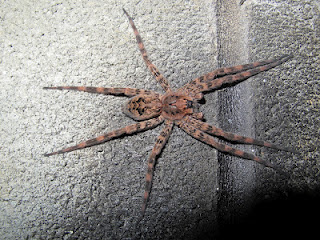
As I was coming down the ladder, I came eye-to-eye with a female Fishing Spider.  I enjoy finding big spiders and this one is about as big and beautiful as they get around here.

There aren’t many animals with a coat as beautifully colored and marked as this girl. 

Atop one barn wall was a fresh shed from a Black Rat Snake.  This is a common find when the snakes are hunting in the barn.  If a week goes by without a new shed appearing, I figure the snakes are in the house.

On the way back to the house I found this walnut shell left by a squirrel.  It must have known how much I like faces.  Sometimes you don’t have to go far to have an exciting walk.  It wasn’t until I walked back into the garage that I noticed I had forgotten to get the pliers.

Saturday, December 17, 2011

Skull

The skull seems to be the most common skeletal part found decorating the Blue Jay Barrens landscape.  At least half of my bone finds are skulls.  I suppose the head yields little of interest to most predators and scavengers.  Meat laden bones from the rest of the animal are carried off and either chewed or consumed.  The tough bones of the skull are also more resistant to decomposition, so they remain recognizable for a longer period of time.  This Raccoon skull was hidden beneath the leaves before I brought it back into the light.

Dentition is important in the proper identification of the skull.  By counting the teeth, you can narrow the range of possible species.  The upper jaw tooth count in this case is 20, which is normal for several genera in this area.  It’s easy to eliminate smaller mammals like moles or shrews and you certainly wouldn’t mistake this little skull for a bear.   Those species that might have a similar size are foxes and dogs.  These are ruled out because their cranial ridges begin at the eye sockets and travel back to merge somewhere near the back part of the skull.  In Raccoons, the ridges quickly merge between the eye sockets and continue back across the top of the skull as a single ridge.

The profile also tells you this isn’t a fox or a dog.  With a little bit of imagination you can put fur, ears and nose in place and make a good guess.  It’s easier when all the teeth are in place.  I’ve had enough dogs growl at me that I’ve gotten pretty good at recognizing that tooth grin.  I would point out that the snout is shorter than the normal dog, but there are so many specialized dog breeds that canine snout lengths and shapes can vary considerably.

I left the skull on top of the leaves.  It’ll be interesting to see how long it stays in place.

I have to end with the image of an alien face emerging from the toothless jaw.  It would be interesting to take a skull and see just how many faces I could find hidden there.

Saturday, July 30, 2011

Baby Raccoons

It’s been a bumper year for young animals. I found these two young Raccoons scrounging for food beneath the bird feeder. They don’t seem bothered by my close proximity.


Raccoon pelt coloration can vary greatly. The individual in the foreground displays the typical coloration of a wild Raccoon. Except for some facial markings, the other has a completely black pelt.


Uncommon coloration often gives rise to stories of strange animal sightings. A glance at this black individual wouldn’t automatically suggest a Raccoon. Raccoons have a rather close relationship to bears and the black Raccoon looked a lot like a bear cub as it moved about.


Both use the same technique to pick up bits of cracked corn. The corn is trapped between the front paws and then lifted to the mouth. Their small paws seemed better able to accomplish this feat than the larger paws of an adult Raccoon.


Here is the classic stretch your legs to the limit and arch your back defensive posture. A mature Raccoon would actually expose some teeth and show a menacing face as part of the attempt to scare away a threat. This baby has a look that makes you think he wants to be petted.


A Camera Critters submission.

Sunday, June 26, 2011

Raccoon

A Raccoon has been making early morning visits to grab some bird feed before the birds get to it. He used to make night raids and was about to destroy the feeder my son got me for Christmas. To stop this, I began putting a daily ration in the feeder each morning. By nightfall, the feeder is empty and of no interest to the Raccoon. Daylight foraging is not typical behavior for Raccoons, but they’ll brave some daybreak sunlight if the prize is tempting enough.


I suppose cracked corn will do until someone nearby has a garden full of ripening sweet corn. Several years ago, a person over the hill from us tried to raise sweet corn for market. As the corn ripened I noticed a total absence of Raccoons at Blue Jay Barrens. He said that the Raccoons overran his fields and left him with almost nothing that he could sell.


Cracked corn can be awfully tough to chew. I’m probably at fault for not softening it up in a bowl of water.


He alternates between corn and sunflower seeds. Sunflower is softer, but I imagine the hulls provide quite a bit of roughage in his diet.


Wild animals must always be on the defensive against larger, more powerful animals that might take away their meal. The Raccoon is not going to willingly abandon his feast. Whatever’s coming, it must be big and powerful.


Or maybe not.


I think these two should be able to share the feeding station without too much conflict. The Raccoon doesn’t stay around very long. As the morning brightens, he becomes more nervous and finally hurries off to sleep the day away.

A CAMERA CRITTERS submission.