Showing posts with label Insects. Show all posts

Thursday, November 26, 2020

Interesting Items Found While Working on Fall Projects

When actively engaged in management tasks, I’m unlikely to stop to take photos.  Completing the activity of the day is usually considered a higher priority than documenting what I do or see.  However, at times when there are natural breaks in the work, I’m quite likely to pull my little Canon G11 from its belt holster and capture some of the interesting items that catch my eye.  Most of the photos illustrate changes that have occurred as a result of my land management activities over the last few decades.  The Little Ladies-tresses, Spiranthes ovalis, is a good example.  This uncommon orchid was represented at Blue Jay Barrens by only a few individuals 30 years ago.  It is now seen commonly across dozens of acres each fall.
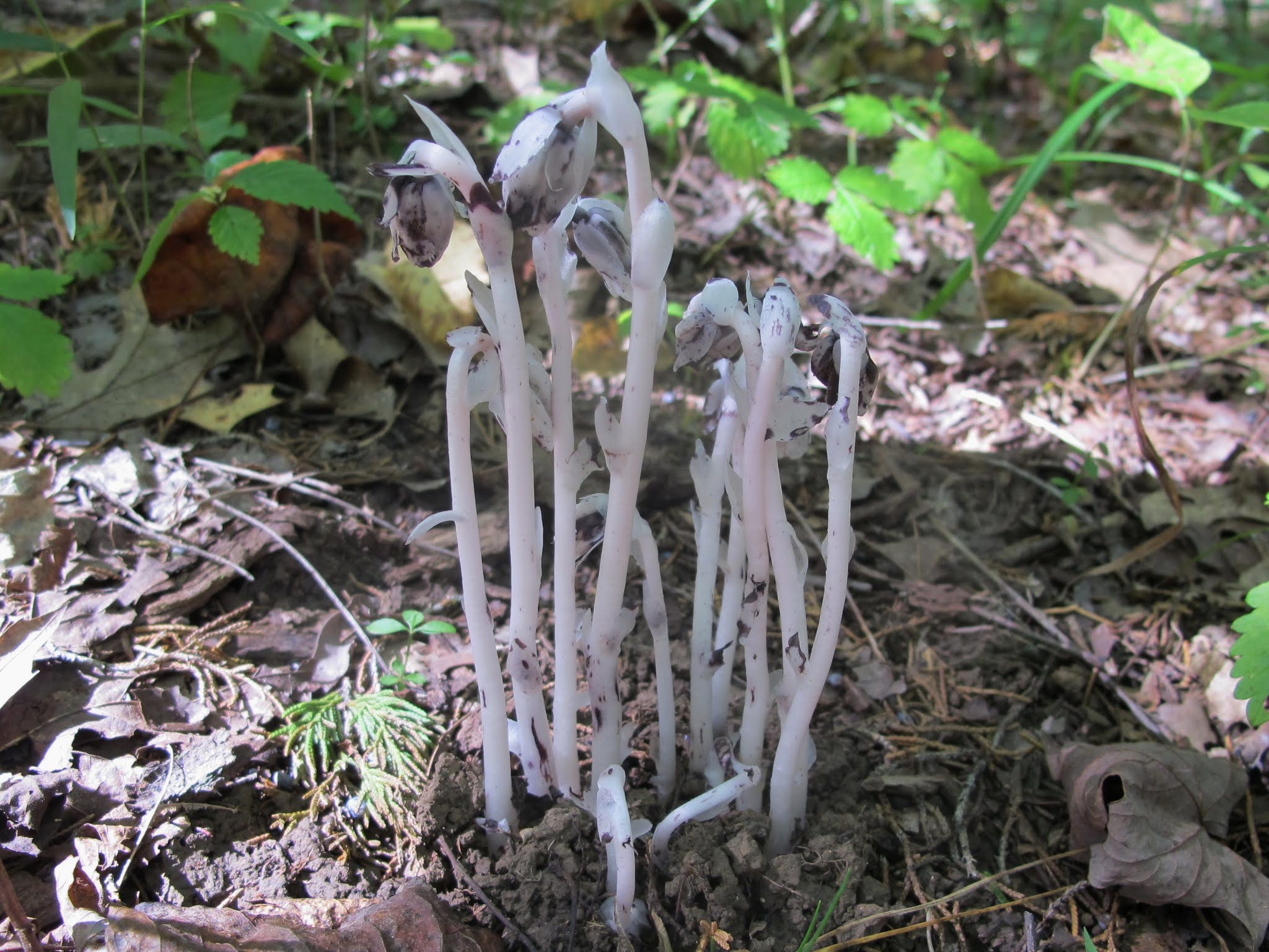

One of my favorite plants, Indian Pipe, Monotropa uniflora, was in abundance this year.  These plants are parasites on fungi and have no chlorophyll.  The new stalks are bright white and almost appear self-illuminated against the background of forest floor leaves.


Carolina Buckthorn was once listed as a potentially threatened species in Ohio.  Being a species of the South-eastern United States, its range just reaches into the southern counties of Ohio.  In 1990 Blue Jay Barrens supported just two small populations of this species, with one of those populations consisting of a single individual.  With the removal of non-native invasive shrubs, Carolina Buckthorn seedlings had a chance to become established and flourish.  Mature fruit bearing individuals are now common and seedlings are coming up everywhere.


Flowering Dogwood was eliminated from the Blue Jay Barrens woodlands when Dogwood Anthracnose decimated the population in the early 1990’s.  A few small specimens survived in the open fields and have been producing fruit and seed for many years now.  Mature dogwoods are finally beginning to recolonize the woodland.  The red and orange of their autumn leaves is hard to miss.


I’m unsure of the seed source, but young American Beech are becoming more common in the woods.  I’m happy to see this occurring since one of the historic hardwood mixes in this area was the Beech-Maple forest.  There is no shortage of Sugar Maple here and it would be nice to see a few mature Beech mixed in.


Partridge Berry is another species that has expanded its number greatly in the past few decades.  Historic grazing of cattle in the woodlands is one probable cause of this plant’s early rarity.  The absence of cattle during the past 35 years has resulted in much improved woodland soil conditions.


Fungi of many species were apparent this year.  One of the most noticeable was this Orange Fungus,   Mycena leaiana.  The orange fruiting bodies emerging from fallen logs rivaled the fluorescent blaze of the brightest hunting jacket.


Above average rainfall coupled with a forest of dead ash trees results in an abundance of fungi.  I believe this to be a polypore known as Dryad’s Saddle.


I must have appeared as though I was ready to collapse, because a large mixed flock of Turkey and Black Vultures moved in and began circling directly above me.  It was early morning, so the most likely explanation for the gathering was the development of a thermal current allowing the birds to ride the rising warm air to higher altitudes.  These thermals are common in areas where the rising sun warms bare southeast facing hillsides.  I’ve been known to generate a lot of body heat while working, but I doubt that it’s enough to change the atmospheric conditions above me.


Except for the early spring breeding congregations, Wood Frogs are seldom seen.  I’ve seen several during the past couple of months, possibly due to the uncommonly frequent rains during that time.


Spring Peepers have also been conspicuous this fall.  It’s not uncommon to hear a peeper or two calling on the first few cool days of autumn.  This year has been no exception.


The Giant Cranefly, Tipula abdominalis, is an impressive insect.  The larvae of this species live in upland streams where they feed on decomposing leaves.  Adults are typically found in woodlands, not far from the streams in which they once lived.


Jumping Bristletails are often referred to as prehistoric insects because they have remained relatively unchanged since their emergence approximately 390 million years ago.  My early elementary school days were filled with plans to become a paleontologist, so anything that may have walked with the dinosaurs still draws my attention.


Wooly Bears are the larva form of the Isabella Tiger Moth.  In my lifetime I’ve seen thousands of these caterpillars on the ground, in a hurry to get from one place to another.  This photo documents the first time I have ever seen a member of this species feeding.  In this case the caterpillar is feeding on the upper leaves of a Tall Boneset plant.


This is a female Carolina Leafroller Cricket.  These insects are generally considered common, but seldom seen creatures.  Part of the reason is their nocturnal habit, meaning that their active period is at night.  The rest of the reason is their method of hiding during the day.  As suggested by the name, the Carolina Leafroller Cricket spends its day rolled up in a leaf, making it extremely hard to find.  This individual seems to have been slowed down by an unusually cold night, and is warming itself in the first of the morning sunlight.


The tiny Pygmy Grasshopper is liable to show up anywhere at Blue Jay Barrens.  An adult specimen may grow to be as much as half an inch in length.  I don’t know that I would ever be successful at finding one by searching, but chance provides many encounters each year.


I regularly see Northern Fence Lizards, but I don’t always get out the camera during such encounters.  This time I noticed a fly on the leaf in front of the lizard’s head.  Thinking I had a chance of capturing an image of the lizard at the moment it captured the fly, I got my camera ready.  Unfortunately, things didn’t work out as imagined.


The fly flew and the lizard gave me what seems very much like an accusing look.


Eastern Box Turtles are opportunistic breeders.  They have no pheromones or calls to bring a couple together.  Breeding occurs when two individuals sharing a like mood happen to meet.  Females are capable of storing sperm for many months and using it when needed, so a positive encounter can take place long before the egg laying season.  I’ve seen an increasing number hatchling Box Turtles during the past few years, suggesting that the population is doing well.


Wednesday, June 21, 2017

Wasps and Other Mud Puddle Visitors

During early afternoon on the day before the Toad Pool went dry, I spent a couple of hours photographing visitors to the rapidly shrinking puddle. During this session I concentrated more on short videos than on stills.

A single, newly morphed toad is a couple weeks behind the hoard that emerged from the pool a few weeks ago. This little guy has only been a land dweller for a short time, but it already displays the mannerisms of an adult.  Click HERE for YouTube version.

The most noticeable visitors to the pool were wasps loading up on water. The wasps were light enough to ride the surface tension of the water as they drank.

Several species of paper wasps took advantage of this dwindling water supply. A few mud wasps also flew in, but they all left with only water.  Click HERE for YouTube version.

The paper wasp in this video doesn’t seem to be intimidated by the beetle larva attacking it from the rear. It’s probably a good thing the larva couldn’t get hold of the wasp, or it might’ve been pulled right out of the water.  Click HERE for YouTube version.

A small wolf spider stalked the mud flats.  It was particularly interested in the movement of what appeared to be a small insect near the edge of the pool. What wasn’t immediately obvious was the fact that the small insect was held in the jaws of a much larger aquatic beetle larva.

The spider finally attempts an attack on the small insect, but is driven back when the beetle larva begins to thrash its head. Immediately after the head thrashing, the beetle larva scoops a small bit of mud into his breathing snorkel, located just to the right of the thrashing head, and shoots a mud ball at the place the spider had just been.  An interesting defense mechanism.  Click HERE for YouTube version.

Several butterflies took advantage of the wet mud to imbibe some mineral laden water. The most persistent of these was a common Buckeye.

The temperature at the time this video was made was 93°F and there was a strong wind blowing. You can see the puddling butterfly occasionally buffeted by the wind. I was pretty much baked all the way through by the time I called an end to this photography session.  Click HERE for YouTube version.

Friday, April 14, 2017

Draba Pollinators

The Draba cuneifolia have been in bloom for over six weeks now.  They went unscathed through a week long bout of cold weather that included single digit low temperatures, heavy frost and a covering of snow.  They baked through several sunny afternoons of temperatures above 80°F, stood beneath the pounding of two inch downpours, and some even spent a few hours submerged during an uncommon upland flooding event.  Despite all this, the plants have continued to produce blooms and in turn, seed pods have been forming.

Draba cuneifolia is an annual species that depends on its seed crop to produce the next generation of plants.  The flowers are capable of self-fertilization, so seeds will be produced even without pollen being moved between flowers.  However, sharing pollen is essential for the maintenance of a genetically diverse plant population, and the number one mover of pollen for these little Drabas is insects.  I recently spent some time sitting in the Draba patch, photographing the many pollinators visiting the flowers.  The rapidity at which the insects moved from flower to flower, along with it being a typical windy March afternoon, made it difficult to get many clear photos. The video above shows what conditions were like, but even though I only captured a few good images, the variety of pollinator species that I saw was amazing.

Draba flowers are tiny, but they must be good nectar producers.  Most flower visitors behaved just like this small native bee, only stop moving when you are drinking.

Another small native bee.  Small bees were the most common insect found on the flowers.

A Paper Wasp.  

Paper Wasps were the only insects large enough to move from plant to plant without flying.

Several species of flies were present.

Flower Flies were the most common of the fly species.

Plant Bugs were the only insects that spent any length of time at a single flower.  This one fed here for several minutes.  When it finally moved on, it went no further than the next open bloom.

I saw two of these day flying moths.

Not a pollinator, but this Carolina Wolf Spider is definitely interested in all of the activity only inches above its burrow.  Some of the flower visiting insects came by low to the ground, but none ever came within reach of the spider.

Monday, January 30, 2017

Robber Flies

I took this series of photos one afternoon about six months ago during a time when I was experiencing internet connectivity problems.  The file has been stuck in my blog folder since then, along with several others.  I deleted the others, but I am such a fan of Robber Flies that I just had to make this post.  Resting on a leaf about half way down into the canopy of an herbaceous border sits this Diogmites species. 

Robber Flies are predators.  They spend much of their time sitting where they can watch for passing flying insects. I enjoy watching this species because its head is so mobile. It swivels its head in the direction of even the slightest bit of movement, which at some point always includes the photographer.

This slightly larger member of the Robber Fly group is a representative of the genus Efferia.  It came to rest on my hand while I was working in the field, which I hope does not give anyone the impression that I move so slowly while working that animals find me a convenient perch.  The end of the abdomen tapers down into an almost sword like appendage. Although it looks to be a formidable weapon, it is used as a tool for laying eggs deep into flower heads or other locations deemed suitable for growth of the larvae.

This is Promachus hinei.  Although it’s not the most common in terms of total Robber Fly numbers at Blue Jay Barrens, it is the most commonly encountered species of Robber Fly. Because of their large size and noisy flight, they are hard to miss when you happen upon them in the field. On this particular day, almost every individual I found was busily feeding, and several were feeding on somewhat unusual items like this paper wasp. When hunting, Robber Flies launch from a perch, grab an insect from the air, and return to a perch to consume their prey. The Robber Fly’s first action after a catch is to insert its piercing mouthparts into the body of the captured insect and inject a chemical relaxant that attacks the nerves and calms the prey. Along with the nerve agent is an enzyme that liquefies the internal body of the insect, so the robber fly can drink its meal.

To some, this may look like a love embrace. Unfortunately, that fly giving the big hug is not moving in for a friendly cuddle. 

These big flies will take any prey they can handle, even if it’s their own species.  That’s a male of the species making a meal of a female.  You can see his piercing mouthparts just below his front leg in a direct line with the grass stem beside his head. I hope next summer is another bumper season for Robber Flies.

Wednesday, July 27, 2016

Cicada Killer Wasp

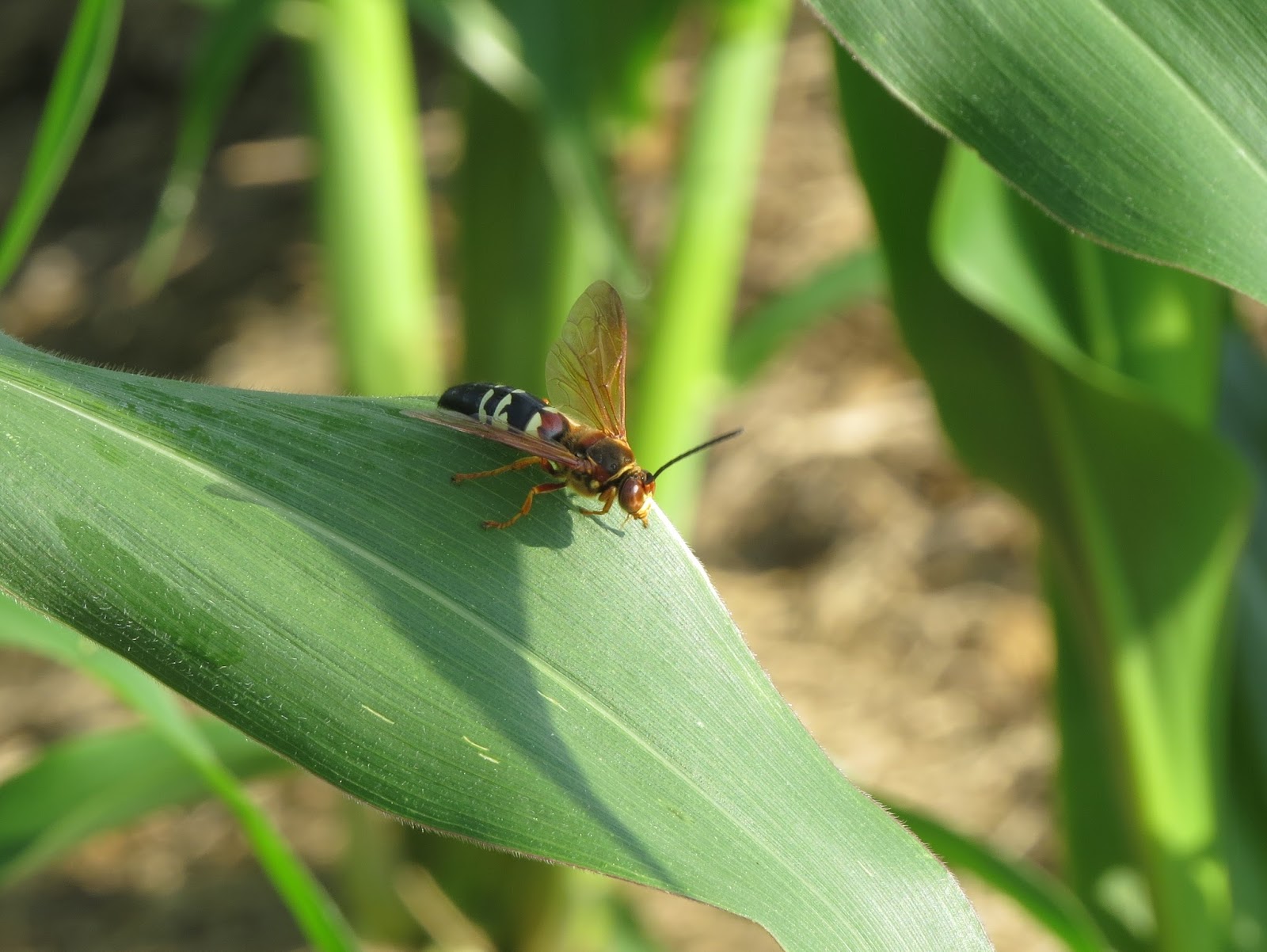
I recently had an entertaining encounter with a Cicada Killer, Sphecius speciosus, our largest native wasp.  The females of this species construct burrows in the soil into which they place a cicada to act as a food source for their developing larvae.  I typically begin to see signs of burrowing activity around the first of August.

This individual provided me with some fine photo opportunities.  Using both corn leaves and the ground as perches, a watchful male spent the morning in the garden on the lookout for female Cicada Killers.  Several chases ensued, with one resulting in a pair of wasps in a love embrace spiraling into the sky.

The video shows the wasp constantly scanning its surroundings.  Body twitches and wing fluttering show its readiness to instantly take off after any passing female.

The Cicada Killer presents a fearsome image, but it is actually not at all aggressive.  Males are incapable of stinging, so this guy is completely harmless.  Females, which are capable of stinging, save that sting for their preferred prey.  A person would have to work hard to make one of these wasps sting, and that sting would be classified as justifiable self defense.

Female Cicada Killers build their burrows in areas of exposed soil.  Around here, they seem to prefer my shallow soiled, south facing front lawn, which typically shows bare ground in August as the lawn grasses enter summer dormancy. 

This is my favorite wasp species.  Many people have asked me how to get rid of these wasps.  I usually respond that the wasps are not a problem, so people should enjoy them.  When people say the wasp burrows are ruining their lawns, I reply that it must have been a poor lawn to begin with, otherwise the wasps would never have been attracted there.  When they accuse the wasps of attacking, I point out that a close fly-by does not constitute an attack.  I’ve never had to respond to any comments beyond that, because by that point, people have given up hope of getting any really practical advice from me.

In this video, the wasp has just had a close encounter with a passing Cicada Killer.  His body movements seem to display a heightened level of excitement.

Wednesday, September 2, 2015

Elephant Mosquito Returns

Back at Blue Jay Barrens after a five year absence, by popular demand, it’s the Elephant Mosquito, Toxorhynchites rutilus septentrionalis.  A behemoth of the mosquito world, this non blood sucking species is the largest mosquito to be found in North America.  I found this larva, posing beside its normal sized relative, living in a tub of water beside my house.  This is a southern species whose range extends into the lower half of Ohio.  It’s possible that the species has trouble surviving Ohio winters.  If so, the Ohio population would depend upon more southern populations moving north each year to recolonize this area.

Elephant Mosquitoes are predators, feeding on small aquatic organisms.  Its diet consists primarily of the larvae of other mosquito species. 

Eating is the primary activity of the Elephant Mosquito larva.  This one is consuming a double helping at one time.  The larval stage can last from a few weeks up to several months.  I’m sure that temperature affects the rate of development, but I would guess that the available food supply is also a critical factor.

Even though the larva will grab prey whenever presented with the opportunity, most of the active hunting seems to occur at the water’s surface.  Floating with a collection of potential prey items, the larva will raise its body into a horizontal position and slowly reach out towards its prey.  When it gets within range, it give a quick lunge and grabs the prey with its strong set of mandibles.  I watched this individual, which is now housed in a small aquarium, consume six mosquito larvae in 20 minutes.  It has since greatly slowed its rate of consumption.  I believe my supplying the Elephant Mosquito with a density of food items about 25 times greater than what it was used to might have been the cause of the initial glut.

This is typically a tree hole species that breeds in water pockets trapped inside tree cavities.  I imagine one of these predators could easily clean out the mosquito population in a small pool.

The Elephant Mosquito larva is primarily an eating machine.  Fortunately, the large sized adults feed on nectar and other plant juices, so are no threat to people.  Click HERE for more information on this insect and details of its first discovery at Blue Jay Barrens.

Blogger is not letting me upload videos today, so I've included three links to videos showing typical hunting behavior for this species.  Click HERE 1 and HERE 2 and HERE 3 to view the videos.  For best viewing, select the full screen option on YouTube.

Monday, August 31, 2015

Orange Coneflower Visitors

Summer 2015 has produced some wonderful displays of single species flower patches.  Masses of Indian Hemp, Milkweed, Purple Coneflower and Monarda all developed attractive displays that drew in a multitude of insects and other animal species.  Now the patches of Orange Coneflower are drawing all of the attention.  Visitors to the Orange Coneflower blooms are usually the most impressive of the season.  I spent about 15 minutes observing visitors to a single 20 square foot patch of Orange Coneflower and was not disappointed with the diversity I witnessed.

Some visitors are attracted by the prospect of making a meal of nectar or pollen.  Orange Coneflower does not typically attract large butterflies, but some of the smaller species are known to visit.  The Pearl Crescent was looking particularly crisp and clean.

I saw two Horace’s Duskywings visiting the patch.  One was looking rather battered, but this one was appeared fresh.

I wasn’t sure this was really a living micromoth until it flew off at the prod of a finger.  At a glance the tiny moths often appear to be just a random bit of chaff.

This is a species of Eristalis fly.  Look at the pollen on those legs and body.  This guy is certainly no slouch when it comes to pollination.  Larvae of this species are aquatic, commonly being referred to as rat-tailed maggots.  Frequent heavy rains through the summer have provided plenty of breeding grounds for these flies.

Tiny solitary bees are everywhere this year.  I’ve found them on every species of flower I’ve examined.  They also like to ride along on me and drink sweat while I’m working.

The slightly smaller black bees have also been quite numerous.  They seem to carry pollen on every part of their body.

There were also many that I was unable to identify.

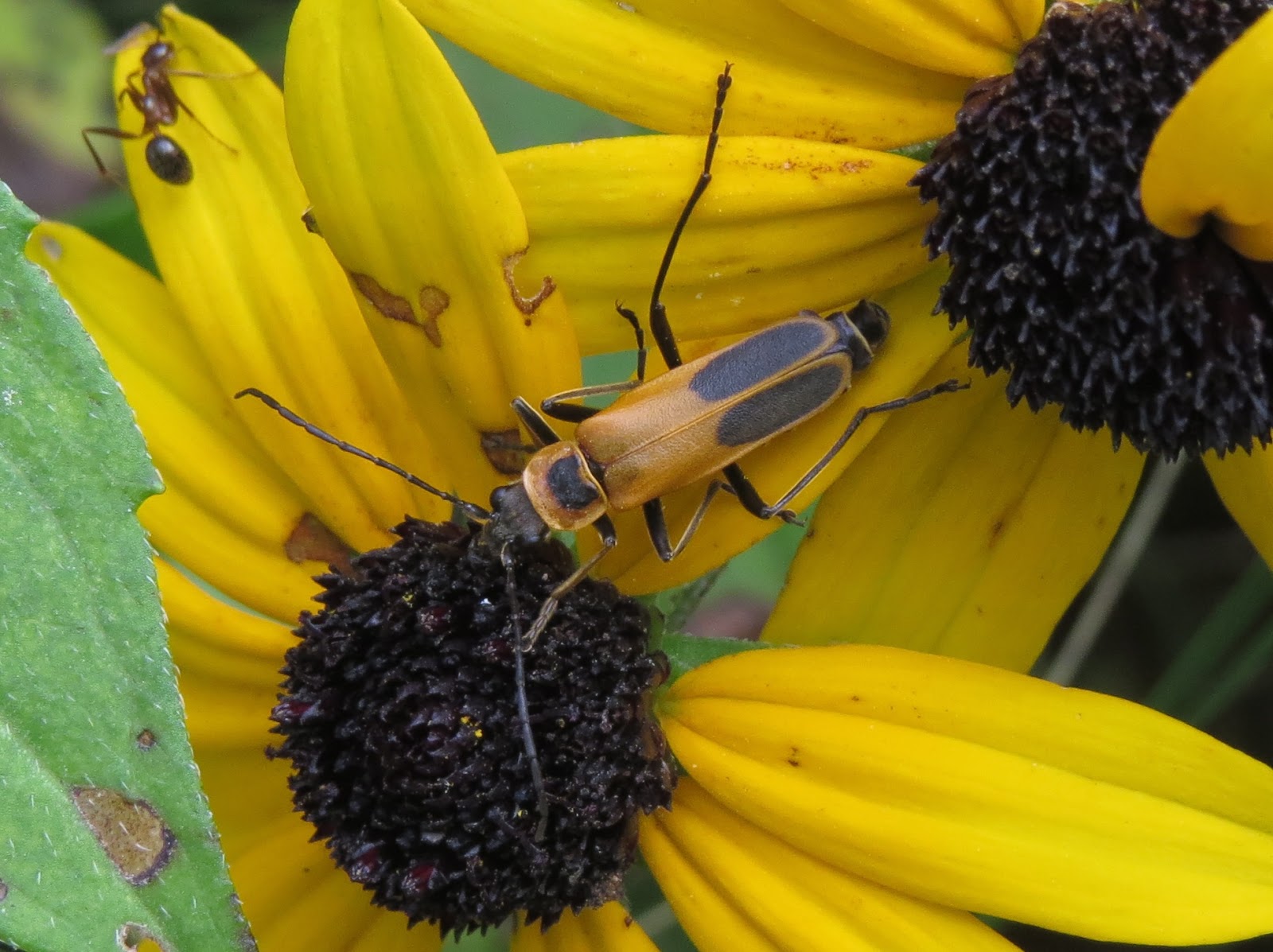
As usual, Soldier Beetles abound.  They move randomly among the flower heads feeding on pollen and flower parts.

There was an interesting encounter between weevils and a small ant.  The ant bit repeatedly at the weevils, but limited its aggression to the weevil’s wing covers.  The weevils continued with their activities, apparently unaware of the ant.

A variety of caterpillars were feeding on the flowers.  I wonder how long a light green looper can sit atop a dark flower disk without attracting the attention of some predator.

One of my favorite caterpillars is the camouflage looper.  With miscellaneous bits of plant material glued to its body, the looper looks more like a plant deformity than a living animal.

This camouflage looper is only lightly adorned, so the actual body of the looper is visible.  This species is frustrating to photograph because even in the best of shots it doesn’t really look like a caterpillar.

Some caterpillars spend their time hidden in the flower head.  Expelled frass is the only evidence that a living creature lurks inside.

Splitting the seed head reveals this little guy feeding among the developing seeds.

Placed on a new seed head, the caterpillar quickly burrows to safety.

This small Tachinid species may be getting a meal from the flower or it could be searching for an insect to act as host for its young.  Large patches of flowers are like a watering hole in the desert.  Animals come to feed on the flowers and predators wait to feed on the flower visitors.

Several small Braconid Wasps were searching the flower heads for possible hosts to receive the wasp’s eggs.  The wasp can reach its ovipositor deep into the seed head to deposit an egg on a hidden caterpillar.

The petals surrounding the flower head are a tasty treat for some insects.

Grasshoppers often feed on the petals.

Leaf Hoppers, such as this Tylozygus species, feed on the plant juices.  Sometimes its hard to tell whether an insect on a plant is actually using that plant as a food source or if that’s just where the insect happened to come to rest.

A flower perch is an ideal location for a young Gray Treefrog to await its next meal.  The treefrogs have taken advantage of the unusual number of breeding sites created by the exceptionally rainy summer.  Little frogs are everywhere.

Abnormalities of the flower structure often indicate the presence of some animal visitor.

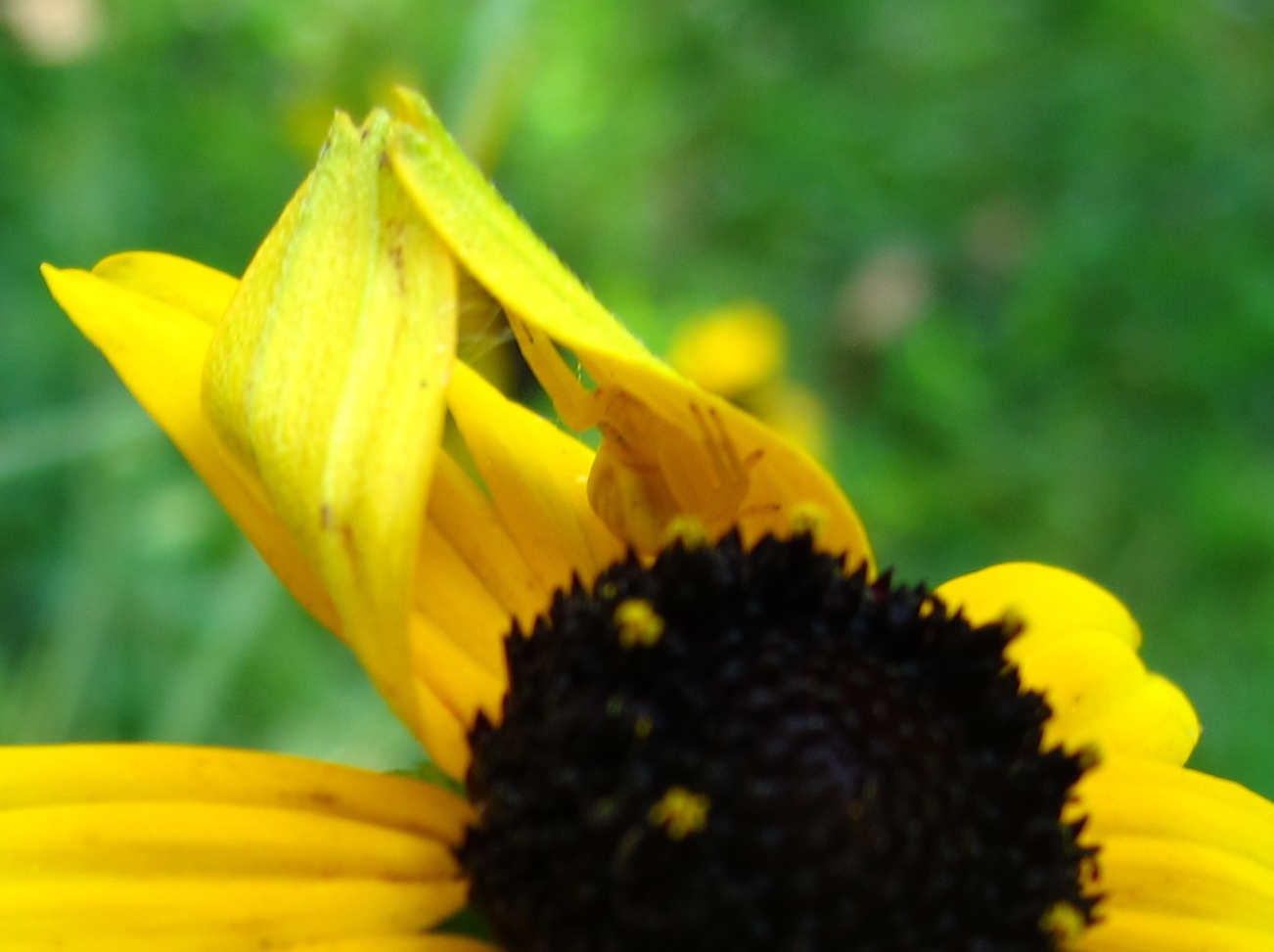
A crab spider has joined the tips of two petals together to form a shelter.

Crab spiders are a common feature of the flower heads.  Some display coloration that helps them blend with the dark central disk.

Others blend with the yellow petals.

Many species of spider hang around the flowers.  Some don’t match color at all, but their posture still allows them to appear to be a natural blemish on the plant.
Ambush Bugs sit ready to grab insects with the curved pinchers of their front legs.  A strangely motionless insect sitting on or dangling from a flower is often in the grip of an Ambush Bug.

The predatory Damsel Bug probes for insects within the flower seed head.

This Spiny Assassin Bug nymph assumes the standard position beside the flower head as it awaits the arrival of a meal.

A highly colorful, though unexpectedly cryptic, Sycamore Assassin Bug nymph prowls the flowers in search of prey.

A large Robber Fly uses the flower as a perch from which to watch for flying insects passing by.  The Robber Fly will catch its prey in the air and return to the perch to feed.  With my allotted time expired, I moved on to complete my scheduled work for the afternoon.  Not a bad tally of interesting animals from 15 minutes of observation, and these are just the ones I captured with my camera.