Saturday, January 7, 2012

Woodpecker Knocking

I was working in the basement the other morning when I thought I heard a knock at the door.  I stopped what I was doing and went upstairs to see who it was.  There was no one.  I went back to the basement and soon heard the knock again.  No one around, but I did hear the knock just before opening the door and I had a pretty good idea of what it was.  I waited upstairs until the knock came again and caught this Downy Woodpecker tapping away at the fascia board around my porch.

He took off when he noticed me looking out the window.

The woodpecker was busy exposing Carpenter Bee tunnels running inside the board.  This section of tunnel was opened several weeks ago, but I never caught sight of the bird.  The tunnels were cleared of everything edible, so I wasn’t expecting the woodpecker to return.

This time a different tunnel was under attack.  The larder looks full.  There are definitely some shiny insect parts showing through the holes.

I used some forceps to draw the bee closer to the opening.  Carpenter Bees spend the winter inside unused tunnels.  I imagine this guy will be woodpecker food before too long.

Friday, January 6, 2012

A Few Tracks in the Snow

I love to go out after a snow and view the tracks left behind by animals going about their normal business at Blue Jay Barrens.  I’ve been wondering what animal has been digging up the mulch in my garden beds.  It looks like it has been Crows.  There has been a group of eight Crows that are always in sight of the yard.  I often see them, but they’re quick to leave if they detect any movement from the house, so I rarely get to see what they are up to.

The Indian Grass seed is supporting a variety of sparrow sized birds.  The amount of seed produced this year should be able to sustain the flocks well into spring.

The snow wasn’t deep enough to cover the Voles as they crossed the mowed paths.  Voles traveling in the open will create an unbroken path through shallow snow.

Mice normally travel through the snow in a series of short jumps.  Individual foot prints are easy to see along with a mark made by the tail.

It looks like there’s a Domestic Cat in the area.  The line of tracks is very distinctive.  You can imagine the cat as it walked along in that line.  The individual tracks are small and will show four toes and no claw marks.

Cottontails have been scarce this winter.  I only saw one set of tracks during my walk.  Excessively wet weather often has negative effects on Cottontail nesting success.  Frequent rains can fill the shallow nest hole with water and cause the young to die from drowning, exposure or illness.

Gray Squirrels have been active every day so far this winter, but their numbers are also down from past years.  The most common Gray Squirrel nest type at Blue Jay Barrens is a mass of cedar bark strips placed high in the branches of an Eastern Red Cedar.  These nests would be susceptible to moisture infiltration from frequent rains.  It’s not unreasonable to believe that a few nestlings were lost because of the unusually wet conditions we experienced during the last year.

Of course, you don’t have to go far to find Whitetail Deer tracks.  The morning after the snow showed every trail to the yard filled with deer tracks.  There were deer tracks to be found everywhere I walked.  If deer had been this numerous when I bought the property, I might have named it Deer Track Valley.

Thursday, January 5, 2012

Snow

Blue Jay Barrens got its first snow of the season on January 2.  A total of two inches accumulated before noon and the rest of the day was a mix of wind, sun, clouds and snow showers.  You would have thought we were finally settling in to winter, if it weren’t for the predictions of a rapid warm-up back into the 50’s.

The flakes were large, but they were dry enough to settle down through the Indian Grass without sticking to the stalks.  There was enough warmth left in the ground to partially melt the snow and allow it to settle into a denser layer.

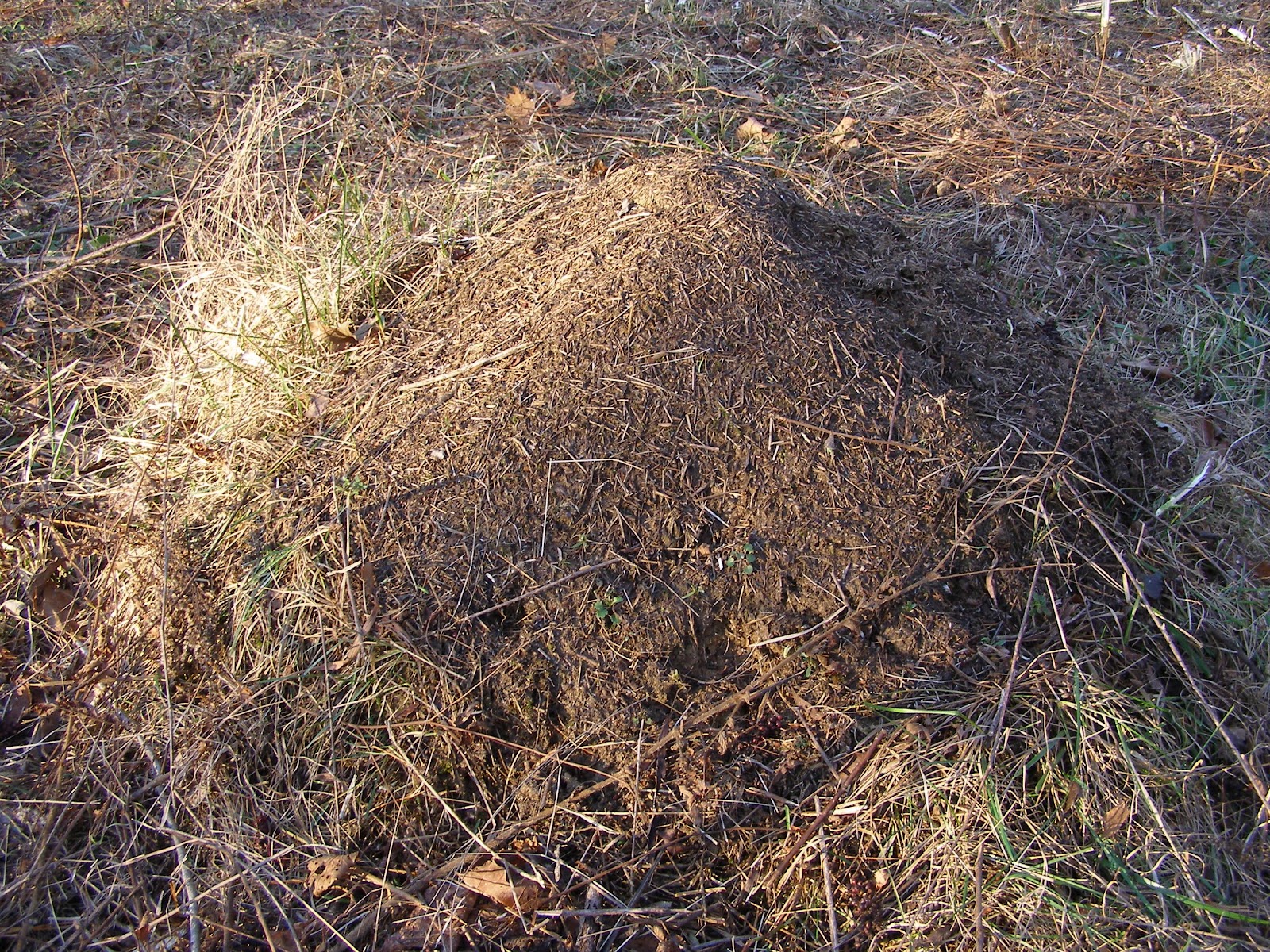
Ant mounds are always easy to see after a snow. Their snow cap will melt as soon as the sun emerges.

Snow on the ground makes it easy to view the trees and shrubs in the woodland understory.  The presence of a Sycamore on a steep slope is usually an indication of a wet weather spring.  These moisture loving trees can survive on the steep slope because of the added water provided by the spring.  The spring flow is often not enough to sustain a large tree, so the Sycamore will likely not grow to extreme proportions.

A snowy background provides the best conditions for illustrating the sprawling growth habit of the Fragrant Sumac.  The trunk of this low growing shrub may reach 20 feet long, but that length sprawls along the ground and drapes over other woodland shrubs.  In some situations this plant can become aggressive enough to displace other vegetation and produce a Fragrant Sumac monoculture.

New fallen snow always enhances the esthetic qualities of the creek.  I’m anxious for the snow to melt quickly, so the creek will be in shape to be beautified by the next new fallen snow.

Robins were busy digging in the wet leaves lining the creek and its tributaries.  I haven’t yet seen them gathered in large flocks.  Most groups contained around a dozen individuals.

The tall grass does a good job of hiding the snow, but it’s easy to see in the areas of sparse vegetative cover.  The afternoon skies showed a few patches of blue that gave the appearance of a pleasant day.  The strong wind and below freezing temperatures made you feel otherwise.

The clouds looked to be coming in as waves, but they were actually moving to the south in columns.  Each band stayed intact and moved quickly from right to left across the sky.  I could imagine the bands stretching all the way to Lake Michigan, which appears to have provided the moisture for this event.

Wednesday, January 4, 2012

Rose Area - Post Mow

Mowing the rose area this year was nothing like the terror of last year.  I never had to use the reverse gear on the mower and I only suffered a single scratch.  I really enjoy viewing this scene without rose bushes.  There are still a few roses in the flanking tree lines that I’ll work on cutting through the winter.


The sparseness of red flags indicates that very few roses survived from last year’s efforts.  I only marked six live bushes in the former rose thicket.  I’m still amazed at the success of this project. 


  The incidence of rose bushes was higher in the neighboring field.  The entire number of marked bushes was just around two dozen, so treatment next spring should be fairly easy.

The Indian Grass was in perfect condition for mowing.  When the stalk has dried, it is easily cut and chopped by the mower.  This allows the cut material to be more uniformly spread.  It’s also easiest to mow when the stalks are still standing upright.

A cut cedar showing green growth will soon return as a tall, thick bush.  It’s hard to spot some of the smaller cedars hidden in the Indian Grass, so it’s important to watch for the bright green patch that indicates a young cedar stump.

It adds to the mowing time, but it’s important to take the time to clip these little cedar bases.  The cedar won’t die on its own and will require even more time to remove later on.

Dried Goldenrod stalks easily break up and disappear into the stubble.  A scattering of young Winged Sumacs were cut, but the large specimens were left.  Their fruits have all dried and are hanging in tight clusters for use by the birds if needed later in the winter.

The Allegheny Mound Ants had just one mound in this field.  The mounds are much more common on higher ground where the soils are drier and more easily drained.

I’ll continue my mowing efforts further into the field to the extent of the Indian Grass stand.  The area beyond these cedars has never been mowed by me, but evidence of Autumn Olive and Multiflora Rose growth now makes it necessary.

Tuesday, January 3, 2012

Rose Area - Pre Mow

Despite the frequent rains, most of the low lying areas at Blue Jay Barrens are still firm.  As winter progresses, these areas will become increasingly soft, so those that are scheduled to be mowed need to be done fairly soon.  This is the area of the rose thicket that I took out last year.  This area needs to be mowed so I can detect any rose sprouts that will require treatment next spring.  I’m also going to mow a portion of the adjoining field that hasn’t been mowed for several years.

The masses of rose canes left after last year’s mowing have partially decomposed and are now covered by plant material produced this year.  Very few rose sprouts survived the mowing and glyphosate treatment.  The area is quickly filling with a mix of native species.

It’s hard to imagine that this was a solid mass of Multiflora Rose bushes just one year ago.  If I didn’t know the history of the site, I would say that it could be left untouched.  The fact that there are still a couple of healthy root masses supporting rose canes means that the area must be thoroughly searched and those roses destroyed.  Mowing is the surest way of examining every square foot of field area and finding those remaining roses.

The neighboring field is in the process of transitioning from goldenrods to Indian Grass.  It won’t be many years before the Indian Grass has taken over.

The Indian Grass is thickest near the center of the narrow field.  Shade from trees along the field edge has slowed the progress of the tall grass, but the Indian Grass advancement continues.  Small shrubs and trees are beginning to show themselves in the grass.  JR stands ready with a fresh batch of red flags to be used as markers of invasive species in need of elimination.

There are a few Eastern Red Cedars becoming established in the Indian Grass.  I clip these off at ground level prior to mowing just to make certain that there is no green growth left to maintain the plant.  When cut off at the ground, cedars will not sprout or continue to grow.

I also searched through the Indian Grass for Oaks that I didn’t want to cut.  This would be a near impossible task if the oaks didn’t maintain their leaves so long into the winter.

The Goldenrod and Indian Grass areas contained several Multiflora Rose bushes.  I suspected that would be the case since the former rose thicket would have produced seeds enough to easily pollute the surrounding area.  With the thicket no longer in existence, the influx of new rose plants should be greatly reduced.

I always find a few bird nests while mowing.  This nest was built in a goldenrod that had branched in response to a gall attack. 

Monday, January 2, 2012

Living Raft

I found this raft of living arthropods floating in the overflow pool of the water garden.  Riding the surface tension of the water, they have been drawn together into a colorful wriggling mass.
At first glance, the living raft appeared to be just another collection of debris floating across the water.  There’s always something floating in the water.  Usually it’s just dust or accumulated pollen or debris from the dwarf pine that hangs over one edge of the pool.  On rare occasions there will be something strange trapped by the water, so I stop and take a look every time I go past.

The sun reflecting from the little bodies caused the whole cluster to sparkle.  Besides those creatures already forming large aggregations, there were many floating as pairs or single individuals.  As the wind moved the large group around the pool, it collected the single drifters into its congregation.

It was hard to get a good look at the raft with the wind blowing it constantly around the pool, so I scooped it up in a shallow bowl and took it to a sheltered place for observation.  The raft seemed primarily composed of various species of Springtails and Mites.  These are common creatures of the soil ecosystem that live near the surface of the soil or in decomposing plant material covering the soil.  Besides being active creatures, they can exist by the thousands in a square foot of soil surface area.  It’s no wonder that a few of them would fall into a pool of water set flush in the ground.

The various species of Springtails and Mites definitely dominated the mix, but there were other soil arthropods present.  This small spider stood free of the water and ran unencumbered over the bodies of its companions.

A few of these denizens of the soil look quite large compared to the others, but the largest was just at the one millimeter mark.  This is what’s underfoot when you walk through the fields.  They play a vital role in the decomposition of organic materials, release of plant nutrients and control of soil born diseases.  It’s not often that they come out to display themselves in such an easy to view array.  After the photo shoot, I released all back onto dry land.  I also quickly washed the cereal bowl and put it back in the cupboard, before my wife saw what I was doing.

Sunday, January 1, 2012

Lost Trademark

I saw something in the water ahead that looked to be a piece of trash, but I was too familiar with that blue color to not recognize what I was seeing.  I headed up to take a closer look.

The more animals you have in an area, the more likely it is that you’ll find one dead.  Blue Jays are a favorite of Cooper’s Hawks and I’ve seen many that were taken by the hawks.  This is the first time in 26 years that I’ve found one dead without an apparent cause. 

My first thought was of the West Nile virus and the sharp drop in the Blue Jay population when the virus came through this area several years ago.  This is just one bird though and it’s a fact of life that birds die.  Because of their small size, we rarely notice a bird carcass.  Being freshly dead and floating in the middle of the creek made this individual impossible to miss. 

I’ve always been impressed by the pattern and colors of the Blue Jay.  I enjoyed the opportunity to get a close look.  The fanned tail provided a view that I rarely observe while watching living specimens.

The Blue Jay must exhibit every shade of blue imaginable.  What a disservice it is to just describe this bird as being blue with black and white markings.

I fished the bird out of the creek and left it on the bank.  It’ll be gone by tomorrow.  There are plenty of Raccoons, Opossums and other animals that would make quick work of a Blue Jay meal.  It’s somewhat sad to see the Blue Jay in this condition, but as I’m taking this shot, I’m listening to a chorus of Blue Jays up on the ridge busily scolding some interloper into their territory.  The population is still healthy and that’s what is really important.