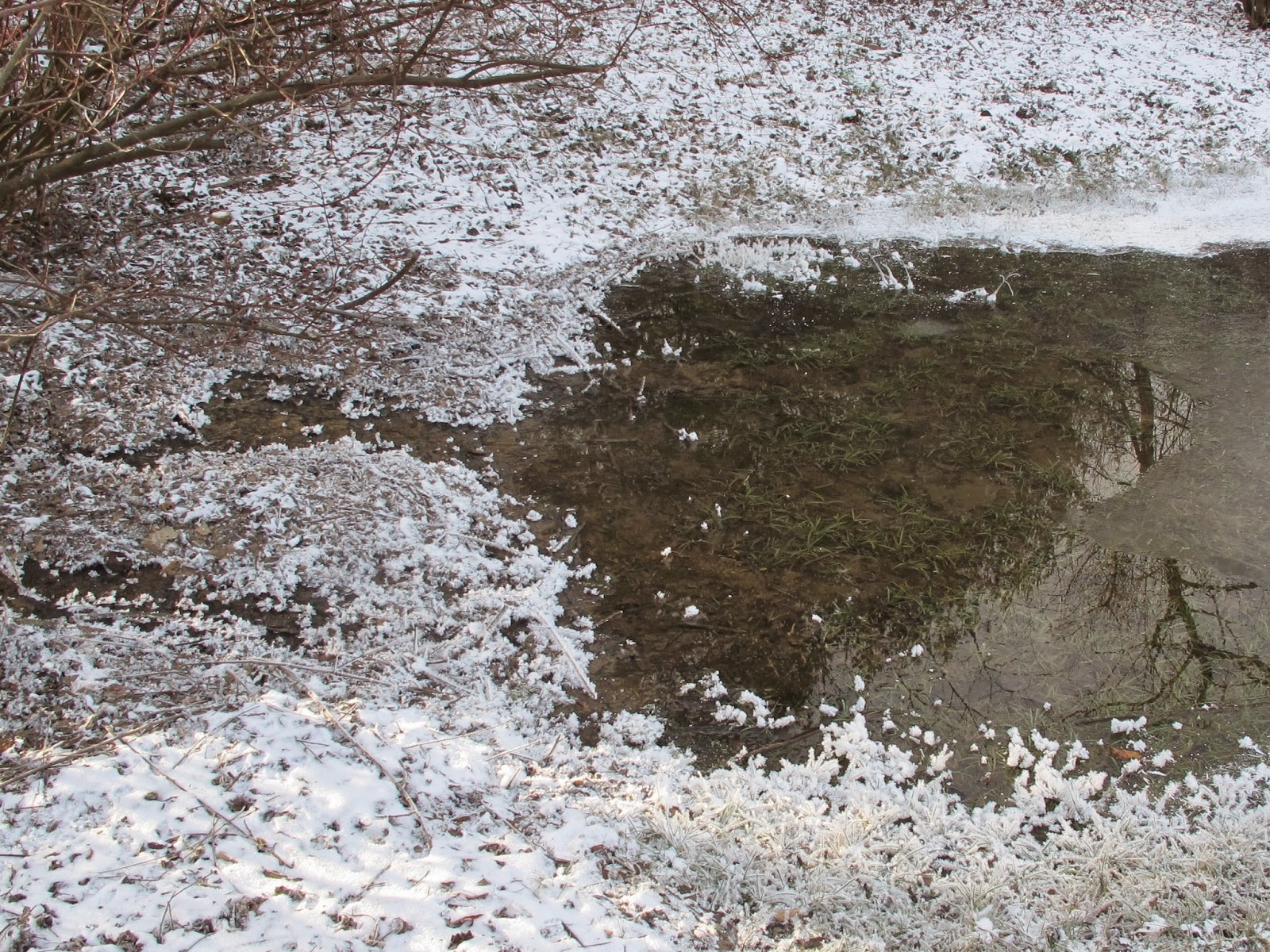
Wednesday, January 14, 2015

Potato Dandelion Transplants

I was in the woods yesterday and decided to go by and check on the Potato Dandelion, Krigia dandelion, tubers that I transplanted last August.  At least a few of the tubers survived and have developed clusters of leaves.

Cold weather causes the leaves to blush a bright lavender.  When temperatures begin to moderate, green blotches will develop that give the leaves a pattern similar to early Trout Lily leaves.  I think this coloration causes the plants to be overlooked by the casual observer.

I planted over 50 tubers along this ridgetop, but only found a small number of plants yesterday.  The bare ground chosen to receive the tubers in August has since been covered by fallen leaves.  By late April the Krigia plants will have developed enough for the leaves to be easily seen above the forest leaf litter.

In addition to planting tubers in the woods, I introduced a few into a new container.  These plants are growing in a 22 inch diameter container that had been filled with recycled potting soil.  First growth appeared in late September.  Growth was rapid until the sub-freezing weather arrived.

Leaves show signs of stress from exposure to cold, dry air.  Each warm spell allows the plant to increase the size of the youngest leaves emerging from the center of the rosette.
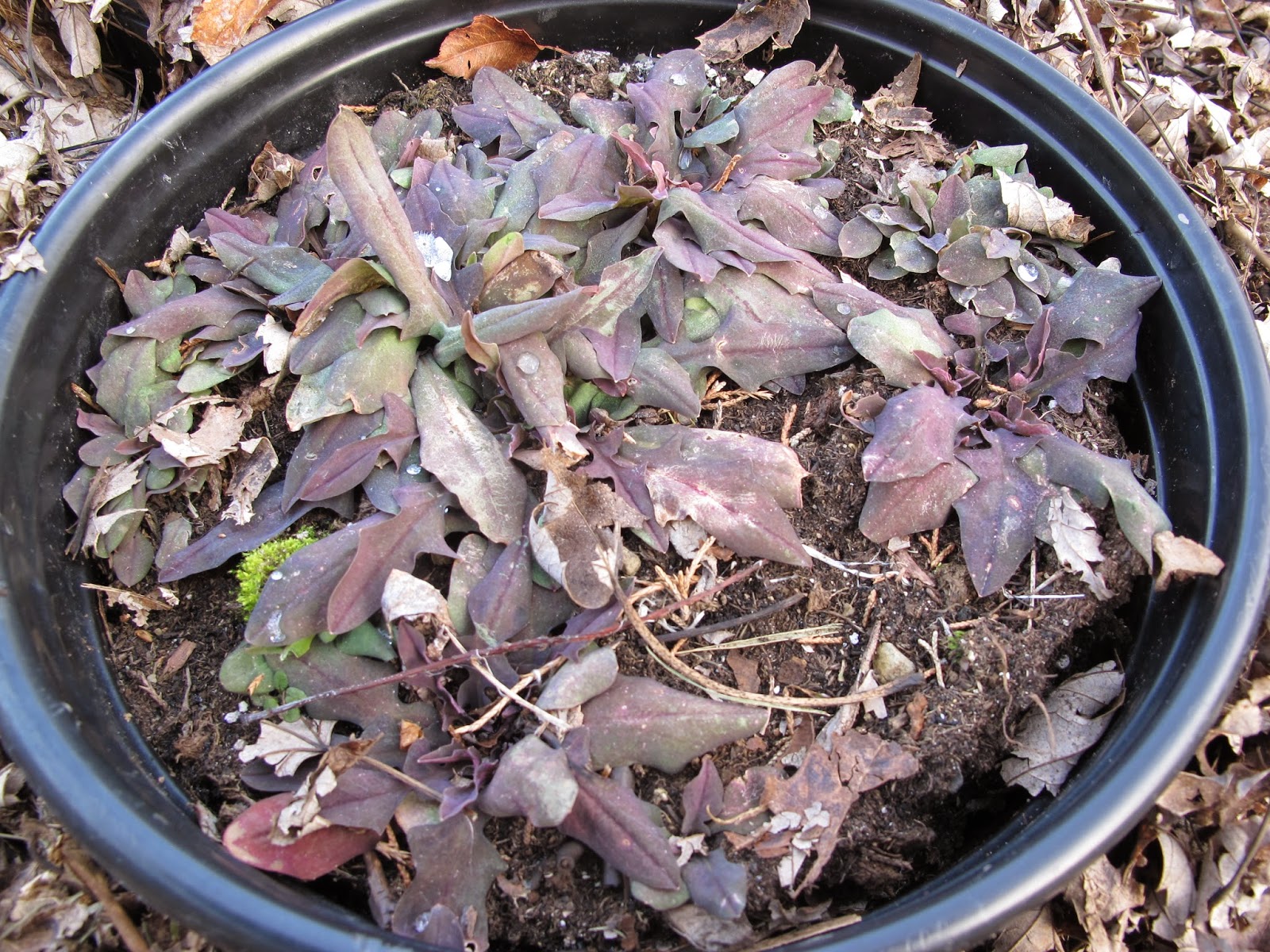
This is the seven inch diameter pot that housed the stray Potato Dandelions found growing in the burned shed site last April.  After sifting out the large tubers last August, I returned the soil to the pot.  There were enough small tubers left in the soil to produce this growth.
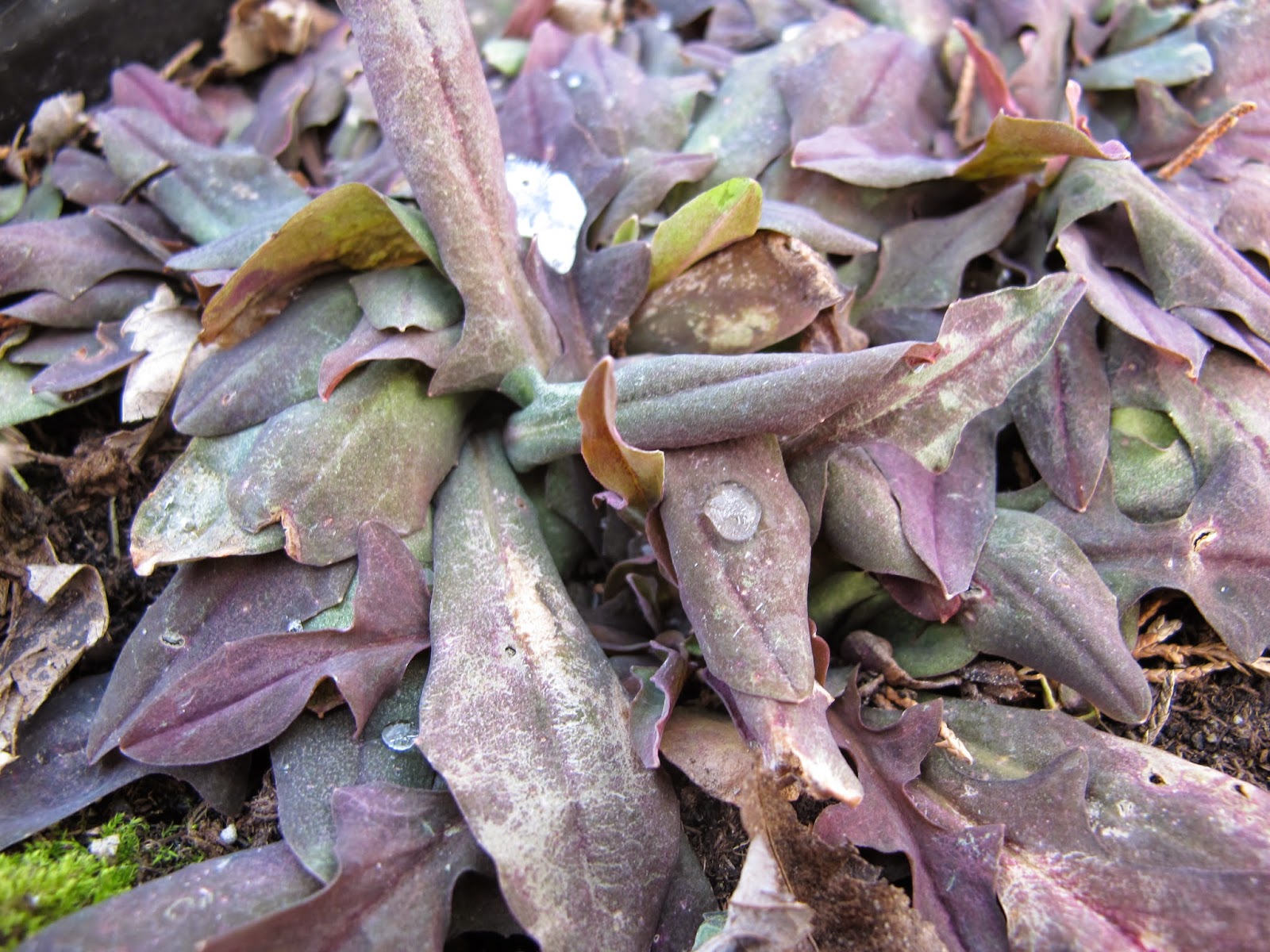
A few drops of water, left by the rain a few days ago, remain frozen on the leaves.  I’ve seen these plants receive much worse damage than this and still recover with the return of warm weather.  So much about this species suggests that it should thrive in this area, but it still remains a rarity in Ohio.

This 18 inch diameter container has been producing Potato Dandelions for many years.  Somehow, this pot has become contaminated with Chickweed.  After harvesting the tubers in August, I’ll add a couple inches of fresh soil to this container.  That should reduce the possibility of Chickweed next year.

Leaf damage is not quite as bad in this container, even though there are still ice crystals sitting on the leaves.

Most of the plants show minimal damage.  All three pots are situated in different locations and this pot was in a position that allowed snow blowing from the barn roof to cover most of the plants.  The snow protected the leaves from the dry air, which seems to be the major cause of leaf damage.  I hope to have an abundance of tubers for transplanting next summer.  Given time, I should be able to find other suitable locations in which this plant can thrive at Blue Jay Barrens.

Friday, January 9, 2015

Open Water

The creek and its tributaries are the only natural source of open water at Blue Jay Barrens.  From Fall through Spring, the creek provides drinking and bathing water to a wide variety of birds and mammals.  Summer water is less dependable.  It is common for the creek to stop flowing for several weeks during August and early September.  Occasionally the dry season extends for months.

I have always enjoyed dabbling in water.  As a child, I could spend hours exploring a puddle in the yard. Finding mosquito larvae in the air conditioner drip pan was like discovering a gold mine.  My parents didn’t appreciate my efforts to increase water opportunities by enlarging potholes in the driveway or excavating beneath the downspouts.  My neighbors seemed to share this attitude.  So it’s only natural that once I reached a point where other people’s opinions had no bearing on my actions, I would create pools of water wherever I pleased.  The water garden, as artificial a body of water as you can get, proved quite effective at drawing animals as well as plants into position for my enjoyment.  It does freeze over easily though and doesn’t provide a reliable source of open water for the local wildlife in winter.

Even though my later attempts at developing open water are still artificial creations, they function more naturally than the water garden.  The established toad pool in the foreground and its under construction counterpart behind, are intended to provide a breeding environment for toads.  A declining toad population is coinciding with a decrease in Hognose Snake sightings.  The snakes feed on toads, so it seems logical that increasing the toad population will benefit the snakes.  It’s just a happy bonus that the pools also benefit a wide variety of other animals and give me more places to play in the water.

The new toad pool is still under construction.  The dam creating this pool is composed of topsoil that will eventually be used as topdressing over the permanent dam.  The center of the planned dam will be along the line of stakes sticking from the water.  Pooled water slowly seeps through this temporary dam and emerges clean on the downstream side.  This keeps sediment from actually leaving the construction site during the winter.

Seasonal springs emerge just above the planned water line.  The springs are almost keeping up with the seepage loss through the dam.  This makes me optimistic that the springs will easily keep the pool full of water well into early summer.  Deer visit the pool every night and seem to delight in running and jumping through the mud.

Cold weather caps the pools with ice.  The established pool is fed by a single small spring, but that is enough to keep a bit of water unfrozen.

The spring keeps a small area of open water available to visiting wildlife


The same conditions occur in the pond, an artificial water body that was created long before I purchased the property. 

A strong seasonal spring produces a continuous stream of water entering the pond throughout the winter.

The warm water from the spring maintains a large area of open water.  Even through the coldest winters, this portion of the pond remains unfrozen.  When other water sources freeze over, birds flock here to drink and bathe.

Water from the spring also helps maintain adequate water for the survival of the breeding salamanders.  The view may be blocked by snow, but the salamanders are busy with courtship and egg laying activities beneath the ice.  I would never threaten the native prairies of Blue Jay Barrens with a water development project.  I’m just glad there are a few areas of undesirable vegetation available for conversion to open water.

Wednesday, January 7, 2015

Snowy Ant Mounds

A dusting of snow on the ant mounds made them stand out like beacons in the tall grass fields.  I took this opportunity to get out and document the abundance of Allegheny Mound Ants, Formica exsectoides, at Blue Jay Barrens.  The larger mounds may contain more than a quarter of a million ants.  When you see clusters of mounds like this, it’s easy to see why the ants are so commonly encountered in the summer prairie.

The mounds are even easier to see in the mowed field.  The largest of the mounds tend to stay active for many years, even decades.  Smaller mounds appear and disappear more rapidly.  A group of ants will sometimes appear and within weeks, build a mound 8 inches high and 16 across.  A few months later, the mound may be abandoned.  I’m guessing that the temporary mound is used as a base from which to exploit a seasonal food supply or to access a new foraging area.

Considering the number of ant mounds in the field, it’s amazing that only a couple received any damage when I mowed.  This view shows about two acres of field with 43 visible ant mounds.  It’s obvious that the ants are a major component of the ecology of this field.

Mounds are most commonly found in the open, but there are a few mounds in the partial shade of the field edges.

Both the near field and the field beyond the trees contain numerous mounds.  Ants can be found anywhere in the grassy fields, but they are rarely encountered in the 60 foot wide band of trees separating the two fields.

The snow highlights a deer trail and a neighboring ant mound.  This mound, just over two feet high and four feet wide, is considered average size for Blue Jay Barrens. 

It’s strange that there are large open areas that are free of ant mounds.  I’m sure that there are certain conditions necessary for the survival of a large ant colony, but even if these fields are unsuited, I would expect to find failed attempts at mound building. Allegheny Mound Ants are certainly in the top ten group of most interesting animals inhabiting Blue Jay Barrens.  Study of this species could easily monopolize my time for many years, but I guess I’ll just have to be satisfied with casual observations while my time is spent dealing with the property as a whole.

Monday, January 5, 2015

Salamander Breeding Season Begins - 2015

Jefferson Salamanders arrived in the pond on the night of January 3 to begin their annual courtship and egg laying activities.  Jeffersons are always the first species to arrive each year.  Depending on weather conditions, they may be as much as six weeks ahead of the Streamside salamanders that follow.  Spotted salamanders, the last of the three species likely to visit the pond, won’t be seen until March or April.

Blue Jay Barrens is still recovering from a minor summer drought, so availability of water may be a possible hindrance to breeding success this year.  This is how things looked on January 2. Weather reports called for heavy rain and temperatures in the 50’s for the next day and night.  I was sure these conditions would get the salamanders moving and was hopeful that we would get enough rainfall to fill the pond.

The temperatures on January 3 did indeed exceed 60 degrees and intermittent rain fell through the day.  The rainfall amount, however, turned out to be much less than anticipated, resulting in a negligible increase in water depth.  This is a record low water level for the beginning of salamander breeding.  If things don’t improve, eggs and adults both may be threatened by a shrinking water supply.  To add to the threat, several days of below freezing temperatures are predicted for the next week and lows are expected to drop to near zero.  A large volume of this shallow pool may freeze before temperatures moderate once again.

We only got 0.8 inches of rainfall and 0.6 inches of that fell during the day.  By sundown, the rain had stopped and the prospects of it starting again were slight.  I was doubtful that any salamanders would emerge.  Sometime during the night, the remaining 0.2 inches of rain fell.  I really didn’t expect to find anything the next morning, but as I approached the pond the dark shapes of salamanders were easy to see against the light colored soil on the pond bottom. 

I counted 16 salamanders moving around in the deepest area of the pond.  At least 12 individuals are visible in this photo.

During the time I watched, several pairs interacted in what appeared to be courtship activities.

I netted a couple of salamanders just to be sure of the identification.  Both were quite robust and appeared to be in good health.

This male seemed almost frantic to get back to the water. 

It climbed from the net and ran for the pond.

No time was wasted rejoining the rest of the group.  I wish them success in their breeding attempts during this atypical year.

Monday, December 22, 2014

Cedar Maintenance - First Field Completed

After 37 hours of work, spread over 12 days, I’ve completed cedar maintenance activities on the first and largest field on my winter maintenance list.  A narrow ridgetop dead ends in the center of this eight acre field.  In this area is found the largest Blue Jay Barrens population of the rare Edwards’ Hairstreak butterfly.

The land falls away in all compass directions from the serpentine ridgetop.  The population of small cedars has now been nearly eliminated.  When I last conducted cedar maintenance on this field ten years ago, I spent only three hours on the activity.  I performed a much wider search pattern and removed only those cedars that were easily seen.  That explains why so many of the larger young cedars that I just cut were clearly older than ten years.  I’m hoping that my more intensive search will allow the field to go several years before young cedars once again become noticeable.

The edges of the field are bounded by woodland or cedar thickets.  This line generally marks the transition to deeper soil.

Grass growth ends abruptly where the tree canopy closes to block the sunlight.

Larger Eastern Red Cedars are scattered throughout the field.  In most cases, sun loving grasses and wildflowers grow right up to the trunks of the trees.

Some wide spreading cedars develop a community of woody plants beneath the tree canopy.

I sometimes call these grassy fields prairies and other times refer to them as barrens.  I’ve studied many different systems of classifying grassland communities and have trouble finding a suitable identifier for Blue Jay Barrens.  Some portions of the field are treeless, but these aren’t the broad expanses of grass associated with prairies.  Several portions of this field would fit neatly enough into categories of common classification systems.  Because of a wide range of vegetation, soil depth and bedrock type; it’s the field as a whole that doesn’t seem to belong.  The term barrens seemed appropriate when I named the property years ago and I think it is still my preference.  Whatever it is, I’ve relieved it of several thousand tiny cedars and the rare plants found here will benefit by that action.

When I did my original clearing of this field 25 years ago, I left a small area untouched as an example of what the field was like prior to my management.  The fact that the cedars have made little noticeable growth since then is testimony to the poor soil and harsh growing conditions on this site.  Some of the trees originally cleared from the field were no taller than this, but showed 60+ growth rings in a trunk not much over one inch in diameter.

The cedars originally cut from the field formed six massive brush piles.  The pile at the base of this cedar once rose up into the green branches of the tree.

Many of the large cedars have been around for more than a century.  1938 aerial photography clearly shows these trees having been large even back then.  I believe them to be a valuable component of this uncommon ecosystem.

Cut banks are clear evidence of massive erosion that historically occurred on the site. 

Areas of bare ground that were present when I first took possession of the property are now covered by native vegetation.  Instead of continuing their progression back into the field, the cut banks are mellowing down to a gentle slope suitable for plant growth.

As I worked, I used orange ribbon to mark items that I wanted to come back and deal with later.  Here is a tangle of barbed wire, thrown into a gully decades ago and left to rust.

At some time in the future I’ll probably have to decide how many and what species of oak will be allowed to grow in the field.  I found it interesting that the Red Oak on the right was ringed by a thick stand of cedar seedlings, while the Blackjack Oak on the left had almost no cedar seedlings.  Blackjack Oak is favored by the Edwards’ Hairstreak Butterfly, so I would hope to maintain that species.  If a point is reached where some oaks must be eliminated, the Red Oak is certainly looking like a species that could be sacrificed.  It’ll be a while before a decision of that nature will be required.  I’ll probably still be thinking about it the next time I do cedar maintenance in this field.