Monday, February 13, 2017

Random Tree Cutting

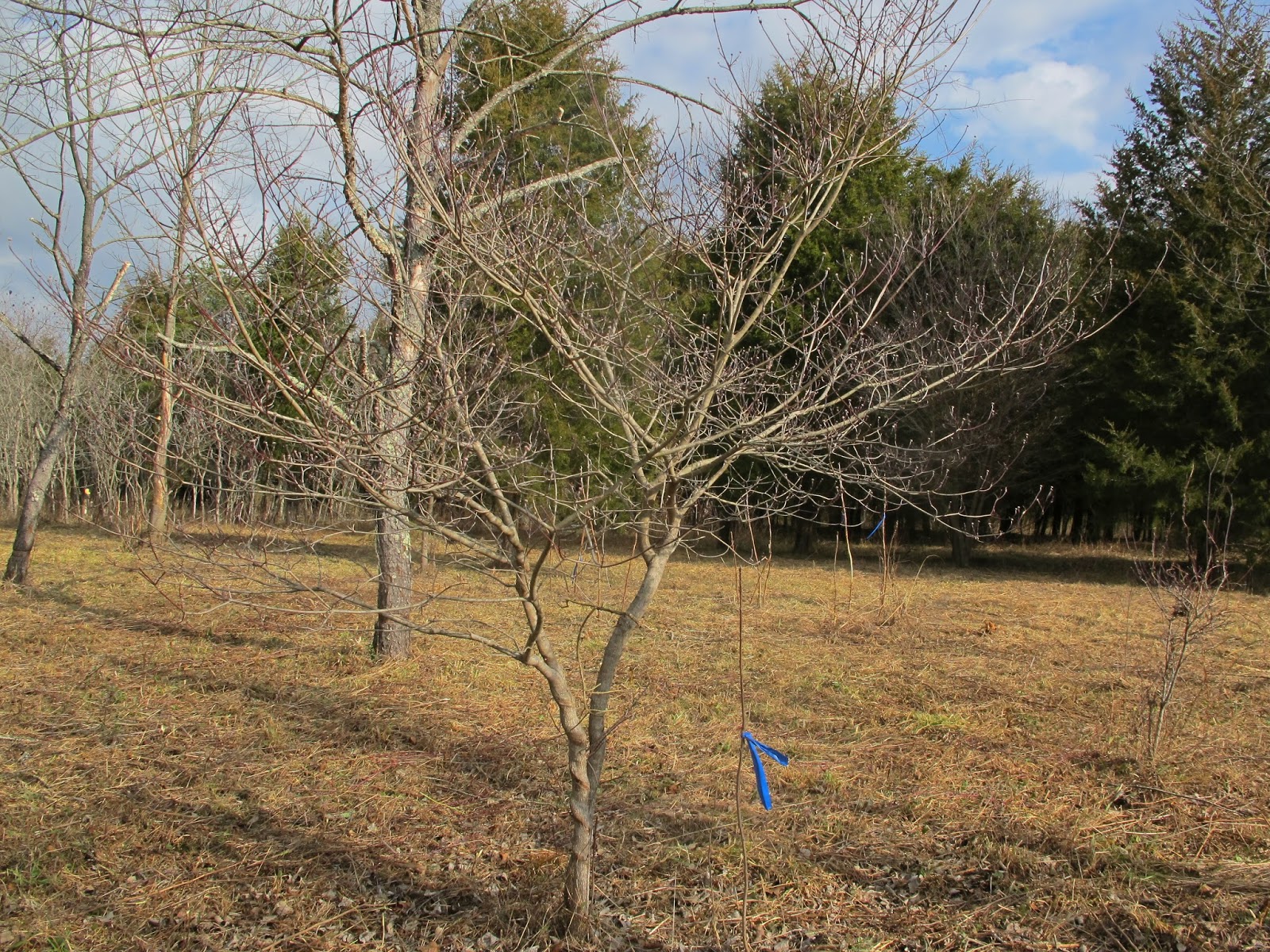
I’ve been working on a lot of small management jobs that have been on my list for some time now.  Several of these have to do with trees that are threatening to fall on or to shade out desirable species.  When a tree begins to lean over, the area covered by its shadow increases.  Lateral branches turn upwards and eventually form what amounts to a line of sapling trees growing along the trunk of the leaner.  New growth adds weight that will eventually make the tree fall.  The Wild Black Cherry tree above is not only causing a thinning of grass in the shade zone.  It is overtopping a grove of Redbud and Carolina Buckthorn that will suffer some severe damage if landed upon by the falling tree.

Removing the tree eliminates both the shade hazard and the threat of physical damage to surrounding vegetation.  Unlike most upright trees, leaning trees offer a limited direction toward which they will fall.  Fortunately, a good cut and a little bit of shoving allowed me to drop this tree without damaging any of the shrubs I was trying to protect.

Actually bringing the tree to the ground is usually the least time consuming part of the process.  It’s taking the tree apart and moving it to a brush pile that takes up most of my time.  When I don’t have time to finish the job before days end, as was the case here, I leave the branches in a conspicuous place where I won’t fail to clear them up later.  In this case I left them blocking one of the main trails leading from my house.  There’s no way I can forget about them being here.

Here is another leaning tree, also a Wild Black Cherry.  This species accounts for 90 percent of the leaning trees I encounter.  In this case, the tree is threatening a cluster of oak saplings seen on the right side of the photo.

I didn’t have time to take the whole tree down before it got dark, but I did remove the lateral branches that produced the majority of shade.  If I don’t happen to make it back to this site this winter, the oaks will still be able to receive needed sunlight next growing season.

Some trees are removed just to eliminate the shade they produce.  This Tuliptree was shading the same cluster of oaks being threatened by the leaning cherry.

The oaks in question can be recognized by the dead leaves that they hold into winter.  These persistent leaves make it fairly easy to spot oaks in a grown up field.

With the shade producers removed, the oaks will respond by rapidly increasing their size.  Removed trees were intentionally cut so as to leave a tall stump.  The stumps will be shortened this spring, and herbicide will be applied to the fresh cut.

Removal of this Tuliptree has been on my to do list for several years, but there always seemed to be more urgent activities that kept me from the task.  Tuliptrees are fast qrowing and have the ability to shade out a large area of grass, so it’s best not to let them go for very long.  Notice just to the right of the Tuliptree is a Wild Black Cherry leaning out from the old fence row.  The original tree top has died and a side branch has grown up to produce a nice sized tree.  Eventually, the leaning trunk will not be able to sustain the weight of the new top and the tree will fall.  When it falls, it will most likely hit the Flowering Dogwoods in the center foreground of the photo.  I’ll probably have to take the cherry down before it falls on its own.

I dropped the Tuliptree right on the trail.  There’s no way I could possibly forget to clear it away.

There are some pretty widely spaced growth rings here.  Ten years ago I could have cut this tree with my loppers and carried the whole thing over to the brush pile.  I now aggressively attack the small trees invading the grassland areas, so I won’t have trees of this size to deal with later.

One disassembled tree ready to be carried off.

The trail is once again open for business.

Three Tuliptrees and two cherries were added to this already existing brush pile.  The logs were positioned for maximum use by fence lizards and skinks.  Whether or not I remove more trees this month will depend on the weather.  I’ve already taken care of the worst offenders, but it would be nice to get just a few more.

Wednesday, February 1, 2017

Removing Fallen Trees

January has been a rough month for getting any heavy work done in the field. Warm temperatures and frequent rains left the soil highly vulnerable to compaction and other damage resulting from inappropriate management activities. It has only been in the last few days that I’ve been able to perform any intensive work, and that has been limited to hilltop areas that drain and dry out quickly. I removed the girdled trees that had fallen in my planned grassland area. A few stumps, some scattered twigs and flattened areas of grass were all that was left after I finished picking things up.

Following the removal of the downed trees, I brought in JR, the brush mower, and mowed the entire work area. Removing the trees and mowing the field were not necessarily required activities in my plans to convert the area to a grassland condition. The fallen trees would quickly decompose and the tall prairie grasses would eventually take over the site. My actions here were in response to the need to easily access the area to locate and eliminate invasive shrubs. Keep in mind that it’s only been a few years since this particular patch of ground was a thicket of Multiflora Rose and Autumn Olive. The site still harbors viable seed and is producing several new seedlings that must be found and killed each year. Anything that interferes with my ability to travel freely through the area in search of these invaders must be removed.

The area is planned to be grassland, but it will not be completely free of trees. This Blackjack Oak, Quercus marilandica, currently surrounded by the standing dead, will one day be surrounded by tall native grasses.

This double trunked Flowering Dogwood will also be left alive. An anthracnose outbreak nearly three decades ago eliminated this species from the woodland understory at Blue Jay Barrens. It has still not returned to the woods, but a few survivors along the field’s edge became the progenitors of flowering Dogwood trees growing in the open fields. I allowed this species to remain in certain designated areas of the fields, and now have dozens of nice sized specimens producing copious amounts of fruit and seed each year. This individual is doing quite nicely despite one of its trunks being disfigured by the choking embrace of a Japanese Honeysuckle vine, yet another invasive species needing to be controlled here.

After mowing the area, I noticed a leaning tree poised to land directly atop the Flowering Dogwood, and a pair of grape and honeysuckle festooned trunks similarly aiming towards the lovely oak. Not wishing the oak or dogwood to be damaged by their menacing neighbors, I removed the threats myself in a safe and controlled manner.

In order to facilitate invasive shrub control, I also removed some fallen branches from the sumac patch.

The patch of Dwarf Sumac was left intact and standing dead stems were not touched. These sumac thickets harbor their own suite of boring beetles, leaf eaters, lichen colonies and other organisms drawn to this type of habitat. I tried to disturb it as little as possible.

The removed wood roughly tripled the size of the brush pile at the edge of the field. Logs were placed on the east facing side of the pile. Skinks and fence lizards are particularly drawn to logs situated in this manner.

Tree branches were dismantled down to individual stems which were then piled as densely as possible. This fosters rapid decomposition, so the pile quickly reduces in volume. The logs are stacked so that they will fall back into the pile as the small branches decompose. It has been pointed out to me numerous times that my brush piles do not follow the classic wildlife management design, which has the goal of providing escape cover to game mammals. My piles serve a broader interest and are utilized by a wide range of reptiles, birds and mammals.

The dead trees will continue to fall for the next couple of years. During that time, the tall prairie grasses will move in and become established. By then the incidence of invasive shrubs should be limited to new arrivals carried by birds as seeds from neighboring properties. For now, I’m pleased with the way things are progressing on the site and hope that all continues favorably.

Monday, January 30, 2017

Robber Flies

I took this series of photos one afternoon about six months ago during a time when I was experiencing internet connectivity problems.  The file has been stuck in my blog folder since then, along with several others.  I deleted the others, but I am such a fan of Robber Flies that I just had to make this post.  Resting on a leaf about half way down into the canopy of an herbaceous border sits this Diogmites species. 

Robber Flies are predators.  They spend much of their time sitting where they can watch for passing flying insects. I enjoy watching this species because its head is so mobile. It swivels its head in the direction of even the slightest bit of movement, which at some point always includes the photographer.

This slightly larger member of the Robber Fly group is a representative of the genus Efferia.  It came to rest on my hand while I was working in the field, which I hope does not give anyone the impression that I move so slowly while working that animals find me a convenient perch.  The end of the abdomen tapers down into an almost sword like appendage. Although it looks to be a formidable weapon, it is used as a tool for laying eggs deep into flower heads or other locations deemed suitable for growth of the larvae.

This is Promachus hinei.  Although it’s not the most common in terms of total Robber Fly numbers at Blue Jay Barrens, it is the most commonly encountered species of Robber Fly. Because of their large size and noisy flight, they are hard to miss when you happen upon them in the field. On this particular day, almost every individual I found was busily feeding, and several were feeding on somewhat unusual items like this paper wasp. When hunting, Robber Flies launch from a perch, grab an insect from the air, and return to a perch to consume their prey. The Robber Fly’s first action after a catch is to insert its piercing mouthparts into the body of the captured insect and inject a chemical relaxant that attacks the nerves and calms the prey. Along with the nerve agent is an enzyme that liquefies the internal body of the insect, so the robber fly can drink its meal.

To some, this may look like a love embrace. Unfortunately, that fly giving the big hug is not moving in for a friendly cuddle. 

These big flies will take any prey they can handle, even if it’s their own species.  That’s a male of the species making a meal of a female.  You can see his piercing mouthparts just below his front leg in a direct line with the grass stem beside his head. I hope next summer is another bumper season for Robber Flies.

Monday, January 23, 2017

Salamander Eggs

So far this month we’ve had 5.8 inches of rain, with rain falling more days than not since January 1.  Temperatures have remained above average.  High temperatures in the 50’s and 60’s Fahrenheit have been the norm so far this year.  It’s been a tough year for pinpointing when salamanders began showing up in the pond for their annual breeding frenzy.  All I can say for certain is that the pond was free of salamanders three weeks ago, and now the pond is full of salamander eggs. 

The frequent rains have kept the water level high and visibility slightly clouded, but it’s easy to see the masses of egg clusters clinging to plant stems scattered across the bottom of the pond.

I found this Jefferson Salamander during a break in the rain a couple of nights ago. 

This is the most common pond breeding salamander at Blue Jay Barrens, and the only one here that produces egg masses this early in the year.  In a month or two, Spottted Salamanders will enter the pond and leave their own egg masses.

Attached to the underside of a floating plank were these eggs of the Streamside Salamander.  This species typically places its eggs on the undersides of flat rocks in small headwater streams.  In situations where they utilize temporary pools, the eggs are placed on the undersides of any available surface.  Once it became apparent that Streamside salamanders were breeding in this pond, I adorned the deepest part of the pond with a variety of items suitable for receiving eggs.    I am assuming that these items are now sporting a nice covering of Streamside Salamander eggs. I’ll find out for sure when the water clears enough for me to see though to the pond bottom.

The Streamside Salamander eggs seem to be developing rapidly.  I suspect that warmer water temperatures have increased the rate of egg development.  This may increase the chances of the salamander larvae reaching their land dwelling stage before the pond water disappears for the summer.

Monday, January 16, 2017

Status of Girdled Trees Project

Back in May 2015 I girdled and applied herbicide to the large trees in this area in an attempt to create a grassland corridor between two areas of healthy prairie.  I thought it would be a few years before any of the killed trees began to fall.  Things are progressing much more quickly than I imagined.

In only a year and a half, about a third of the girdled trees have already fallen.  With one exception, all of the fallen trees have been Tuliptrees. 

Some of the trees dropped into the neighboring prairie.  Since this area is still being treated to eliminate invasive shrubs, I’ll remove the fallen trees to make it easier to find and destroy any invading sprouts.

The trees broke just above the girdle ring.  The girdling was done high enough on the trunk that a tall stump remains.  It’s best to leave the stump tall enough to be visible in the grass.  This way you are less likely to fall over or run your mower up onto the stump.

It looks as though the dead trees hosted quite a few wood boring insects.  I was surprised to see the extent to which the wood had been penetrated.

Woodpeckers appear to be taking advantage of the insect laden tree trunks.  I thought some of the trees were large enough to serve as woodpecker nesting sites, but I don’t think they are going to be standing long enough to serve that purpose.  I’m expecting this tree to fall soon.

In June 2016, about a year after being girdled, the Tuliptrees were still producing leaves on a few branches.  I was having some doubts that I had successfully killed the trees.

The trunks themselves gave some positive evidence that I was getting the desired results.  Impressive fungus growths suggested that decomposition was occurring beneath the bark.

A variety of fungus species were present.

I was impressed by the number of fungus species that were able to so quickly take advantage of the recently killed trees.

This area will soon be dominated by tall grass, but it won’t be without a few trees.  I have left several young Blackjack Oaks, Quercus marilandica, to grow among the grass.  Blackjack Oaks have a special relationship with several prairie invertebrates, and are well worth saving.  There won’t be enough trees left to hinder the growth of the prairie grasses, but there will be enough to enhance the quality of this small area.

You can read about the original girdling project by clicking HERE.  

Wednesday, January 11, 2017

2017 Blue Jay Status

January weather typically includes a bout of cold temperatures and snow cover. These conditions bring an increase in activity at the Blue Jay Barrens birdfeeders and give me an opportunity to assess the local Blue Jay population.

Blue Jay numbers are running at about their normal level this year. Except for one or two birds that have a distinctive marking or unique behavioral trait, I can’t tell the individual birds apart, so I don’t know for certain how many are year-round residents of Blue Jay Barrens and how many have just moved in for the winter. The general behavior of the flock makes me think that the majority of individuals are here all 12 months of the year. In particular, I don’t believe that a new arrival would automatically know to sit in the apple tree and yell when the feeder goes empty.

As always, the almost constant movement between the feeding area and the nearby trees makes it nearly impossible to get an accurate count. I spotted 29 Blue Jays in the previous photo, including the one in the air. I know there were at least 47 here at one time, but at that same time I could see several more moving in the trees at the edge of the field a few hundred feet away.

The feeder on the post contains black oil sunflower seed. The area at the base of the tree in the upper right-hand corner of the photo gets a few cups of cracked corn scattered out each morning.

Second to the Blue Jays in producing consistently high numbers in the feeder area are the Cardinals. In between trips to the feeder, the Cardinals tend to hang out in the dry stalks of Giant Ragweed and Wingstem adjacent to the feeder.  The smaller feeder visitors also seem to prefer this area for feeding and loafing. The large crop of seeds produced by these plants has now been nearly consumed.

The tall plant stalks have been battered by rain, wind, and snow, but they continue to remain upright.

It’s not uncommon to count 30 or 40 Cardinals in the feeder area at one time. Most take their seed from the ground instead of directly from the feeder.

Mourning Doves typically arrive a couple hours after sunrise. There are usually 25 or 30 individuals in this flock.

Most of the doves in the area spend the winter gleaning seed from nearby harvested crop fields. A deep snow can make that source of food inaccessible, and the result is a substantial increase in Mourning Doves at the feeder.

These two Blue Jays demonstrate how so much sunflower seed gets on the ground beneath the feeder. They scrape seed up and over the edge of the feeder tray until they find just the seed they want. This also explains why my feeder sometimes so rapidly runs out of feed. I thought for a while that they were searching for the few shelled seeds that could be found in the mix, but that didn’t turn out to be the case. When they start to load up with seed, it’s just the standard seed in a shell. Maybe they just want to be sure that their friends down below have plenty to eat.

Wednesday, December 21, 2016

Draba cuneifolia

Is it too early in the season to begin talking about Draba cuneifolia?  I didn’t think so.  We are into the third growing season for Draba planted in one of my garden beds.  Classified as a winter annual, this plant grows through the winter and produces flowers and seed the following spring.  The plant then dies, leaving a scattering of seeds to produce the next generation. 

Draba cuneifolia plants remained alive in this bed until mid-June 2016.  Seedlings began to appear in late July.  The profusion of plants now growing in the bed points out the inefficiency of my seed collection methods.  Plants cover the top and sides of the bed, are growing in the walkway between beds and have shown up in neighboring beds.

New plants emerged from the end of July through October.  There are probably still new plants appearing, but they are hard to notice among the mass of plants that are already there.

In order to survive the winter, these plants must quickly get a root down below the frost line.  Since they grow primarily in areas of bare soil, they are in danger of being pushed from the ground through the process of frost heave, which occurs when soil alternately freezes during cold nights and thaws during the day.  Having their roots penetrate stable soil anchors the plant and keeps it in its proper place.  These small plants can produce some extra long roots.  I once saw some plants that had their roots exposed when heavy deer traffic caused part of a bank to break away.  One plant had 15 inches of root showing.

Those plants that began growing in July have reached an impressive size.  These are the plants that will produce masses of flower stalks next April.

Remnants of last year’s plants are still evident.  These spindly stalks, along with the dried Draba leaves, did a good job of protecting the site from erosion through the summer.  I once perceived the appearance of Draba cuneifolia to be an annual event that passed so quickly, it could easily be missed.  Two decades of observation has caused me to alter my perceptions.  I’ll admit that the blooming season can sometimes be short, but I have seen years where blooming plants could be found over a two month period.  It seems that the living plants can be found during a ten month period each year, and their skeletal remains are around during that two month break.  Now that I know what to look for, I can check on my little friends at any time of the year.