Saturday, April 14, 2012

Woodcock Chick

I’ve faced off with many wild creatures and it’s usually the animal that backs down.  In my most recent encounter, I chose to break contact and withdraw.  Not because I feared an attack, but because I didn’t want to stress my opponent.  I was face-to-face with a very young Woodcock and it was prepared to play the staring game all day.

I was working my way along the old fence row, spraying invasive sprouts, when a Woodcock flushed just inches in front of my boot.  I froze and began scanning the ground at my feet.  It was likely that the bird had flown from its nest and I certainly didn’t want to step on any eggs.  I could find nothing directly in front of me, so I began to expand the search.  A Woodcock nest typically looks like a mashed down spot in the dead leaves.  The brown spotted eggs blend perfectly with the leaves and are nearly impossible to see.  It turns out that there was no nest.  I finally caught sight of a Woodcock chick about three feet in front of me.

Before moving in to get some close-up shots, I began searching for other chicks.  A chick’s defense behavior is to sit quietly and let camouflage do the work, so I was sure the chick wouldn’t run away before I could get my camera ready.  My concern was in the possibility that I might tromp on a chick as I positioned myself for a shot.  I took a quick look beneath each boot and along my approach route to make sure I hadn’t already inadvertently performed an act of aggression against any of the little fellows.  All clear behind.  I found a second chick about three feet farther on from the first, but I knew there could have been a total of four or five, so I was very careful about where I put my feet.

Woodcock incubation takes about three weeks.  Soon after hatching, the chicks are able to follow after the mother.  The bill will elongate as the bird grows, but it’s already an effective device for probing for food.  Chicks begin searching for earthworms just a few days after hatching.  Dirt on the bill indicates that this chick has been actively hunting, so it must already be several days old.

I left the chicks after a few quick shots, so the mother bird could return.  I’m surprised that she didn’t try to lure me away from the chicks by feigning an injury, but I suppose she’s more expert on Woodcock behavior than I. 

A Camera Critters submission.

Friday, April 13, 2012

Ant Mound Attacked

Seen from a distance, the mound of an Allegheny Mound Ant, Formica exsectoides, should display a fairly uniform curve.  When it has a shape such as this, you know there’s been a problem.

Some animal took out a 20 inch wide section clear across the mound.  There must be something awfully tasty in there for something to invest this much effort in excavation work.  This has got to be the work of a larger mammal, but it’s hard to imagine the reward being sufficient for this type of exercise.  In the warmth of the afternoon sun, the ants were enthusiastically attacking me as I knelt beside the mound.  I wasn’t concerned because the ants were only biting my clothing.  The intruder probably took the brunt of any colony defense with his hair and didn’t care anymore than I did that he was covered with ants.

It’s hard to tell how long ago the attack occurred.  Undisturbed soil on the surrounding leaves show that it hasn’t rained since the time of excavation, but it hasn’t rained a drop in two weeks, so that doesn’t narrow it down much.  Plants uprooted from the top of the mound were well desiccated, indicating that their roots have been exposed for several days.

There was quite a path of destruction left by the attack.  It looked like at least 8 inches had been removed from the top of the mound.

The mound material is full of tiny limestone crumbs that come from the pulverized bedrock beneath the soil.  Soil depth on this site is just over half a foot, so I’m assuming the presence of the limestone means that the colony has built its tunnels and chambers down into the bedrock.

The ants are busy making repairs, but the mound really needs some water to help things along.  The soil is just dust and rocks that won’t stick or stack.  It’s like trying to make sand castles with dry sand.

It may be well into summer before the mound is back in shape. Some ants will continue with the repairs while others forage for food and perform other colony duties.  Maybe I should pitch them a treat from time to time, so some of the food gatherers can stay at home and help with the building.

Thursday, April 12, 2012

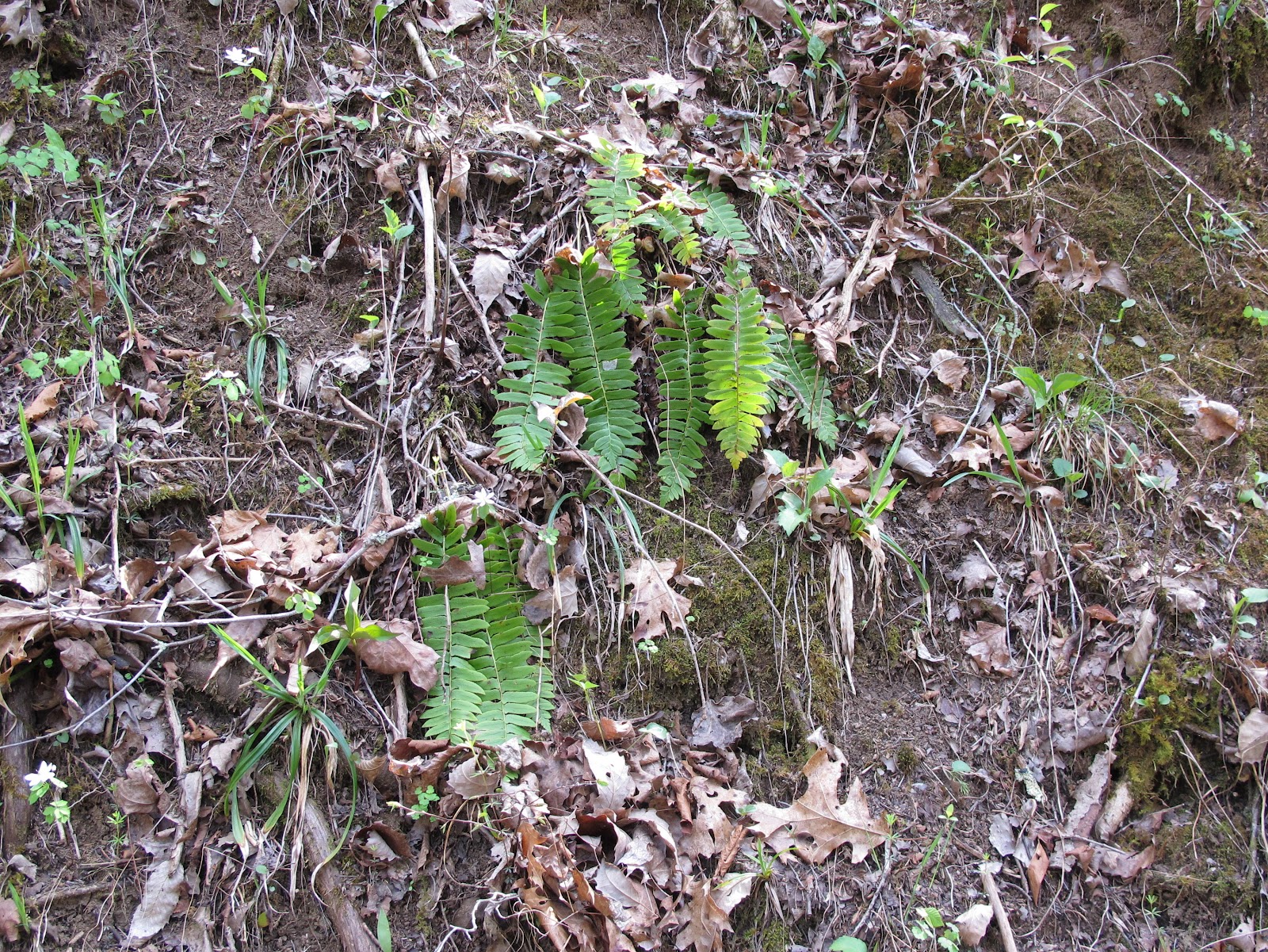
Large Flowered Trillium 2012

The Large Flowered Trilliums are blooming a month ahead of last year.  Although I haven’t made an official count for this year, it looks like the number of plants is slightly below last year.  One cluster of three plants that has consistently produced one or two blooms per year appears to be completely missing.  I couldn’t find any evidence to suggest whether it had sprouted and been eaten or if it had just failed to grow.

The plant with the bloom was just beginning to come out of the ground two weeks ago. 

Three young plants that I discovered last year are back up.  I don’t know if they will get any larger, but at this point they’re identical in size to what I saw last spring.  I suppose it will be a few more years before they’re ready to flower.

The steep, almost vertical bank that contains most of these plants suffered some damage from the intense rain we had in early March.  Dropping 1.2 inches of rain on the ground in five minutes results in some intense overland flow and anything not firmly anchored is going to move.  Most of the dead leaf cover ended up at the bottom of the hill. 

Fortunately, there was little loss of soil and most of the Trilliums are still in place.

If this bloom opens, it will make a total of two for this season.  I’m hoping that it opens soon, so I can take my pollination brush out and make the plants share some pollen.  I’ve been hand pollinating these flowers for the last few years in an effort to get some viable seeds.  The fact that I’m beginning to see small plants may mean I’m having some success.

Wednesday, April 11, 2012

Sniffing Out Invasives

I take every opportunity to eliminate invasive species from Blue Jay Barrens.  Autumn Olive has been one of my key targets the past few years and I’m closing in on my goal of eliminating all plants of fruit bearing age.  I’ve taken care of the areas of Autumn Olive concentration, but there are still random individual plants that must be dealt with.  These potential fruit producers have just made themselves vulnerable to detection.  They have recently opened their blossoms and released their unmistakable fragrance into the air.  All I have to do is walk around until I cross a scent trail and then follow the odor back to the bush.

Most of the Autumn Olives that I’m finding are crowded in with other shrubs.  Without the fragrance, they would have been difficult to locate. 

A few took advantage of the open environment beneath large cedars.  These shade grown plants are less dense than the typical field grown specimens and are easily camouflaged by the dappled sunlight filtering through the tall evergreens.

The cuttings were carted off to the nearest brush pile.  After wrestling with several flowery Autumn Olives, I became covered with the scent and began smelling Autumn Olive everywhere I went.  Fortunately, it didn’t get so bad that I could no longer find the living shrubs.  The flowers will remain for several more days, so I should be able to track down some more mature shrubs before the scent fades.

Each stump is marked for future herbicide application.  In a few weeks, these stumps should be surrounded by a dozen sprouts at the ideal stage for treating with glyphosate herbicide.

Tuesday, April 10, 2012

Streamside Salamander Eggs Hatching

One of the photo opportunities that spent years on my want list has just been removed.  I’ve always wanted to take pictures of Streamside Salamander eggs hanging naturally in the water below the rock to which they were attached.  I’ve taken shots of the eggs on an overturned rock, but in those shots the eggs have lost the buoying properties of water and are all flattened down.  Yesterday, things worked in my favor and I got the shots I wanted.
Streamside Salamanders lay their eggs beneath large, flat rocks that have their under surface below water level.  Each egg is individually attached to the rock.  The rock to which these eggs are attached was moved violently down the creek bed by the flood in early March.  The eggs were probably laid soon after the rock arrived at this site, so I’m estimating these eggs to be about 40 days old. 

They may be clustered tightly together, but each egg is independent of the rest and attached only to the rock.  Flowing creek water moves between the individual eggs to keep each developing larva well supplied with oxygen.

The larvae are moving freely about within their eggs.  Hatching should occur soon.

Here’s the setup I used to photograph the eggs.  That’s a five gallon aquarium supporting the rock.  The salamanders usually use larger rocks, so it’s taken a while to find an egg cluster beneath a rock that was light enough not to crush the aquarium.  I thought I had one earlier in the year, but the flood carried it off before I could get back to take pictures.

The rock and aquarium fit together perfectly.  My only problem was reflection off the glass.  It took practically all of my clothing to make a cover large enough to eliminate reflections. 

Newly hatched larvae are showing up in other parts of the creek.  Most of these are in pools associated with large, immovable slabs of limestone that offer secure egg laying sites.  Eggs beneath those rocks would not have been bothered by the raging flood water.

That rock in the center of the shot supports the eggs.  It will surely be relocated by the next big rain, but it should stay in place long enough for the eggs to hatch.

I hope some of the larvae survive to adulthood.  A school of hungry fish wait in the pool a dozen feet downstream of the eggs.  The standard rule is Fish + Salamander Larvae = Well Fed Fish.

Monday, April 9, 2012

Butterflies - Early April

Butterflies are certainly out in impressive numbers and a first impression might indicate this to be the beginning of an outstanding butterfly year.  Olive Hairstreaks are certainly making a superb showing.  They showed up weeks earlier than expected and may be the most common butterfly species currently in the air at Blue Jay Barrens.  Every gravel bar in the creek seems to have one or two of the colorful creatures.

Many have staked out territories on their host plant, Eastern Red Cedar.  I’ve seen this butterfly in every prairie opening here.  I’ve probably seen more Olive Hairstreaks this year than I’ve totaled in all of my years prior to this.

They’re the only small butterfly I’ve seen at the Redbuds.  While I’m enjoying the bounty of this uncommon species, I’m wondering about the absence of other species.  Henry’s Elfin, which I mentioned earlier, usually appears a couple of weeks prior to the Olive Hairstreak.  So far this year, I’ve seen no Henry’s Elfins.  I’m wondering why.

Eastern Tailed Blue made its appearance early this year and is also common on the wet gravel along the creek.  A common butterfly that I haven’t seen this year is the Spring Azure.  Spring Azures are usually seen several weeks earlier than Eastern Tailed Blues.  What happened to the Spring Azures this year?  I’m out often enough that I shouldn’t have missed seeing them, no matter how early they emerged.

Clouded Sulphurs are all over the place.  Populations of this species always increase as summer progresses, so this may indeed be a record year for Sulphurs.

The white form of Clouded Sulphur is also abundant, but once again there’s a similar looking butterfly that is conspicuous by its absence.  I counted just a single Falcate Orange-Tip this year.  Falcate Orange-Tips show up about a week before the Clouded Sulphurs and I usually count dozens of them before the sulphurs begin adding their numbers to the mass of white butterflies.  This absence of regularly seen species makes me wonder if the weird winter weather is somehow responsible.  Warm wet winters have been known to cause fungus and disease problems in some overwintering insect species.  I hope that hasn’t happened to these butterflies.

Some species are here on their normal schedule.  Gemmed Satyrs show up early and are never very numerous.  It’s also hard to catch them sitting still, so I don’t have an excess of quality photos.  This is about my average shot for this species.

Swallowtails are around in near normal numbers.  Most stay on the wing and are just seen briefly as they pass.  This Zebra Swallowtail was visiting a damp spot along the creek.  Now that we’re in the season when rain is to be expected, all the rain storms seem to be giving us a miss.  We’re getting the wind, but the water has stayed away.  Most damp spots have turned dry and the creek is the only suitable area for puddling.

Juvenal’s Duskywings have flocked to the creekside.  This is a large skipper that is quite conspicuous in flight.  I saw up to a dozen of these sharing the same gravel bar.  Having them all take wing at once was quite an impressive sight.

This Mournful Thyris is a day flying moth, not a butterfly.  The tiny little thing was feeding on a bird dropping in the gravel along the creek.  If it hadn’t flown in just as I walked up, I would never have noticed it.  It’ll be interesting to see how things develop this year with our typical summer time butterflies.

Sunday, April 8, 2012

Nests and Eggs

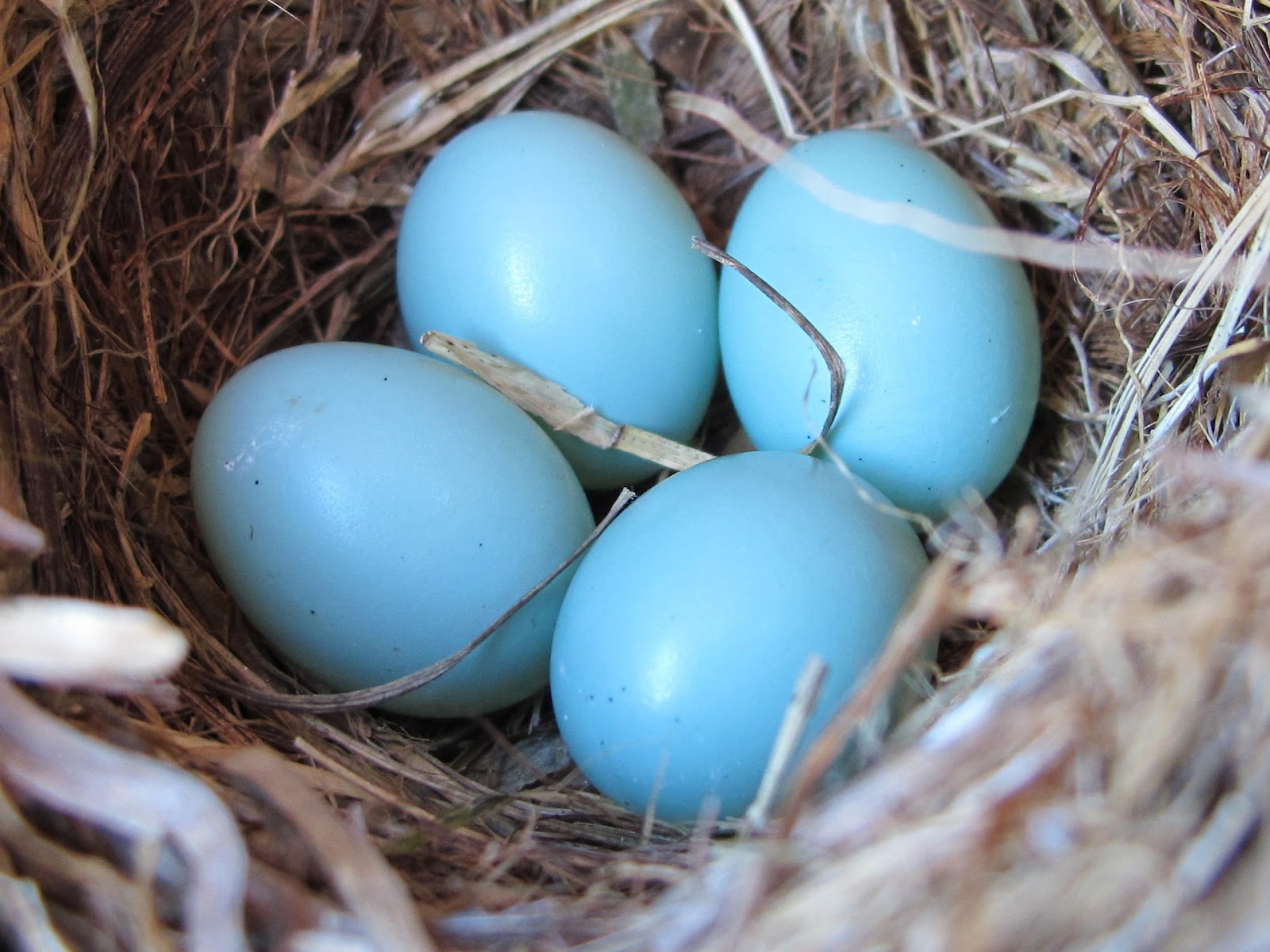
I took a stroll around to see how egg laying activities were progressing in the local nests.  Two boxes contain four Bluebird eggs each.  I’m seeing Bluebirds all around the field, but I don’t know where all of these birds are nesting.  Tree Swallows have claimed half a dozen boxes, but have not yet begun to lay eggs.

I found this Robin’s nest a few days ago.  The odd angle of the nest comes from my holding the camera at arms length above my head to get a shot without disturbing the nest.

The nest was in the fork of a low White Pine branch, far out from the trunk.

This is the way things looked following a violent wind storm.  The nest wasn’t very well anchored and probably just popped off the branch as the storm thrashed the tree.

The eggs look like they just broke as they fell from the nest.  I don’t think any type of predator was responsible for this loss.

A Cardinal has its nest in the juniper bush overhanging the Water Garden.  The female has been sitting on these three eggs for about a week.

For this shot, I pulled back an overhanging branch to improve the view.  The nest is normally roofed by a thick mass of cedar leaves.  The female voluntarily left the nest and was down near the pond when I moved in to take these shots.  I don’t scare birds off their nests just to get a picture.